




01. Edit your 1125 e online
Type text, add images, blackout confidential details, add comments, highlights and more.

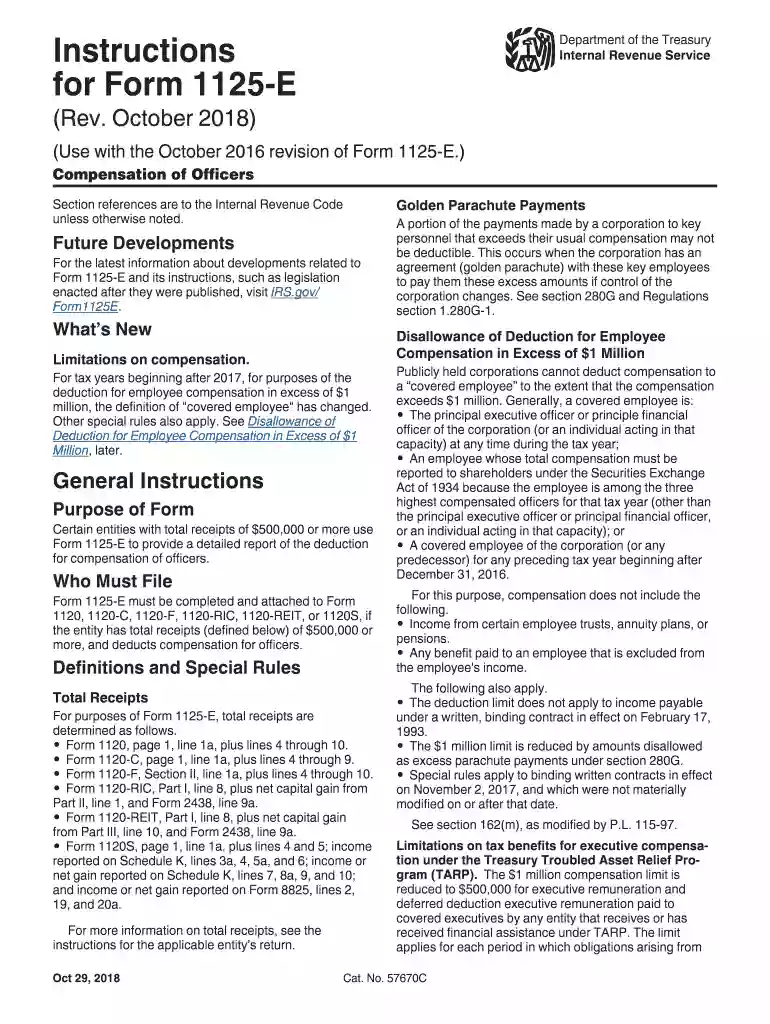
Type text, add images, blackout confidential details, add comments, highlights and more.

Draw your signature, type it, upload its image, or use your mobile device as a signature pad.

Send 1125 e 2018 via email, link, or fax. You can also download it, export it or print it out.
Form 1125-E is designed for specific corporations to report deductions related to officer compensation. This form is essential for corporations assessing deductions for compensation exceeding $1 million, as outlined in IRS regulations. Understanding the role and function of Form 1125-E is crucial for accurate financial reporting and compliance with tax regulations. This form also addresses golden parachute payments, which are compensation agreements for executives that often occur when mergers or acquisitions take place.
Understanding and using Form 1125-E is necessary for any corporation that compensates officers within the higher tiers of the organization. It mitigates risks related to incorrect compensation deductions, thereby avoiding potential audits or fines imposed by the IRS. Moreover, properly completing this form ensures compliance with regulations regarding executive pay structures. Failure to file correctly could result in penalties or adjustments to reported financial outcomes.
Completing Form 1125-E involves several detailed steps that require precision:
Corporations must use Form 1125-E within the framework of the IRS’s legal stipulations, ensuring that it accurately reflects the compensation paid and deductions claimed. The form’s legal usage extends beyond mere reporting and into maintaining the integrity of a corporation’s financial disclosures.
For timely filing, corporations must be cognizant of the deadlines associated with Form 1125-E, typically aligning with standard corporate tax return timelines. Missing a filing deadline could expose the corporation to penalties or compliance issues.
The IRS provides explicit guidelines to ensure the form is accurately completed, targeting discrepancies or non-compliance within corporate compensation strategies. These guidelines stress the importance of proper documentation and adherence to the stipulated thresholds of deductibility.
When filing Form 1125-E, corporations should have a comprehensive set of documents ready for submission. This documentation supports the figures reported and provides a clear view of the compensation landscape of the corporation.
Corporations that successfully navigate the form facilitate a seamless compensation deduction process, enabling them to retain more earnings legally and reinvest in their operations. For instance, a corporation that undergoes an executive transition due to a merger will utilize the form to report any compensation deals accurately, ensuring no deductions exceed permissible limits.
Form 1125-E's structure ensures that corporations report officer compensation strictly and transparently, linking to lawful deductions. Key elements include identifying the officers whose compensations are attached to the deductions and calculations that take into account IRS regulations.
We've got more versions of the 1125 e form. Select the right 1125 e version from the list and start editing it straight away!
At DocHub, your data security is our priority. We follow HIPAA, SOC2, GDPR, and other standards, so you can work on your documents with confidence.
This course will provide skills necessary to be successful in college level math courses such as Statistics or Quantitative Reasoning.Read more
Mar 30, 2026 Certain entities with total receipts of $500,000 or more use Form 1125-E to provide a detailed report of the deduction for compensation ofRead more


