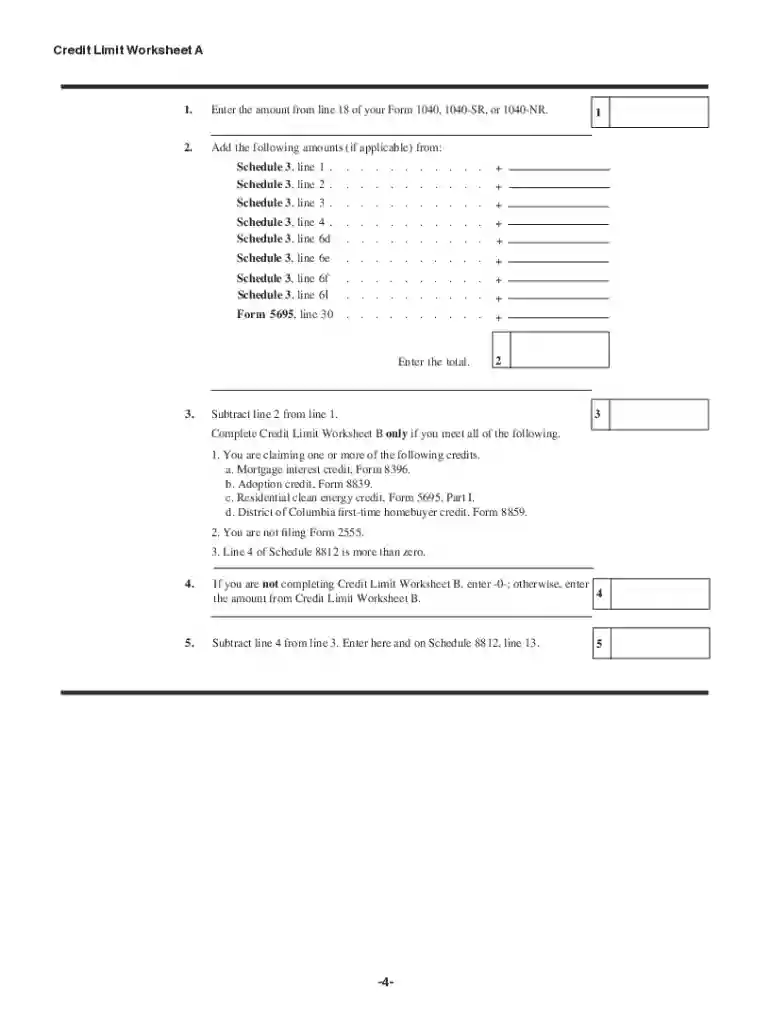
About Schedule 8812 (Form 1040), Credits for Qualifying Children and ...-2026

Get Form
credit limit worksheet a Preview on Page 1

Here's how it works

01. Edit your credit limit worksheet a online
Type text, add images, blackout confidential details, add comments, highlights and more.

02. Sign it in a few clicks
Draw your signature, type it, upload its image, or use your mobile device as a signature pad.

03. Share your form with others
Send credit limit worksheet a 2024 pdf via email, link, or fax. You can also download it, export it or print it out.

Definition and Purpose of Schedule 8812 (Form 1040)

Schedule 8812, officially titled "Credits for Qualifying Children and Other Dependents," serves a critical function in the U.S. tax system by allowing eligible taxpayers to claim tax credits for their dependents. This form is chiefly associated with the Child Tax Credit (CTC) and additional credits for dependents, such as the Credit for Other Dependents (ODC). These credits aim to alleviate the financial burden of raising children and dependents, thereby supporting working families.

  • Child Tax Credit (CTC): This credit provides financial relief to taxpayers with qualifying children under the age of 17 at the end of the tax year. The CTC can significantly reduce an individual's tax liability, depending on their income level and the number of qualifying children.
  • Additional Child Tax Credit (ACTC): If a taxpayer cannot utilize the full Child Tax Credit due to limited tax liability, they might be eligible for the ACTC, which allows for a refund even if there are no tax liabilities.
  • Credit for Other Dependents (ODC): This credit extends benefits to taxpayers with dependents who do not qualify for the CTC. This includes older children or other relatives that may depend on the taxpayer for financial support.

To maximize benefits, it is crucial for taxpayers to understand the qualifications for each credit, as well as the process of claiming them via Schedule 8812.

How to Complete Schedule 8812 (Form 1040)

Completing Schedule 8812 involves several distinct steps that require careful attention to detail. Proper completion ensures that all eligible credits are claimed accurately.

  1. Determine Eligibility: Check the eligibility criteria for the Child Tax Credit and Additional Child Tax Credit to ensure that you meet the income thresholds and other requirements.
  2. Gather Required Information: Collect key information regarding your qualifying dependents, including their names, Social Security numbers, and ages. Documentation of income and tax returns from previous years may also be helpful.
  3. Fill Out Personal Information: Complete the top section of Schedule 8812, which includes your name, Social Security number, and filing status.
  4. Complete the Worksheet: Follow the provided worksheet instructions on the form to calculate the credits. This may involve assessing your modified adjusted gross income (MAGI) and comparing it against the income limits set by the IRS.
  5. Transfer Information to Form 1040: The final section of Schedule 8812 requires you to enter the calculated credits into your Form 1040, ensuring your overall tax calculation is updated accordingly.

Failing to complete any sections accurately could result in denied claims or delays in processing your return.

Key Eligibility Criteria for Schedule 8812

Understanding the eligibility requirements for claiming credits on Schedule 8812 can optimize tax savings and ensure compliance with IRS regulations.

  • Age Requirements for Dependents: To qualify for the Child Tax Credit, dependents must be under 17 years old at the end of the tax year. The ODC applies to dependents aged 17 or older.
  • Support and Residency Requirements: Dependents must reside with the taxpayer for more than half of the year and receive more than half of their financial support from the taxpayer.
  • Income Limitations: The amount of credit available begins to phase out for taxpayers with incomes exceeding certain thresholds, currently set at $200,000 for single filers and $400,000 for joint filers.
  • Social Security Numbers: All qualifying children must have valid Social Security numbers issued by the IRS, ensuring proper identification for credit claims.

Effectively reviewing and confirming each criterion is essential for maximizing potential credits and satisfying IRS requirements.


decoration image ratings of Dochub

Important Dates for Filing Schedule 8812 and Related Tax Forms

When preparing taxes, adhering to important deadlines is vital for avoiding penalties and ensuring timely processing of returns. Below are key dates relevant to Schedule 8812 and Form 1040.

  • Filing Deadline: Typically, the filing deadline for individual income tax returns, including Form 1040 and Schedule 8812, is April 15 of the following year. For example, the deadline for the tax year 2022 is April 15, 2023.
  • Extended Deadline: Taxpayers can request an extension, which typically allows for additional six months. However, any owed taxes must still be paid by the original deadline to avoid penalties.
  • Amendments: If corrections need to be made, taxpayers can file Form 1040-X to amend their return. This form can include adjustments to credits reported on Schedule 8812, particularly if additional credits become apparent after initial filing.
  • Refund Processing Times: Understanding average IRS processing times can help taxpayers plan financially. Expect delays, especially during peak tax season.

Staying informed about these dates ensures that taxpayers remain compliant while maximizing their credits and refunds.

Common Mistakes to Avoid When Filing Schedule 8812

Mistakes on Schedule 8812 can lead to delayed refunds or rejection of claims. Awareness of common pitfalls can help taxpayers file accurately.

  • Inaccurate Dependent Information: Misreporting the names, ages, or Social Security numbers of dependents can result in lost credits. Double-checking this information against official documents is advised.
  • Neglecting Income Phase-outs: Failing to consider income restrictions may cause taxpayers to erroneously claim credits. Awareness of MAGI calculations is essential to receiving the appropriate credit amounts.
  • Incomplete Documentation: Incomplete forms or missing required information can trigger requests for additional documentation. It’s critical to follow all instructions thoroughly to avoid these issues.
  • Ignoring Changes in Legislation: Tax credits and regulations can change yearly. Taxpayers should stay updated on any modifications that may affect their eligibility and potential credit amounts.

By being aware of these common mistakes and taking proactive steps to prevent them, taxpayers can file Schedule 8812 more effectively.

Resources and Assistance for Schedule 8812

Several resources are available to assist taxpayers in navigating the complexities of Schedule 8812 effectively.

  • IRS Publications: The IRS offers a wealth of information via its website, including detailed instructions for Schedule 8812, eligibility requirements, and frequently asked questions.
  • Tax Preparation Software: Many popular tax software products automatically guide users through claiming credits via Schedule 8812. Look for options that include integrated checks for common errors.
  • Professional Tax Advisors: Engaging a tax professional can help individuals with complex situations or questions about eligibility and maximum credit claims.
  • Community Tax Assistance Programs: Non-profit organizations often offer free tax assistance in low-income communities, helping taxpayers with their filings and maximizing credits.

Using these resources ensures that individuals receive the assistance needed to claim the credits they qualify for effectively.

See more About Schedule 8812 (Form 1040), Credits for Qualifying Children and ... versions

We've got more versions of the About Schedule 8812 (Form 1040), Credits for Qualifying Children and ... form. Select the right About Schedule 8812 (Form 1040), Credits for Qualifying Children and ... version from the list and start editing it straight away!
Versions Form popularity Fillable & printable
2023 4.2 Satisfied (29 Votes)
2022 4.7 Satisfied (41 Votes)
2021 4.8 Satisfied (57 Votes)
2020 4.4 Satisfied (62 Votes)
2019 4.3 Satisfied (60 Votes)
2018 4.4 Satisfied (200 Votes)
2017 4.4 Satisfied (170 Votes)
2012 4.3 Satisfied (291 Votes)
be ready to get more

Complete this form in 5 minutes or less

Get form

Got questions?

We have answers to the most popular questions from our customers. If you can't find an answer to your question, please contact us.
Contact us
Youll need to check your 1040 form to know if youve claimed either or both of the credits. Itll be on Earned Income Credit (EIC) line 27, Additional Child Tax Credit line 28. Select your product below to find your 1040 form: Note: If your TurboTax navigation looks different from whats described here, learn more.
Eligibility. Your family can claim this credit if you: Paid for care in 2024 for a qualifying child under age 13 claimed as a dependent*, or a spouse or dependent not able to care for themselves, who lived with your family for more than half of the year.
Families must have at least one qualifying child under 6 years old at the end of the tax year, must file a California state tax return, and meet the requirements of the CalEITC. Taxpayers do not need to have earned income to be eligible however, you must otherwise meet CalEITC and YCTC requirements.
The Child Tax Credit is up to $2,000 for 2024. The Credit for Other Dependents is worth up to $500. The IRS defines a dependent as a qualifying child (under age 19 or under 24 if a full-time student, or any age if permanently and totally disabled) or a qualifying relative.
The child has to be younger than 17 at the end of the tax year and cannot provide more than half of their own financial support. Finally, each child you claim a credit for has to have have lived with you for more than half of the tax year.

Security and compliance

At DocHub, your data security is our priority. We follow HIPAA, SOC2, GDPR, and other standards, so you can work on your documents with confidence.

Learn more
ccpa2
pci-dss
gdpr-compliance
hipaa
soc-compliance
be ready to get more

Complete this form in 5 minutes or less

Get form

People also ask

To qualify for the ACTC, you must earn more than $2,500 from work (including wages, tips, or net self-employment income). That $2,500 is the minimum income required to be eligible its called the refundability threshold.
Taxpayers can claim a child tax credit (CTC) of up to $2,200 for each child under age 17 who is a U.S. citizen, national, or resident and has a Social Security number (SSN). The credit is reduced by 5 percent of adjusted gross income over $200,000 for single parents ($400,000 for married couples).

credit limit worksheet a 2023 pdf