
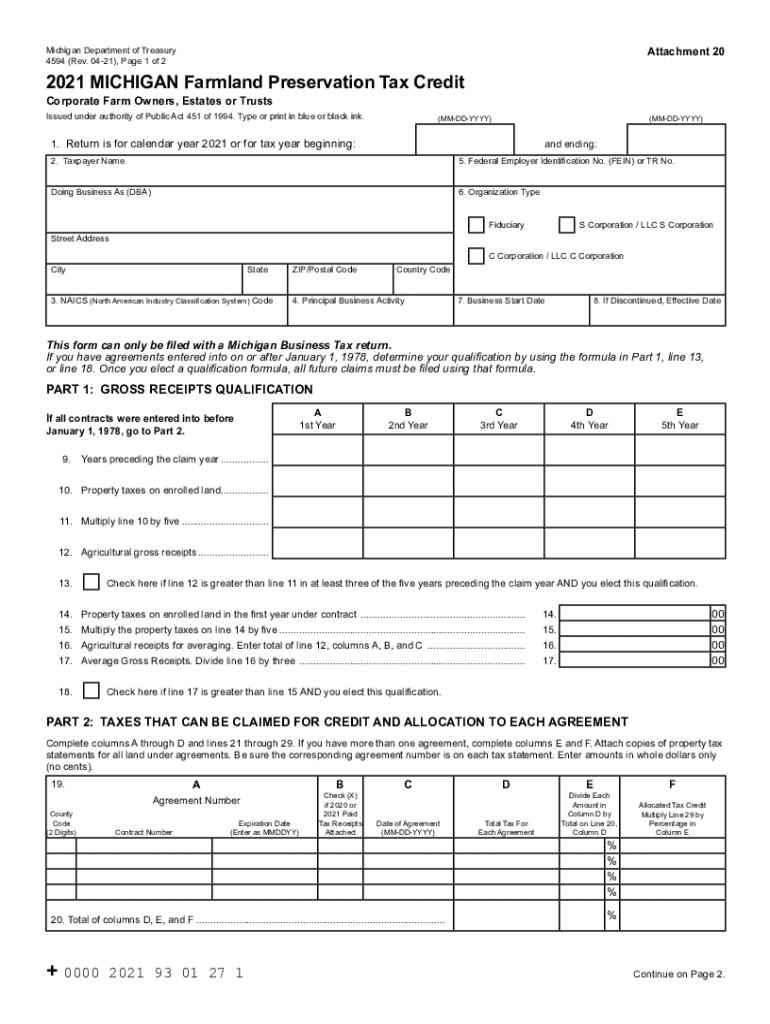







Definition and Purpose of the Michigan Farmland Preservation Tax Credit
The Michigan Farmland Preservation Tax Credit, also known as Form 4594, is a state initiative designed to encourage landowners to maintain their properties for agricultural use. This tax credit provides financial relief to landowners who agree to restrict their land from being developed for non-agricultural purposes. By participating, landowners can receive credits on their property taxes, making it economically viable to preserve farmland. This program is pertinent for corporate farm owners, estates, and trusts engaged in agricultural activities.
Eligibility Criteria
To qualify for the Michigan Farmland Preservation Tax Credit, applicants must meet certain criteria. Eligibility includes owning land covered by a farmland preservation agreement and using the land primarily for farming or agricultural purposes. Additionally, gross receipts from farming activities must meet a minimum threshold. It is important for applicants to review these requirements thoroughly, as any discrepancies can affect their application’s success.


Steps to Complete the Michigan Farmland Preservation Tax Credit
Completing the Michigan Farmland Preservation Tax Credit involves several steps:
-
Review Eligibility Requirements: Ensure that the farmland meets all the necessary criteria.
-
Obtain the Correct Forms: Access Form 4594 and any supplementary documents required for submission.
-
Gather Necessary Documentation: Collect documents such as property tax assessments and records of farm income to prove eligibility.
-
Complete the Form: Carefully fill out Form 4594, ensuring all sections are completed accurately.
-
Submit the Application: Send the completed form and supporting documents to the relevant Michigan state authority.
Important Terms Related to the Tax Credit
Understanding the terminology specific to the Michigan Farmland Preservation Tax Credit can simplify the application process:
-
Farmland Development Rights Agreement: A contract between landowners and the Michigan Department of Agriculture and Rural Development to maintain land for agricultural use.
-
Gross Receipts: Total income earned from all farming activities, which determines eligibility for the tax credit.
-
Property Tax Credit: A reduction in property taxes owed by the landowner as part of the preservation agreement.
Key Elements of Form 4594
Form 4594 contains several critical elements that applicants must address:
-
Land Description: Detailed information on the location and size of the farmland.
-
Income Reporting: A section specifying gross receipts from farming operations.
-
Tax Information: Details of property taxes eligible for the credit.
Careful attention to these elements ensures accurate and effective application submission.
Application Process and Approval Time
The application process for the Michigan Farmland Preservation Tax Credit includes submitting Form 4594 along with all required documentation. Once submitted, the review and approval process may take several weeks. During this time, the application is evaluated for completeness and conformity with eligibility requirements. If approved, the landowner receives confirmation and the applicable tax credit.
Filing Deadlines and Important Dates
Adhering to specific deadlines is critical when applying for the Michigan Farmland Preservation Tax Credit. Applications and all accompanying documentation must typically be submitted by a specified date each year to qualify for that tax period. Applicants should check the Michigan Department of Agriculture and Rural Development’s announcements for up-to-date deadlines.
Required Documents for Submission
Applicants for the Michigan Farmland Preservation Tax Credit are required to provide several key documents:
-
Form 4594: The main application form for the tax credit.
-
Proof of Farmland Ownership: Documents verifying the applicant’s ownership of the farmland.
-
Income Statements: Records of gross receipts for the farming operation.
-
Property Tax Records: Official tax assessments and records for the property in question.
These documents must accompany the submission to facilitate assessment and approval.




