




01. Edit your 2022 arizona form 140 online
Type text, add images, blackout confidential details, add comments, highlights and more.

Type text, add images, blackout confidential details, add comments, highlights and more.

Draw your signature, type it, upload its image, or use your mobile device as a signature pad.

Send 2022 az 140 via email, link, or fax. You can also download it, export it or print it out.
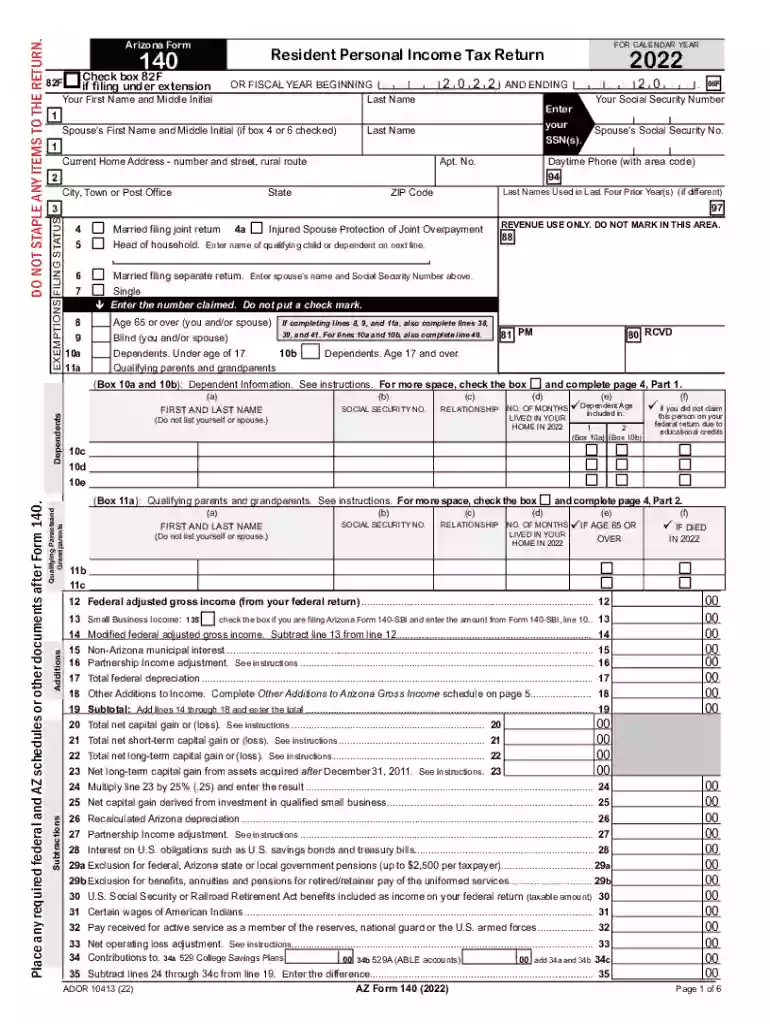
Arizona Form 140 is a state-specific personal income tax form required for residents of Arizona to report their income, adjust deductions, and apply for tax credits specific to the state. Unlike federal forms, the Arizona Form 140 provides details unique to state taxation laws, such as state-specific deductions and credits. This non-fillable form requires manual completion, which means individuals must print the form and fill it out by hand or type directly onto the printed document. Understanding this form is crucial for residents to comply with state tax obligations and to ensure accurate reporting of their financial transactions.
Residents use Arizona Form 140 to complete their annual state income tax return. To begin, gather all necessary documentation, including W-2s, 1099s, and any other income sources. The form includes sections for personal information, filing status, income adjustments, deductions, and credits.
Ensure each section is completed accurately to avoid delays in processing or potential penalties.
Arizona Form 140 can be obtained directly from the Arizona Department of Revenue's official website. For those without internet access, physical copies may also be available at local libraries or tax offices. It's crucial to ensure that you have the correct year's form, as tax regulations and form requirements can change annually. If you have trouble accessing the form, consider visiting a local tax office where assistance is provided in obtaining and filling out the form properly.
Every section must be completed as per Arizona tax guidelines to avoid discrepancies.
Arizona's standard deadline for submitting state income tax, including the Arizona Form 140, aligns with the federal deadline, typically April 15. Extensions are possible but must be filed prior to the deadline to avoid late penalties. Filing early is recommended to ensure adequate time for form corrections and additional submissions if needed. Confirm annually with the Arizona Department of Revenue for specific deadline announcements or changes.
To accurately fill out the Arizona Form 140, you will need:
Having comprehensive documentation ensures you capture all applicable income and deductions.
The Arizona Form 140 submission options include:
The choice of submission method may determine processing speed, so consider your needs and preferences.
Failing to file Arizona Form 140 on time or providing inaccurate information can result in penalties and interest charges. Common penalties include:
Avoiding these penalties requires careful form completion and adherence to deadlines.
We've got more versions of the 2022 arizona form 140 form. Select the right 2022 arizona form 140 version from the list and start editing it straight away!
| Versions | Form popularity | Fillable & printable |
|---|---|---|
| 2025 | 4.4 Satisfied (47 Votes) | |
| 2024 | 4.9 Satisfied (40 Votes) | |
| 2023 | 4.8 Satisfied (46 Votes) | |
| 2022 | 4.5 Satisfied (66 Votes) | |
| 2021 | 4.8 Satisfied (35 Votes) | |
| 2020 | 4.4 Satisfied (255 Votes) | |
| 2019 | 4.3 Satisfied (138 Votes) | |
| 2018 | 4.2 Satisfied (83 Votes) | |
| 2017 | 4.3 Satisfied (87 Votes) | |
| 2016 | 4.2 Satisfied (124 Votes) | |
| 2013 | 4.5 Satisfied (41 Votes) |
At DocHub, your data security is our priority. We follow HIPAA, SOC2, GDPR, and other standards, so you can work on your documents with confidence.


