Md 588 2026

Get Form
md 588 Preview on Page 1

Here's how it works

01. Edit your form online
Type text, add images, blackout confidential details, add comments, highlights and more.
02. Sign it in a few clicks
Draw your signature, type it, upload its image, or use your mobile device as a signature pad.
03. Share your form with others
Send it via email, link, or fax. You can also download it, export it or print it out.

How to use or fill out md 588 with our platform

Form edit decoration
9.5
Ease of Setup
DocHub User Ratings on G2
9.0
Ease of Use
DocHub User Ratings on G2
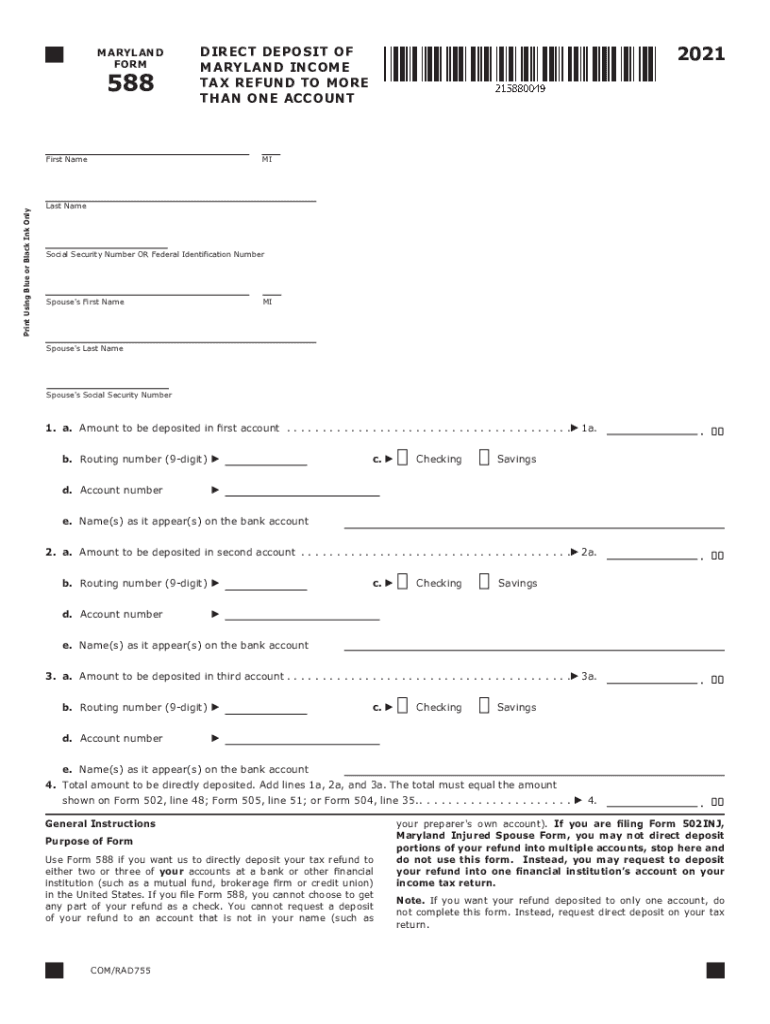
  1. Click ‘Get Form’ to open the md 588 in the editor.
  2. Begin by entering your first and last name, along with your Social Security Number or Federal Identification Number. Ensure you print using blue or black ink only.
  3. Next, provide your spouse's details if applicable, including their name and Social Security Number.
  4. For each account where you want your refund deposited, fill in the amount on lines 1a, 2a, and 3a. Remember that each deposit must be at least $1.
  5. Enter the corresponding routing number (9-digit) for each account on lines 1b, 2b, and 3b. Verify these numbers with your financial institution to avoid errors.
  6. Complete the account numbers on lines 1d, 2d, and 3d. Ensure there are no spaces or special symbols.
  7. Finally, confirm that the total amount on line 4 matches your total refund as shown on your tax return. If it doesn’t match, a check will be issued instead.

Start filling out your md 588 form online for free today!

See more md 588 versions

We've got more versions of the md 588 form. Select the right md 588 version from the list and start editing it straight away!
Versions Form popularity Fillable & printable
2023 4.7 Satisfied (49 Votes)
2022 4.7 Satisfied (53 Votes)
2021 4.9 Satisfied (59 Votes)
2020 4.4 Satisfied (91 Votes)
be ready to get more

Complete this form in 5 minutes or less

Get form

Got questions?

We have answers to the most popular questions from our customers. If you can't find an answer to your question, please contact us.
Contact us
If you are a Maryland resident and need to amend your return, file Form 502X. If you lived in Maryland only part of the year, file Form 502. If you are a nonresident, file Form 505 and Form 505NR. If you are a nonresident and need to amend your return, file Form 505X.
You can check the status of your current year refund online, or by calling the automated line at (410) 260-7701 or 1-800-218-8160. Be sure you have a copy of your return on hand to verify information. You can also e-mail us at taxhelp@marylandtaxes.gov to check on your refund.
Generally, you are required to file a Maryland income tax return if: You are or were a Maryland resident; You are required to file a federal income tax return; and.
You may submit paper tax forms and payments at any of the local branch offices between 8:30 a.m. - 4:30 p.m., Monday through Friday. If you are sending a Form 502 or Form 505 (with a payment) through the US Postal Service, send it to: Comptroller of Maryland, Payment Processing, PO Box 8888, Annapolis, MD 21401-8888.
EXEMPTION AMOUNT CHART The personal exemption is $3,200. This exemption is reduced once the taxpayers federal adjusted gross income exceeds $100,000 ($150,000 if filing Joint, Head of Household, or Qualifying Widow(er) with Dependent Child).

Security and compliance

At DocHub, your data security is our priority. We follow HIPAA, SOC2, GDPR, and other standards, so you can work on your documents with confidence.

Learn more
ccpa2
pci-dss
gdpr-compliance
hipaa
soc-compliance
be ready to get more

Complete this form in 5 minutes or less

Get form

People also ask

A Maryland estate tax return is required for every estate whose federal gross estate, plus adjusted taxable gifts, plus property for which a Maryland Qualified Terminal Interest Page 2 Property (QTIP) election was previously made on a Maryland estate tax return filed for the estate of the decedents predeceased spouse,
In some cases, you may not need to file state taxes if you only lived in the state for a short time or if your income falls below a certain level. Some states follow a progressive tax rate, which means the rate increases with income, while others stick to a flat tax rate.

Related links