




Here's how it works

01. Edit your form online
Type text, add images, blackout confidential details, add comments, highlights and more.

02. Sign it in a few clicks
Draw your signature, type it, upload its image, or use your mobile device as a signature pad.

03. Share your form with others
Send it via email, link, or fax. You can also download it, export it or print it out.
How to use or fill out California Change Venue with our platform

- Click ‘Get Form’ to open the California Change Venue document in the editor.
- Begin by filling out the case information section, including the original court details and case number. This ensures that all relevant information is accurately captured.
- Next, provide a detailed explanation for the change of venue request. Clearly outline reasons such as pretrial publicity or bias that may affect the fairness of the trial.
- In the subsequent section, indicate your preferred alternative venues if applicable. This helps streamline the process by suggesting suitable locations for the trial.
- Finally, review all entered information for accuracy before submitting. Utilize our platform’s features to sign and distribute your completed form easily.
Start using our platform today to fill out your California Change Venue form online for free!
Fill out california change venue online
It's free
It's free
See more california change venue versions
We've got more versions of the california change venue form. Select the right california change venue version from the list and start editing it straight away!
Got questions?
We have answers to the most popular questions from our customers. If you can't find an answer to your question, please contact us.
Contact us
What does venue rule?
Venue rules are essential in Civil Procedure, guiding where federal civil cases can be heard. They focus on factors like defendant residence and where key events occurred, ensuring cases are handled in the most relevant and convenient locations for all parties involved.
Can the prosecution request a change of venue?
Understanding Change of Venue in a Criminal Case Circumstances that make juror impartiality unlikely can, however, arise. In those circumstances, defense attorneys often move (ask) to have the trial take place somewhere else. (In most states, the prosecution cant request a change of venue.)
How to challenge venue in California?
A defendant may challenge venue by writing to the court. The defendant is not required to personally appear at the hearing on the venue challenge. If the court denies the challenge and the defendant is not present, the hearing must be continued to another appropriate date.
How do I change my court venue in California?
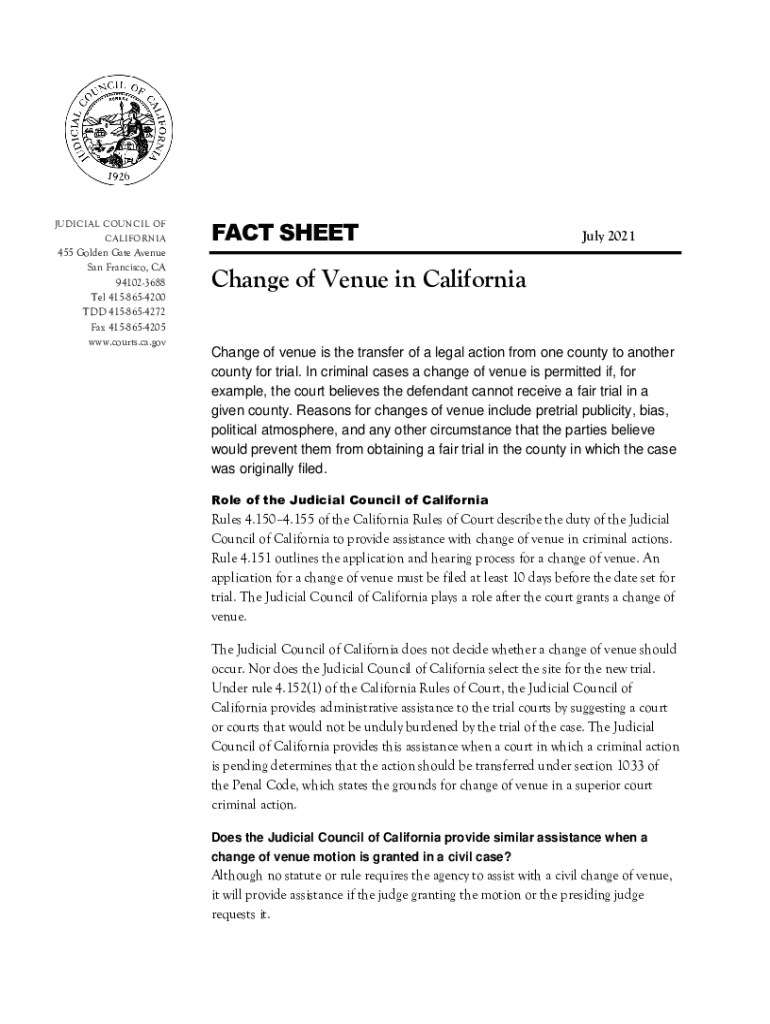
An application for a change of venue must be filed at least 10 days before the date set for trial. The Judicial Council of California plays a role after the court grants a change of venue. The Judicial Council of California does not decide whether a change of venue should occur.
What is the legal definition of venue?
A venue is the location in which something takes place. In a legal context, it is important to have the proper geographic location and court to hold a civil or criminal trial; otherwise, there could be procedural issues that nullify the case.
Security and compliance
At DocHub, your data security is our priority. We follow HIPAA, SOC2, GDPR, and other standards, so you can work on your documents with confidence.
Learn more


People also ask
What is the venue transfer rule?
Section 1404(a) of Title 28 provides that: for the convenience of parties and witnesses, in the interest of justice, a district may transfer any civil action to any other district where it might have been brought. Any party, including plaintiff, may move for a transfer under 28 U.S.C. 1404(a).
What is the venue in California law?
The purpose of the venue statute is to protect defendants from being forced to try cases in unrelated locations. The general rule is that a defendant is entitled to have actions tried in the county of his residence.
What is the venue rule in California?
Usually, venue is in the county where: The person you are suing lives or does business (if you are suing a business or organization); or. The dispute arose, like where an accident happened, or where a contract was entered into or broken.


