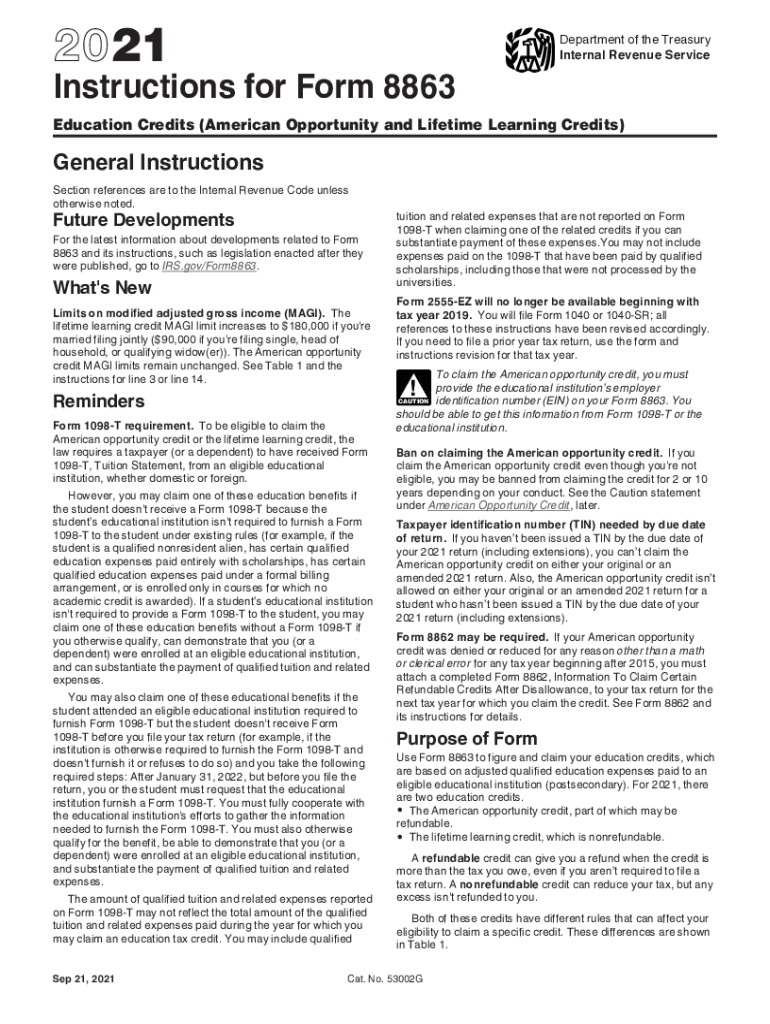







Definition and Purpose of IRS Form 8863
IRS Form 8863, titled "Education Credits (American Opportunity and Lifetime Learning Credits)," is utilized by taxpayers in the United States to claim education tax credits. These credits aim to reduce the burden of educational expenses, thus offering financial benefits to those investing in higher education. The form is particularly essential for taxpayers who have incurred costs related to tuition, enrollment fees, and needed course materials, providing a financial reprieve through the American Opportunity Credit and the Lifetime Learning Credit.
How to Use IRS Form 8863
Using IRS Form 8863 involves a careful understanding of eligible education expenses and potential credits. Taxpayers must first verify their eligibility to claim these credits based on their educational expenses within the tax year. The form requires detailed input on qualified expenses, which generally include tuition and required fees. Taxpayers should also confirm their individual eligibility to utilize the American Opportunity Credit, Lifetime Learning Credit, or both, which entails examining factors such as enrollment status and whether the student is pursuing a degree or another recognized educational credential.
Obtaining IRS Form 8863
Form 8863 can be easily accessed and downloaded from the Internal Revenue Service’s official website or through tax preparation software. Most taxpayers also receive relevant forms from educational institutions, such as Form 1098-T, which outlines the amounts billed and received for tuition during the tax year. This is essential for accurately completing IRS Form 8863. Taxpayers may also find the form at libraries, post offices, or request it by mail from the IRS.
Steps to Complete IRS Form 8863
To accurately complete IRS Form 8863, follow these steps:
- Gather Required Documents: Start by collecting Form 1098-T from the educational institution along with receipts for any other qualifying education expenses.
- Determine Eligibility: Assess qualification for each credit by reviewing IRS guidelines for the American Opportunity and Lifetime Learning Credits.
- Fill Out Part I: This section deals with the American Opportunity Credit, where taxpayers must enter expenses like tuition and fees, then compute the credit based on these figures.
- Complete Part II: Here, the Lifetime Learning Credit is claimed, which does not require students to be enrolled at least half-time, making it broader in scope.
- Submit Along with Tax Return: Form 8863 must be filed with the individual's federal tax return, either electronically or in paper format.
Eligibility Criteria for IRS Form 8863
Eligibility for Form 8863 depends on several factors:
- Income Limits: The credits are subject to income limitations, with phase-out ranges specified for modified adjusted gross income.
- Student Status: For the American Opportunity Credit, the student must be pursuing a degree or other recognized educational credential and enrolled at least half-time for at least one academic period.
- Eligible Expenses: Only qualified educational expenses strictly tied to enrollment or course requirement can be claimed, excluding room and board or insurance.


Required Documents for IRS Form 8863
Preparation of Form 8863 necessitates the following documents:
- Form 1098-T: This document is crucial for reporting tuition expenses and is sent from the educational institution.
- Receipts: Any additional receipts for qualifying expenses that are not covered by Form 1098-T should also be gathered.
- Prior Year Tax Returns: Having prior tax returns helps compare tax situations and ensure all possible credits are claimed.
Key Elements of IRS Form 8863
The critical components of Form 8863 include:
- Educational Institution Information: The form must include details of the institution, such as their name and EIN, which is found on Form 1098-T.
- Taxpayer and Student Information: It is important to match the taxpayer or student details with those provided on associated forms to avoid discrepancies.
- Credits Computation: Accurate calculation of the claimed credit according to the formula provided on the form, ensuring it aligns with IRS guidelines.
Common Taxpayer Scenarios
Understanding varied taxpayer scenarios can illuminate how each taxpayer can predicate their decisions on past experiences:
- Students or Parents of Students: Those paying qualified educational expenses for themselves, their spouse, or dependents.
- Part-Time Students: Eligible for the Lifetime Learning Credit even if enrolled less than half-time.
- Graduate Students: The Lifetime Learning Credit can provide relief since the American Opportunity Credit is generally targeted towards undergraduate education.
IRS Form 8863 provides significant financial aid by way of education credits, but only when used accurately and comprehensively by complying with associated IRS requirements.