



01. Edit your otp form online online
Type text, add images, blackout confidential details, add comments, highlights and more.

Type text, add images, blackout confidential details, add comments, highlights and more.
Draw your signature, type it, upload its image, or use your mobile device as a signature pad.

Send otp form template via email, link, or fax. You can also download it, export it or print it out.
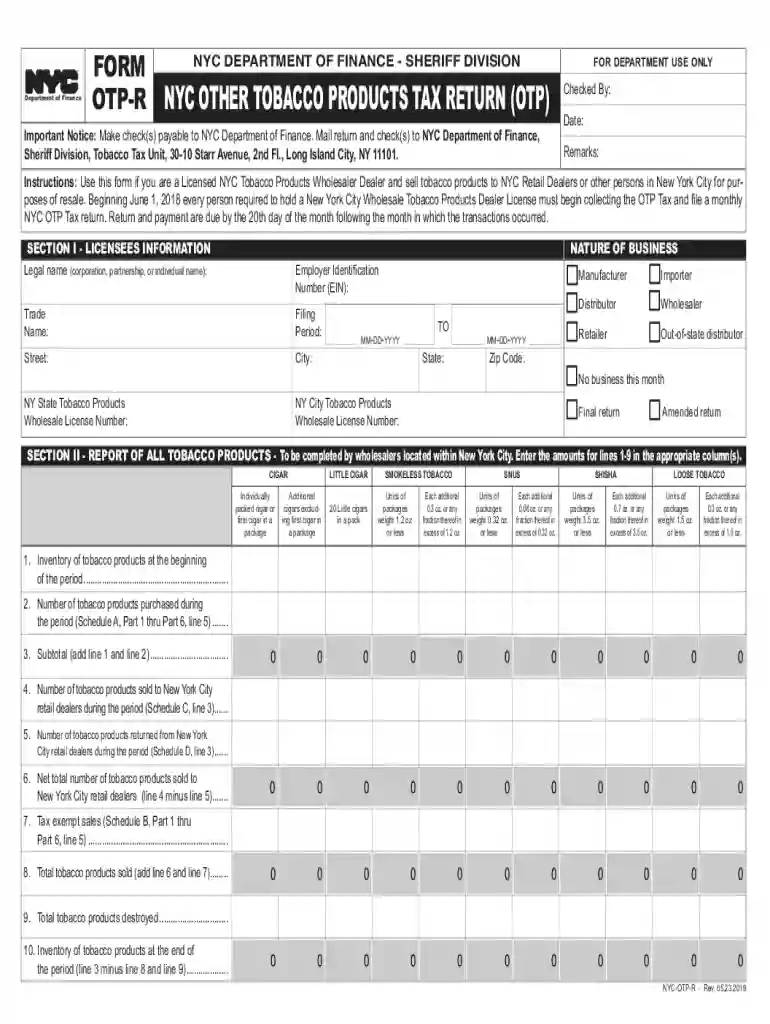
The NYC Other Tobacco Products Tax Return, commonly referred to as the OTP R form, is an official document required by licensed tobacco wholesalers in New York City. The form is designed for reporting and paying taxes on tobacco products sold within the city. Key sections of the form include licensee information, sales and purchase reports of tobacco products, tax-exempt sales, and a certification statement. Wholesalers are mandated to file this return monthly to comply with the city's tax regulations.
Using the OTP R form involves accurately documenting all transactions related to tobacco products over a specified period. Wholesalers must provide detailed items such as:
To ensure accurate reporting, users should maintain meticulous records throughout the month, readying them for the form's completion.
The OTP R form can typically be obtained from the New York City Department of Finance's official website. Alternatively, wholesalers may request physical copies by visiting the department's offices or contacting their support services. Ensuring immediate access to the form aids in timely submissions.
The OTP R form must be filed monthly, with the deadline set on the 20th of each month following the reporting period. For example, a report for January needs submission by February 20. Missing this deadline could result in penalties, so adhering to these dates is crucial for compliance.
The OTP R form serves as a legally binding document mandating the accurate reporting of tobacco product sales and taxes. Misrepresentation or errors on this form could lead to audits, financial penalties, or restrictions on wholesale licenses. Thus, accuracy in reporting is legally critical for all filing businesses.
Non-compliance with the OTP R form can lead to significant repercussions, including:
Ensuring compliance is foundational to maintaining good standing within the industry.
New York City’s regulations around tobacco products necessitate that the OTP R form's guidelines are followed rigorously. State-specific rules can vary, therefore wholesalers must be informed of both statewide regulations and local NYC-specific requirements to avert potential legal challenges.
Completing the OTP R requires comprehensive understanding of its main components:
Understanding these elements ensures adherence to reporting obligations and sound management of tax responsibilities.
We've got more versions of the otp form online form. Select the right otp form online version from the list and start editing it straight away!
At DocHub, your data security is our priority. We follow HIPAA, SOC2, GDPR, and other standards, so you can work on your documents with confidence.
May 6, 2024 The vignette introduces some of the more advanced features of OTP and gives some examples of the types of analysis that are possible when using OTP and RRead more
4K OTP M. ICROCONTROLLER. FEATURES. □. Standard Programmable OTP Options: RC Oscillator. EPROM 34 R/RL ROM/ROMless select Input. 35 RESET Reset


