
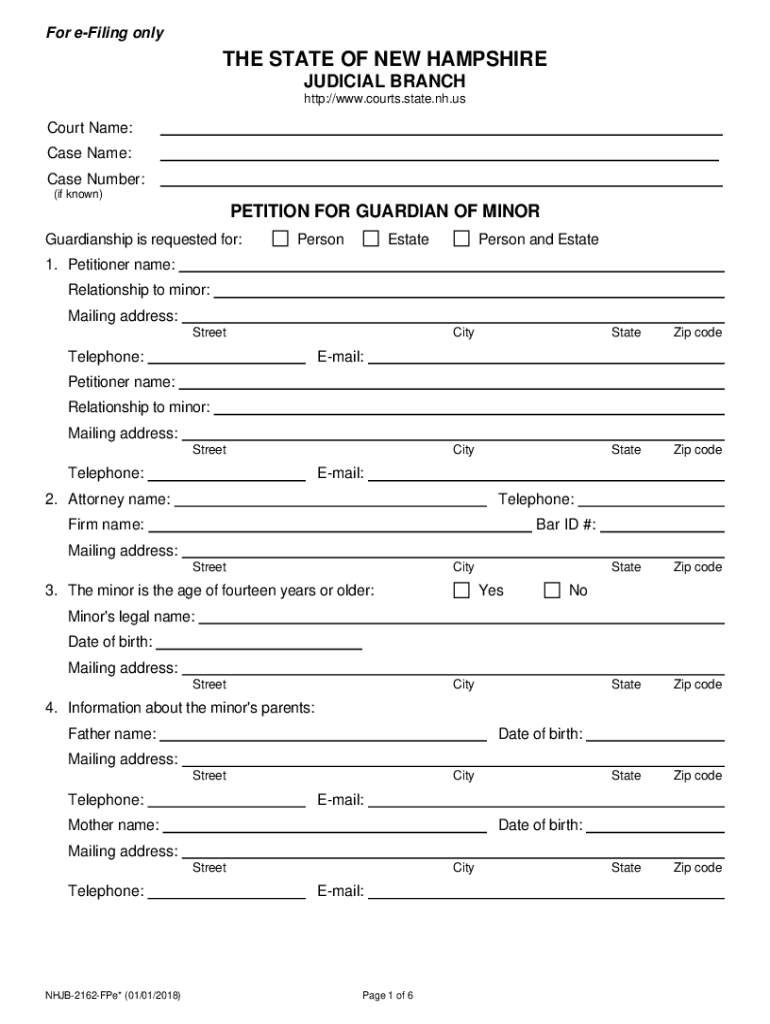







Definition and Purpose of the NH Petition for Guardianship
The NH Petition for Guardianship is a legal document used to request court approval to become the legal guardian of a minor in New Hampshire. This form is essential for individuals seeking to make important decisions regarding the minor's welfare, including health care, education, and general upbringing. The document ensures that the petitioner is qualified and that their intentions align with the best interests of the child.
Guardianship is typically necessary when the minor's parents are unable or unwilling to fulfill their parental responsibilities. The petition includes crucial information about the petitioner, the minor, and the minor’s biological parents or current legal guardians.
How to Use the NH Petition for Guardianship
-
Prepare Information: Collect detailed information about the minor, including their full name, date of birth, and current living situation. You'll also need similar details about both the petitioner and the minor’s parents or current guardians.
-
Follow Legal Protocols: Ensure that you understand the legal implications of becoming a guardian, as well as any terms and conditions set forth by New Hampshire state law. Familiarity with the Uniform Child Custody Jurisdiction and Enforcement Act (UCCJEA) can be beneficial.
-
Complete the Form: Accurately fill out the form sections related to the petitioner’s relationship to the minor, reasons for guardianship, and the proposed living arrangements. Be meticulous in providing truthful and full responses, as inaccuracies can delay or nullify the petition process.
Steps to Complete the NH Petition for Guardianship
-
Information Gathering:
- Compile information about the petitioner, minor, and the minor’s parents.
- Gather documentation supporting your case for guardianship, such as existing custody agreements or evidence of current caregivers’ inability to provide care.
-
Complete Each Section:
- Start with the top section meant for the court’s usage and proceed methodically to fill out personal information of all involved parties.
- Pay special attention to sections regarding custodial details and the reasons necessitating the guardianship.
-
Review and Verification:
- Double-check all entries for correctness.
- Have the sections verified by a legal professional if possible to ensure compliance with legal standards specific to New Hampshire.
-
Submission:
- File the form with the appropriate New Hampshire Probate Court.
- Pay any necessary filing fees and ensure you have copies for your records.
Key Elements of the NH Petition for Guardianship
- Petitioner Information: Includes personal details such as name, address, relationship to the minor, and contact information.
- Minor's Details: Full name, age, gender, and current living situation.
- Parental Details: Names, addresses, and current custody status of the minor's biological parents.
- Custodial Intentions: Detailed explanation of why guardianship is sought and how the petitioner plans to care for the minor.
- Jurisdiction Considerations: Responses concerning the UCCJEA to determine whether New Hampshire has jurisdiction over the guardianship case.
Legal Use of the NH Petition for Guardianship
This petition is used legally to transfer parental responsibilities from the minor's current guardians to the petitioner. Legal use implies adherence to relevant state laws and regulations like the UCCJEA, ensuring that the guardianship serves the minor's best interest. The document must be submitted to and approved by a court to become effective.
Understanding the legal obligations a guardian assumes is crucial. This includes decisions around education, health care, and daily well-being, securing that all actions and decisions will align with the court's decision and the legal framework provided by the state.
State-Specific Rules for the NH Petition for Guardianship
In New Hampshire, state-specific laws mandate that the petition must be filed in the Probate Court of the county where the minor resides or is currently found. The petitioner must also meet particular age and competency requirements dictated by state law.
New Hampshire law also dictates a period for objections from biological parents or current custodians before the court finalizes guardianship. Petitioners should be prepared for potential court hearings where they might need to further argue or substantiate their petition.
Examples of Using the NH Petition for Guardianship
-
Family Circumstances: When a grandparent or another relative realizes that a parent can no longer care for the minor due to circumstances like illness or incarceration, the petition can be filed to secure legal guardianship.
-
Custodial Rights Determination: The petition can determine custodial arrangements when parents are divorced and one parent is unfit or unable to care for the child.
Each case demonstrates how the form is vital for those stepping into legally recognized guardianship roles.
Required Documents for Filing the NH Petition for Guardianship
- Completed Petition: Fully filled out form with no omitted sections related to necessary legal information.
- Birth Certificates: Copies of the minor’s birth certificate as well as identification for the petitioner.
- Affidavits or Evidence: Any supporting documents that strengthen the petitioner’s case, such as affidavits from teachers, testimonials from neighbors, or any previous legal documents indicating existing custody issues.
- Proof of Income: Financial statements or income proof to demonstrate the ability to care for the minor financially.
Form Submission Methods (Online / Mail / In-Person)
- Online: While some forms can be initiated online, final submissions usually occur in person or via mail to the appropriate county court.
- Mail: A complete set of the petition and accompanying documents can be posted to the court’s mailing address.
- In-Person: Deliver the document package directly to the Probate Court to ensure all materials are correctly submitted and queries can instantly be resolved via court clerks.
This broad overview provides a comprehensive understanding of the New Hampshire Petition for Guardianship, ensuring potential guardians are well-informed on the procedures and requirements surrounding this important legal step.




