




01. Edit your form online
Type text, add images, blackout confidential details, add comments, highlights and more.

Type text, add images, blackout confidential details, add comments, highlights and more.

Draw your signature, type it, upload its image, or use your mobile device as a signature pad.

Send it via email, link, or fax. You can also download it, export it or print it out.
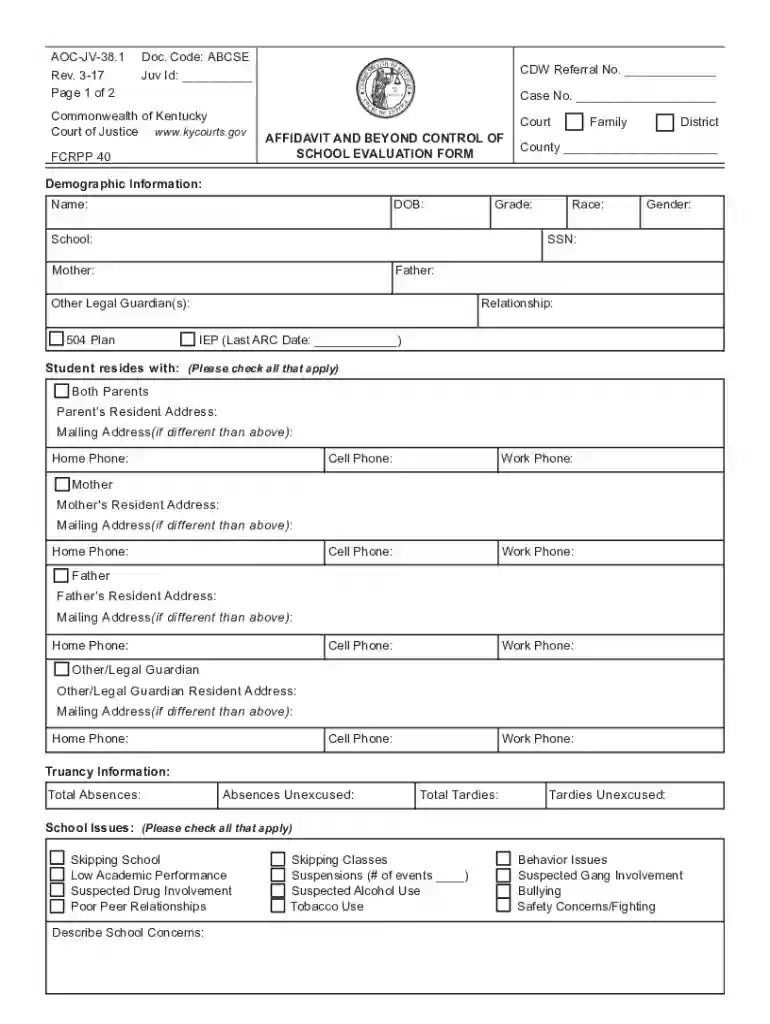
The "KY Beyond Control School" form, known officially as the Affidavit and Beyond Control of School Evaluation Form, serves a critical role in the Commonwealth of Kentucky's judicial process. It is designed to assess cases where a student's behavior is deemed beyond the control of educational institutions. The form provides a detailed account of various aspects of the student's school life and behavioral challenges, which can influence court decisions regarding jurisdiction and necessary interventions.
Accessing the form is relatively straightforward. Individuals can obtain it from the Commonwealth of Kentucky Court of Justice's official website or local court offices. The form may also be available through schools or educational authorities who are familiar with the process of reporting behavioral and attendance issues to the court. For those who prefer digital access, downloading it from relevant online legal resources is an option.
The form contains several key elements designed to capture comprehensive details about a student's situation. These include:
Each section is crucial for providing a holistic view of the student's challenges, ensuring that the court receives a well-documented report.
Kentucky has unique guidelines governing the usage and processing of this form. For instance, the form is explicitly a part of the state's juvenile justice process, helping determine cases of truancy or delinquency. Compliance with state-mandated protocols is essential, including timelines for submission and the requirement for supporting documents. Users should familiarize themselves with local statutes that might affect the interpretation and handling of the form.
Case studies illustrate the practical application of the form:
These scenarios demonstrate the form's utility in addressing complex student issues within the educational and legal systems.
The form plays a pivotal role in legal proceedings concerning minors perceived as beyond the control of school jurisdiction. It allows the court to understand the student's background, behavior, and the school's response, thereby informing decisions around protective or corrective measures. It is vital that the form is used ethically and accurately to ensure fair treatment of the student and adherence to legal standards.
These stakeholders collaborate to ensure the student's welfare and compliance with legal obligations, highlighting the form's importance across various levels of engagement.


We've got more versions of the ky beyond control school form. Select the right ky beyond control school version from the list and start editing it straight away!
At DocHub, your data security is our priority. We follow HIPAA, SOC2, GDPR, and other standards, so you can work on your documents with confidence.
This Beyond Parental Control Evaluation Form and Affidavit is mandatory and shall accompany any complaint/petition of Beyond Parental Control submitted to the
include offenses such as beyond the control of school or beyond the control. 21. Id. 22. Id. See also Preston Elrod R. Scott Ryder, Juvenile Justice: ARead more


