




01. Edit your release record online
Type text, add images, blackout confidential details, add comments, highlights and more.

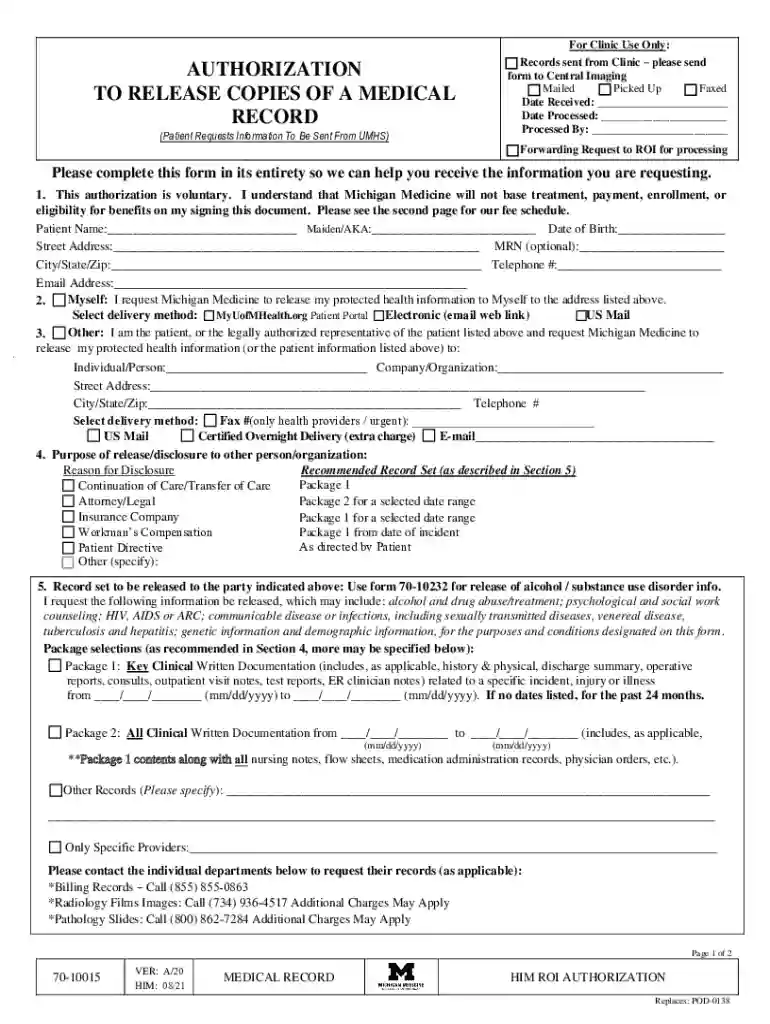
Type text, add images, blackout confidential details, add comments, highlights and more.

Draw your signature, type it, upload its image, or use your mobile device as a signature pad.

Send release record form via email, link, or fax. You can also download it, export it or print it out.
The release record edit form is utilized primarily to authorize the sharing or amendment of specific records, such as medical documents, financial statements, or other sensitive information. Its primary function is to provide a systematic way to manage record dissemination or modification, ensuring compliance with privacy and data protection regulations. This form serves several purposes, including safeguarding the interests of both parties involved and providing a clear trail of authorization.
The definition of this form includes specific identifiers related to its use case, such as patient information requests within healthcare institutions like Michigan Medicine. Understanding its definition helps in framing its application across various scenarios such as patient data updates or financial record amendments.
Completing a release record edit form involves several critical steps to ensure accuracy and compliance. The process typically includes:
Secure the Form: Obtain the necessary version of the form through official channels or institutional websites.
Provide Detailed Information: Fill in mandatory fields, including personal details like full name, date of birth, and contact information. This ensures that the records are associated with the correct individual.
Specify the Records: Clearly outline which records require release or modification. If applicable, provide identifying details such as the document number or date.
Select the Delivery Method: Indicate how the records should be shared or returned, which might include electronic mail, direct download, or postal service delivery.
State the Purpose: Explain the reason for the record release or edit to provide context and justify the request.
Consent and Sign: Conclude the process by signing the form. While this is often deemed voluntary, it is crucial as it signifies consent for the records' handling as outlined in the form.
Understanding the critical components of the release record edit form is vital to its effective use. Key elements include:
Personal Identification: Captures the essential identifiers of the person authorizing the record release, ensuring documents are matched correctly.
Data Scope: Defines the specific information or part of the record being amended or shared.
Recipient Details: Identifies who will receive the records, including institutions or individuals, to maintain clear communication and accountability.
Confidentiality Agreements: May include clauses that dictate how the records will be handled post-release to protect privacy.
Consent Confirmation: An explicit acknowledgment that the signing party understands the implications of record release or modification.
When handling the release record edit in a digital format, compatibility with various software platforms is essential. This ensures seamless integration with systems such as:
Document Management Software: Tools like DocHub facilitate digital editing and signature processes, which are pivotal for electronic forms.
Cloud Storage Services: Integration with Google Drive, Dropbox, or similar platforms to secure data storage and easy retrieval.
The transition from paper to digital reduces processing time and enhances accuracy while maintaining comprehensive security protocols such as encryption.
The legal implications of a release record edit form are profound, as it touches on issues of data privacy and compliance with statutes like the Health Insurance Portability and Accountability Act (HIPAA) for medical records. The legal use involves:
Regulatory Alignment: Adhering to local, state, and federal regulations to prevent unauthorized access or sharing.
Informed Consent: Ensuring that the individual authorizing the release is fully aware of the consequences and has given permission without coercion.
Audit Trails: Maintaining records of who accessed the sensitive information and when, as part of organizational compliance and transparency mandates.
The release record edit serves several strategic roles. Its core functions include:
Facilitating Updates: Streamlining the process of updating or correcting information in official records without disrupting existing workflows.
Ensuring Accuracy: By clearly outlining the records involved, the form helps prevent misinformation or miscommunication.
Securing Transactions: Provides a formalized method to ensure both parties agree on the terms of data exchange or modification, reducing the risk of disputes.
Eligibility for using this form generally applies to individuals or entities seeking to manage or disseminate sensitive records. Typical scenarios include:
Healthcare: Patients or guardians requesting amendments to medical records.
Legal: Lawyers requesting financial documents for case evaluations.
Corporate: Organizations updating employee records post-promotion or internal role change.
These scenarios highlight the diverse applications of the release record edit form across different sectors.
Submitting the release record edit form necessitates gathering associated documentation that supports the request. This might include:
Identification Proof: Copies of government-issued ID to verify the identity of the individual authorizing the release.
Previous Records: Existing documents that are the subject of the modification request, aiding in accuracy and context establishment.
Accompanying Authorizations: Possible letters of consent from involved third parties or legal representatives if applicable.
Preparedness in documentation ensures smooth processing and adherence to submission guidelines, thus facilitating timely approval and action.
We've got more versions of the release record form. Select the right release record version from the list and start editing it straight away!
At DocHub, your data security is our priority. We follow HIPAA, SOC2, GDPR, and other standards, so you can work on your documents with confidence.
Jan 31, 2025 Releasing records from the MDE allows other catalogers at the institution or in the network to edit, merge, and replace those records. Unless aRead more
Jan 15, 2026 This template has custom formatting. Parameter, Description, Type, Status. Date of release (any format, can lack month or day)Read more
Sep 9, 2025 You can make updates and edits to records published on ClinicalTrials.gov by logging into the ClinicalTrials.gov PRS.Read more


