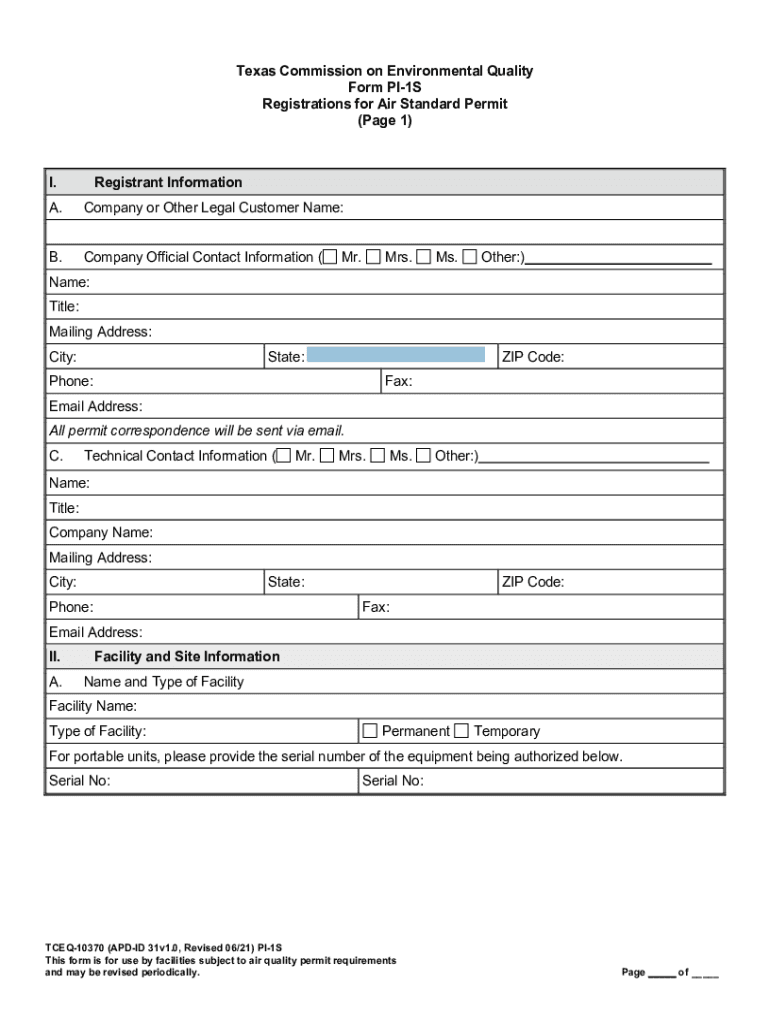
Air standard registration 2026

Get Form
air standard registration Preview on Page 1

Here's how it works

01. Edit your form online
Type text, add images, blackout confidential details, add comments, highlights and more.
02. Sign it in a few clicks
Draw your signature, type it, upload its image, or use your mobile device as a signature pad.
03. Share your form with others
Send it via email, link, or fax. You can also download it, export it or print it out.

How to use or fill out air standard registration with our platform

Form edit decoration
9.5
Ease of Setup
DocHub User Ratings on G2
9.0
Ease of Use
DocHub User Ratings on G2
  1. Click ‘Get Form’ to open the air standard registration form in the editor.
  2. Begin by filling out the Registrant Information section. Enter the legal name of your company and provide contact details for both a company official and a technical contact.
  3. In the Facility and Site Information section, specify the name and type of facility. Ensure that you provide a descriptive name and check whether it is permanent or temporary.
  4. Complete the Fee Information section by entering the required fee amount based on your selected standard permit. Make sure to pay this fee through our platform.
  5. If applicable, fill out the Public Notice section, identifying responsible persons for public communication regarding your application.
  6. Review all sections carefully before submitting. Ensure that all required documents are attached, including any necessary technical information.

Start using our platform today to streamline your air standard registration process for free!

See more air standard registration versions

We've got more versions of the air standard registration form. Select the right air standard registration version from the list and start editing it straight away!
Versions Form popularity Fillable & printable
2021 4.8 Satisfied (75 Votes)
2021 4.3 Satisfied (81 Votes)
2020 4.3 Satisfied (264 Votes)
2020 4.3 Satisfied (78 Votes)
2019 4.3 Satisfied (50 Votes)
2015 4.4 Satisfied (369 Votes)
2013 4.3 Satisfied (66 Votes)
be ready to get more

Complete this form in 5 minutes or less

Get form

Got questions?

We have answers to the most popular questions from our customers. If you can't find an answer to your question, please contact us.
Contact us
Air permits are legal documents that identify the potential sources of air pollution emissions at a given facility and specify all applicable state and federal air pollution regulations and requirements for protecting human health and the environment.
Any location that emits more than 10 tons pe year of a hazardous air pollutant or 25 tons per year of any combination of hazardous air pollutants must obtain a Title V Federal Operating Permit through the TCEQ.
An air quality standard defines the maximum amount of a pollutant averaged over a specified period of time that can be present in outdoor air without harming public health, and thus, it defines clean air.
Projects Which Typically Do Not Require Permits Painting or Wallpapering. Installing Hardwood Floors. Tiling. Carpeting. Cabinets. Countertops and similar finish work. Minor electrical repairs that do not involve new service or moving existing service. Replacement of a faucet.
Title V is an air permitting program generally specific to major sources. The term major source refers to the entire site. The determination of whether a site is a major source is done by calculating and summing emissions from all stationary sources at the site. The term stationary source includes facilities.

Security and compliance

At DocHub, your data security is our priority. We follow HIPAA, SOC2, GDPR, and other standards, so you can work on your documents with confidence.

Learn more
ccpa2
pci-dss
gdpr-compliance
hipaa
soc-compliance

People also ask

The first step is to conduct a needs assessment to determine the type and amount of emissions that will be released. The second step is to produce an outline of necessary emission controls to reduce the amount of pollutants released into the air.
The thresholds are the potential to emit: 100 tpy of any criteria pollutant; 10 tpy or more of any single hazardous air pollutant; or 25 tpy or more of any combination of hazardous air pollutants. Public participation is possible through the Part 70 permitting process.
There are three primary types of air permits in Texas: Permits By Rule (PBR), Standard Permits, and New Source Review. When establishing a new facility, exploring Permits By Rule should be the initial step.

Related links