




01. Edit your request for conveyance sample online
Type text, add images, blackout confidential details, add comments, highlights and more.

Type text, add images, blackout confidential details, add comments, highlights and more.

Draw your signature, type it, upload its image, or use your mobile device as a signature pad.

Send request for occupied via email, link, or fax. You can also download it, export it or print it out.
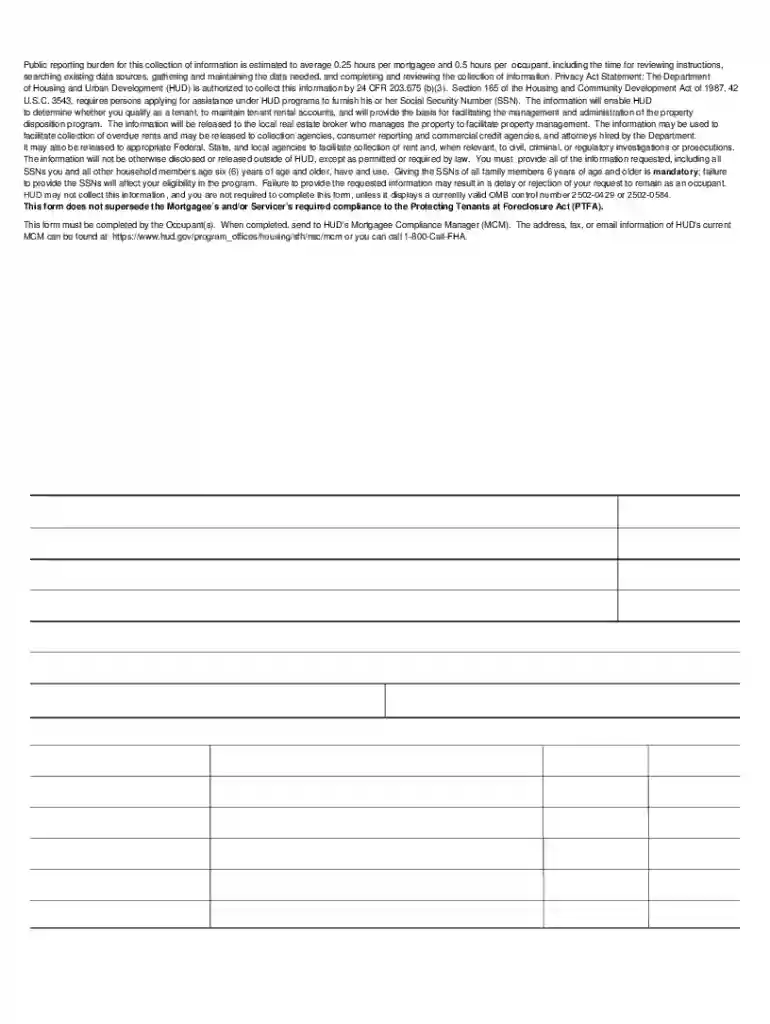
The conveyance HUD form is utilized within transactions involving real estate, primarily when properties are acquired by or transferred under the oversight of the U.S. Department of Housing and Urban Development (HUD). This document serves as a formal request for occupants who wish to continue residing in a property that HUD might acquire. It outlines necessary details and conditions that need to be met for eligibility assessment, such as providing accurate personal, financial, and compliance information that determines if tenants are allowed continued occupancy under specific HUD regulations.
Using the conveyance HUD involves several important steps to ensure correct completion and submission. Applicants must first acquire the form, ensuring they have all necessary personal and financial documentation at hand. Once the form is filled out, typically with detailed disclosures of income information and Social Security Numbers, it is submitted to HUD for review. Pay particular attention to the accuracy of each entry to avoid processing delays. Providing incorrect or incomplete information can impede the eligibility determination process.
Completing the conveyance HUD requires following a structured approach that ensures no step is overlooked. Begin with reading the entire form to understand what information is required. Progress to gradually filling in identifiable information, such as names and Social Security Numbers, moving to financial disclosures and other pertinent details, such as occupancy status and compliance obligations. It’s crucial to sign and date the form where indicated, confirming all information is truthful and complete. Review the filled form for accuracy before submitting.
Understanding the conveyance HUD’s fundamental components is essential. These elements include applicant identification, financial disclosures, and intended property use or occupancy. Additionally, there are sections for legal compliance, emphasizing adherence to HUD regulations and guidelines. This section of the form also specifies the need for truthful information and the repercussions of misrepresentation. Each part of the form plays a critical role in determining the eligibility for continued occupancy under HUD’s governance.
The conveyance HUD is a legally binding document governed under HUD’s regulatory framework. It is designed for lawful use in property transactions involving HUD to prevent unauthorized or fraudulent occupancy. The form is essential for ensuring that properties under HUD’s purview are occupied by eligible individuals meeting certain legal and regulatory standards. Any misuse or manipulation of the document can lead to legal penalties, highlighting the importance of providing honest and accurate information.
The form is primarily used by tenants and occupants of properties that may be acquired by HUD. These can include individuals or families residing in properties subject to federal housing policies. Property managers and landlords may also interact with this form when coordinating with HUD to ensure compliance with occupancy laws. The primary audience consists of those needing to establish their intent and eligibility to reside in federally managed housing as changes in property ownership occur.


To complete the conveyance HUD, applicants need to provide a range of supporting documents. These often include proof of identity, such as a driver’s license or passport, and financial documentation like pay stubs, tax returns, or bank statements. Additional documents may involve proof of current occupancy, such as lease agreements or utility bills, to establish the home as a primary residence. Ensuring that these documents are up-to-date and reflect accurate information is crucial in the eligibility assessment.
Submission of the conveyance HUD can be carried out through various channels, making the process flexible. Options generally include online submission through HUD’s official portal, mailing a hard copy directly to HUD, or potentially submitting in person at a local HUD office. Each method has specific guidelines and deadlines that must be observed to ensure the process completes efficiently. Time-sensitive elements, such as submission deadlines, should be prioritized to maintain compliance with HUD policies.
We've got more versions of the request for conveyance sample form. Select the right request for conveyance sample version from the list and start editing it straight away!
At DocHub, your data security is our priority. We follow HIPAA, SOC2, GDPR, and other standards, so you can work on your documents with confidence.
The Servicer shall convey the property to HUD by one of the following: (1) Direct conveyance to HUD. The Servicer shall cause for the deed to be transferredRead more
Oct 5, 2018 CONVEYANCE RELEASES. means an air carrier with authority to conduct operations ・ review of heads-up display systems, enhanced vision systems


