




01. Edit your form online
Type text, add images, blackout confidential details, add comments, highlights and more.

Type text, add images, blackout confidential details, add comments, highlights and more.

Draw your signature, type it, upload its image, or use your mobile device as a signature pad.

Send it via email, link, or fax. You can also download it, export it or print it out.
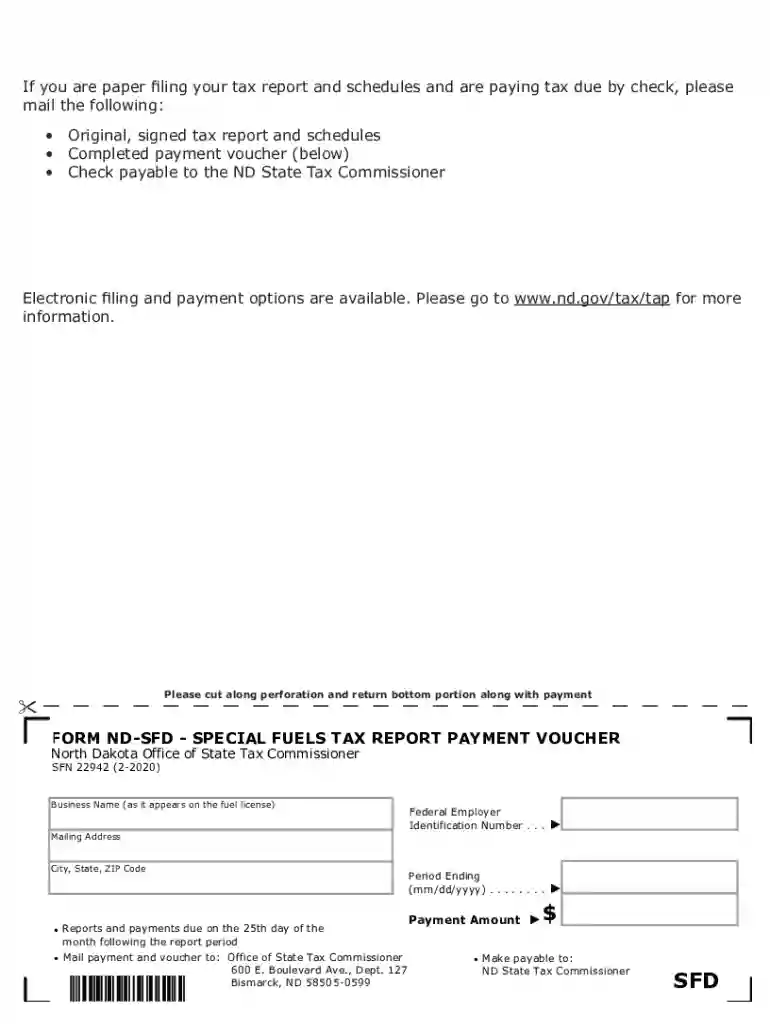
The "Special Fuel Tax Report and Schedules" is a comprehensive document mandated by the North Dakota Office of State Tax Commissioner. It is aimed at businesses involved in the handling and distribution of special fuels such as diesel or biodiesel. The document records details including the amount of fuel received, distributed, and used for taxable purposes. The primary objective is to ensure that businesses report and remit the correct amount of fuel tax to the state authorities by the specified deadline.
Completing the Special Fuel Tax Report requires attention to detail and adherence to specific procedures. Here are the steps:
Consider a logistics company operating within North Dakota. The firm maintains records showing it started the month with 10,000 gallons of diesel. By month-end, after purchases and sales, their inventory reduced to 7,500 gallons. Taxable fuel usage must be calculated by considering the 2,500 gallons distributed during the month.
Meeting filing deadlines is crucial to avoid penalties. The standard requirement is that the report must be submitted by the 25th day of the month following the reporting period. For instance, a report detailing fuel usage for January should be filed by February 25.
The report serves as a binding legal document for tax reporting purposes. It is essential for compliance with North Dakota state laws regarding fuel taxation. Businesses must accurately reflect their fuel transactions to avoid legal disputes and ensure accountability.
To correctly complete and submit the Special Fuel Tax Report and Schedules, several documents are needed:
The Special Fuel Tax Report is predominantly used by businesses engaged in the sale, distribution, or use of special fuels within the state of North Dakota. This includes:


A trucking company distributing goods across state lines would use this report to differentiate taxable in-state fuel use from non-taxable uses outside state boundaries.
While the general form structure remains consistent, certain rules are unique to North Dakota:
Failing to comply with filing requirements or submitting inaccurate information can result in significant penalties:
DocHub integrates seamlessly with various digital tools to facilitate smooth and efficient form completion. Businesses often use accounting software like QuickBooks for tracking fuel purchases and distributions, which aids in automated data entry into the Special Fuel Tax Report and Schedules.
Adopting these technologies not only enhances accuracy but also minimizes the margin for human error, ensuring that reports are comprehensive and submitted correctly.
We've got more versions of the Special Fuel Tax Report and Schedules. Special Fuel Tax Report and Schedules form. Select the right Special Fuel Tax Report and Schedules. Special Fuel Tax Report and Schedules version from the list and start editing it straight away!
At DocHub, your data security is our priority. We follow HIPAA, SOC2, GDPR, and other standards, so you can work on your documents with confidence.
by CG Assembly 2021 No refund of the gasoline or special fuel tax shall be claimed by or allowed to any person on any gasoline or special fuel used for propelling motor vehiclesRead more
IFTA Quarterly Fuel Use Tax Return (Sample). IFTA 100V*. IFTA Payment Voucher and Instructions. IFTA 101*. IFTA Quarterly Fuel Use Tax Schedule (Sample). IFTARead more


