




01. Edit your 14950 online
Type text, add images, blackout confidential details, add comments, highlights and more.

Type text, add images, blackout confidential details, add comments, highlights and more.

Draw your signature, type it, upload its image, or use your mobile device as a signature pad.

Send form 14950 via email, link, or fax. You can also download it, export it or print it out.
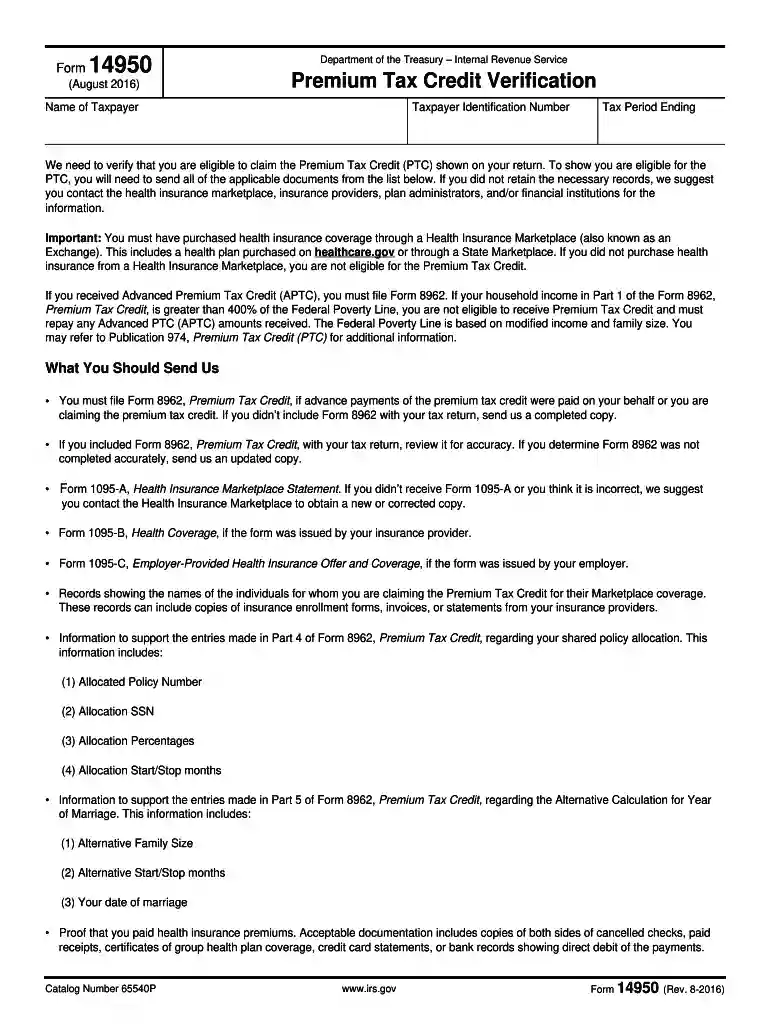
Tax credit verification is a crucial procedure employed by the IRS to confirm a taxpayer's eligibility for specific credits, like the Premium Tax Credit (PTC). This process involves verifying that individuals and entities claiming tax credits have adhered to requisite guidelines and submitted appropriate documentation. Ensuring compliance with tax credit rules is pivotal in avoiding audits and facilitating smooth financial planning. By mandating tax credit verification, the IRS upholds the integrity of the tax system, ensuring that only eligible taxpayers benefit from available credits.
Eligibility for tax credits such as the Premium Tax Credit hinges on several conditions. Primarily, taxpayers must have purchased health insurance through a Health Insurance Marketplace and have income within a designated range. The IRS also requires that individuals not qualify for other governmental health programs, including Medicaid or employer-sponsored insurance. These prerequisites are essential for maintaining fairness and ensuring that the credits assist those who genuinely require financial support for health premiums.


Successfully completing tax credit verification demands adherence to a structured process.
Various documents are integral to the verification process. Form 8962 allows taxpayers to reconcile Advanced Premium Tax Credit (APTC) payments, while Form 1095-A provides details on health coverage. Additional income documentation may include W-2s, 1099 forms, or other attestations of income. Ensuring the accuracy and completeness of these documents is vital to verify eligibility for tax credits and avoid potential audits or discrepancies in tax reporting.
The IRS has established comprehensive guidelines to streamline the verification process. These directives outline acceptable documentation, the step-by-step submission process, and critical deadlines. For instance, verification forms must align with IRS-defined formats, and any discrepancies noted in submissions may trigger further inquiries. Adhering to IRS guidelines fosters a smoother verification process, enhancing compliance and reducing the risk of administrative complications.
Awareness of the relevant filing deadlines is imperative for individuals seeking tax credit verification. Typically, the deadline aligns with annual tax return submissions, but early submission is advisable to address potential discrepancies. Missing these deadlines can lead to penalties or delays in the receipt of tax credits, underscoring the importance of vigilance in meeting IRS timelines.
Tax credit verification serves various practical scenarios. An example includes a self-employed individual who purchases insurance through the Marketplace and claims APTC to lower monthly premiums. Verification ensures eligibility and reconciles any advance credits received with actual income reported. Another example involves a retiree on fixed income using verification to confirm continuing eligibility for health premium assistance. These scenarios highlight the diverse applications and benefits of undergoing tax credit verification.
Failure to comply with tax credit verification requirements can result in significant penalties. Taxpayers may face fines, a reassessment of owed taxes, or loss of future credit eligibility. Non-compliance can also lead to increased scrutiny from the IRS, resulting in audits and further administrative burdens. Understanding and adhering to verification requirements is crucial in mitigating these risks and ensuring fair tax practices.
Tax credit verification can be completed through digital platforms or traditional paper-based submissions. Digital submission, often facilitated through IRS-approved portals or software, offers a streamlined process with instantaneous feedback on submission status. Conversely, paper submissions require mailing documents to the IRS, with longer processing times. Selecting the suitable submission method depends on taxpayer preferences, access to technology, and comfort with digital platforms.
Several components form the core of tax credit verification. Essential elements include accurate documentation of premium payments, income verification, detailed reconciliation of advance credits, and adherence to IRS guidelines. Mastery of these components ensures that taxpayers accurately report their financial situations, maintain compliance with IRS requirements, and receive the full benefits of available tax credits.
We've got more versions of the 14950 form. Select the right 14950 version from the list and start editing it straight away!
At DocHub, your data security is our priority. We follow HIPAA, SOC2, GDPR, and other standards, so you can work on your documents with confidence.
Enrolled students can submit the W-9S electronically and claim qualified educational expenses as a tax credit on a federal tax return.Read more
each housing credit agency is required to review its extended low-income housing commitments for compliance. This review must be completed by December 31, 2004.
Apr 17, 2026 The Property Tax Credit Lookup is updated in real time as credits are issued. You can view and print the following information regarding the property taxRead more


