




01. Edit your form online
Type text, add images, blackout confidential details, add comments, highlights and more.

Type text, add images, blackout confidential details, add comments, highlights and more.

Draw your signature, type it, upload its image, or use your mobile device as a signature pad.

Send it via email, link, or fax. You can also download it, export it or print it out.
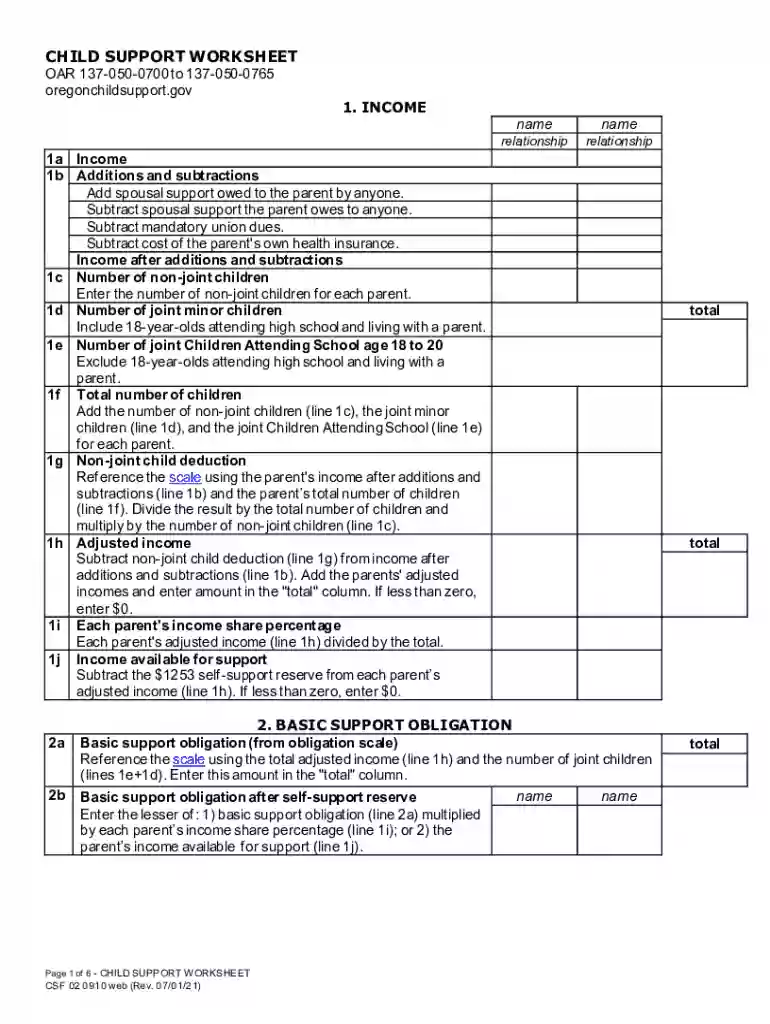
OR CSF 020910 is a standardized form utilized primarily in the state of Oregon to facilitate the calculation and arrangement of child support responsibilities among divorced or separated parents. This document plays a crucial role in balancing financial obligations, ensuring that both parents contribute equitably to the upbringing of their joint and non-joint children based on income and other relevant factors. It serves as a structured guide for fair assessment, considering various expenses such as child care and medical support.
To effectively use OR CSF 020910, parents must first gather all necessary financial information, including their income statements, expenses related to child care, health care premiums, and any other relevant financial documentation. By following the form’s detailed sections, users can input data methodically, which helps calculate the suggested financial responsibilities accurately. Each section of the form corresponds to different aspects of child support, offering a comprehensive overview of obligations and ensuring clarity and fairness in contributions.
Identify Parties: Fill in the identification information for both parties involved, ensuring accuracy.
Income Assessment: Input comprehensive income details for each parent. This includes wages, bonuses, and other relevant forms of income.
Expense Allocation: Provide documented details on child-related expenses such as child care and healthcare. Ensure alignment with receipts or documented costs.
Calculate Obligations: Follow the form's guided calculations to establish the basic financial responsibilities, allowing for straightforward contribution determination.
Review and Submit: After completing all sections, double-check for accuracy and discrepancies. Submit the form through the designated methods—typically online or by mail, depending on state directives.
This form is primarily used by parents navigating child support agreements in Oregon. It is especially relevant for individuals undergoing divorce proceedings or those revisiting existing child support arrangements. Legal professionals, such as family lawyers, often assist their clients in filling out this form accurately. Additionally, state child support agencies may use it to standardize support calculations, ensuring consistency across various cases.
OR CSF 020910 is legally binding once completed and signed by both parties or issued as part of a court judgment. Courts in Oregon rely on this document to ensure that child support obligations are clearly outlined and followed, reducing the likelihood of disputes. It helps provide a legally compliant framework within which parents can negotiate and adjust their support contributions according to their evolving financial situations.
The use of OR CSF 020910 adheres to Oregon state regulations, which may differ from federal or other state guidelines. These rules dictate how income is calculated, the types of deductions allowed, and specific considerations for children with special needs or extraordinary circumstances. Individuals using the form must be aware of these rules to ensure compliance and prevent legal complications.
While OR CSF 020910 does not have a universal filing deadline, it is typically completed during divorce proceedings or when revisiting current agreements. Timeliness is essential; delays in submission might impact legal proceedings or enforceability of determined obligations. Any modifications require prompt submission to avoid backlogs in legal judgments or personal agreements.
We've got more versions of the or csf 020910 form. Select the right or csf 020910 version from the list and start editing it straight away!
At DocHub, your data security is our priority. We follow HIPAA, SOC2, GDPR, and other standards, so you can work on your documents with confidence.
Apr 28, 2014 CSF 02 0910 (Rev. 04/28/14). CHILD SUPPORT WORKSHEET. OAR 137-050-0700 to 137-050-0765 oregonchildsupport.gov. 1. INCOME. 1a Income. 1bRead more
by GN Powell-Rodgers 2023 Proinflammatory GM-CSFproducing B cells in multiple sclerosis and B cell depletion therapy. Sci. Transl. Med. (2015). 32. Vacher, P. et alRead more


