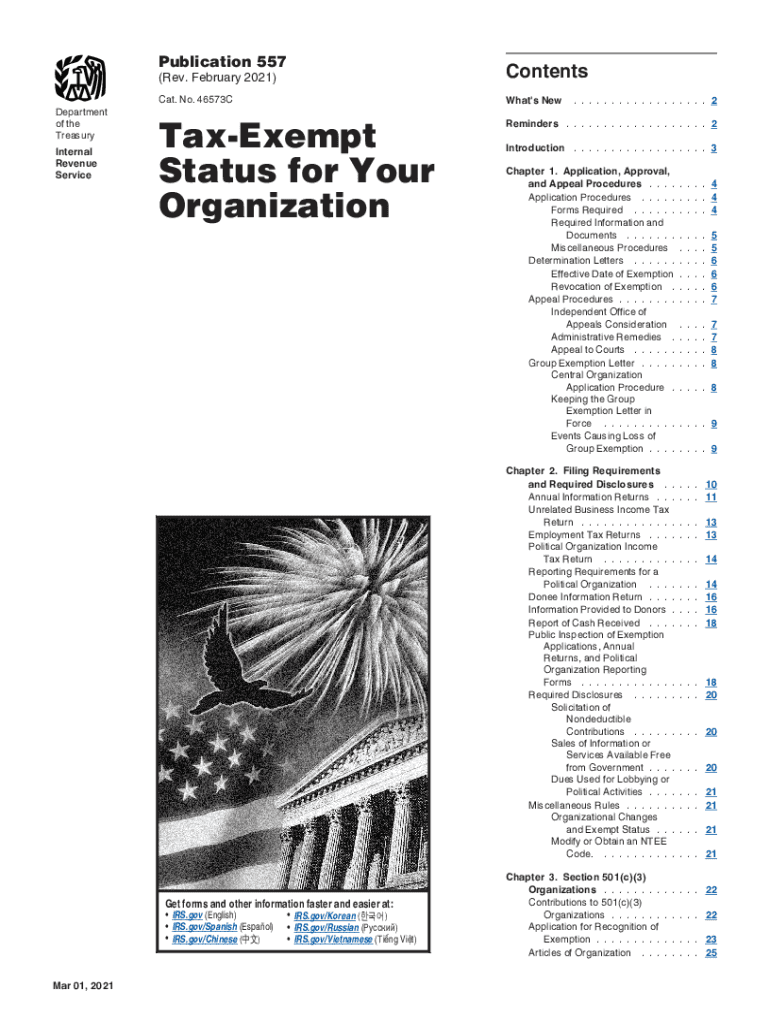





Publication 557 (Rev. February 2021). Tax-Exempt Status for Your Organization-2026

Get Form
pub 557 Preview on Page 1

Here's how it works

01. Edit your pub 557 online
Type text, add images, blackout confidential details, add comments, highlights and more.
02. Sign it in a few clicks
Draw your signature, type it, upload its image, or use your mobile device as a signature pad.
03. Share your form with others
Send irs publication 557 via email, link, or fax. You can also download it, export it or print it out.

The easiest way to edit Publication 557 (Rev. February 2021). Tax-Exempt Status for Your Organization in PDF format online

Form edit decoration
9.5
Ease of Setup
DocHub User Ratings on G2
9.0
Ease of Use
DocHub User Ratings on G2

Handling documents with our extensive and user-friendly PDF editor is straightforward. Adhere to the instructions below to fill out Publication 557 (Rev. February 2021). Tax-Exempt Status for Your Organization online quickly and easily:

  1. Sign in to your account. Sign up with your credentials or register a free account to try the product prior to choosing the subscription.
  2. Import a document. Drag and drop the file from your device or import it from other services, like Google Drive, OneDrive, Dropbox, or an external link.
  3. Edit Publication 557 (Rev. February 2021). Tax-Exempt Status for Your Organization. Effortlessly add and highlight text, insert images, checkmarks, and icons, drop new fillable areas, and rearrange or remove pages from your paperwork.
  4. Get the Publication 557 (Rev. February 2021). Tax-Exempt Status for Your Organization completed. Download your adjusted document, export it to the cloud, print it from the editor, or share it with other people via a Shareable link or as an email attachment.

Take advantage of DocHub, the most straightforward editor to rapidly manage your documentation online!

See more Publication 557 (Rev. February 2021). Tax-Exempt Status for Your Organization versions

We've got more versions of the Publication 557 (Rev. February 2021). Tax-Exempt Status for Your Organization form. Select the right Publication 557 (Rev. February 2021). Tax-Exempt Status for Your Organization version from the list and start editing it straight away!
Versions Form popularity Fillable & printable
2023 4.5 Satisfied (59 Votes)
2022 4.8 Satisfied (118 Votes)
2021 4.2 Satisfied (58 Votes)
2013 4.1 Satisfied (51 Votes)
be ready to get more

Complete this form in 5 minutes or less

Get form

Got questions?

We have answers to the most popular questions from our customers. If you can't find an answer to your question, please contact us.
Contact us

Electronic document approval demands a software solution that complies with data protection and eSignature laws. DocHub is an excellent tool for that, since it fulfills all the previously mentioned requirements. Whatever method you prefer to sign your publication 557 in DocHub, your eSignature will be legally binding and court-admissible.

With DocHub, you have several convenient ways to edit your publication 557 tax exempt status online. You can drag and drop the form and modify it directly at the DocHub website or use our browser extension to fill out your form right away. Additionally, you can modify your PDF on your phone, as DocHub works with all the available mobile platforms.

You can search Pub.78 data (for 501(c)(3) or other organizations eligible to receive deductible charitable contributions) or the exempt organizations business master file extract (for other 501(c) organizations) to find out if the organizations tax- exempt status has been reinstated.
Tax Exempt Organization Search Tool You can check an organizations eligibility to receive tax-deductible charitable contributions (Pub 78 Data). You can also search for information about an organizations tax-exempt status and filings: Form 990 Series Returns. Form 990-N (e-Postcard)
IRS Publication 557 is a document issued by the Internal Revenue Service (IRS) that details the steps to apply for and maintain tax-exempt status. For non-profit organizations, obtaining tax-exempt status is essential as it means they can avoid paying any federal income tax on their earnings.

Security and compliance

At DocHub, your data security is our priority. We follow HIPAA, SOC2, GDPR, and other standards, so you can work on your documents with confidence.

Learn more
ccpa2
pci-dss
gdpr-compliance
hipaa
soc-compliance

People also ask

Filing as exempt on a W-4 means no federal income tax is withheld from your paycheck, but Social Security and Medicare taxes will still be deducted. If you incorrectly claim exemption when you do not qualify, you may face a large tax bill and possible penalties when filing your return.
The EIN is not your tax-exempt number. That term generally refers to a number assigned by a state agency that identifies organizations as exempt from state sales and use taxes. You should contact your state revenue department for additional information about tax-exempt numbers.
Tax-exempt status means that an organization is exempt from paying federal corporate income tax on income generated from activities that are substantially related to the purposes for which the entity was organized (i.e., to the purposes for which the organization was granted tax-exempt status).
Tax-exempt organizations must make annual returns and exemption applications filed with the IRS available for public inspection and copying upon request. In addition, the IRS makes these documents available.

Related links