LA R-210NR 2026

Get Form
LA R-210NR Preview on Page 1

Here's how it works

01. Edit your form online
Type text, add images, blackout confidential details, add comments, highlights and more.

02. Sign it in a few clicks
Draw your signature, type it, upload its image, or use your mobile device as a signature pad.

03. Share your form with others
Send it via email, link, or fax. You can also download it, export it or print it out.

Definition and Meaning of LA R-210NR

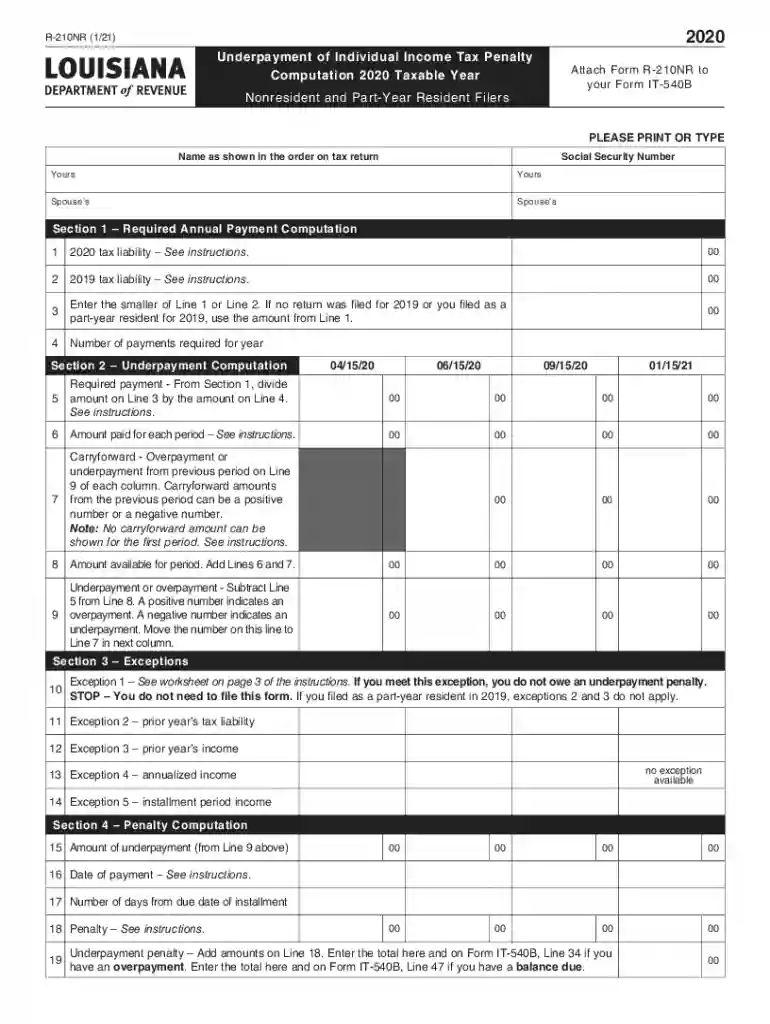
The LA R-210NR form is a critical document used for calculating the Underpayment of Individual Income Tax Penalty for the taxable year 2020. It specifically addresses the tax requirements of nonresident and part-year resident filers in Louisiana. This form outlines the methods to compute required annual payments, calculate any underpayment, and determine exceptions and applicable penalties. Understanding the LA R-210NR is crucial for those needing to assess their tax liability accurately and avoid penalties due to underpayment.

How to Use the LA R-210NR

Using Form LA R-210NR involves several key steps that help filers assess their tax penalties accurately:

  1. Calculate Annual Payments: Determine the required annual payments based on your situation.
  2. Underpayment Computations: Evaluate if there has been any underpayment and compute the amount.
  3. Evaluate Exceptions: Identify if exceptions apply to avoid penalties.
  4. Determine Penalty Calculations: Calculate possible penalties for underpayment.

By following these steps, filers can accurately document their tax situation, adhere to requirements, and potentially minimize any penalties.

Steps to Complete LA R-210NR

Completing the LA R-210NR involves a structured process to ensure all areas are addressed:

  1. Gather Documentation: Collect all relevant tax documents and information.
  2. Review Filing Status: Confirm your status as a nonresident or part-year resident to meet the form's criteria.
  3. Compute Necessary Payments: Calculate necessary annual payments using the provided guidelines.
  4. Underpayment Calculation: Follow the form's instructions to compute any underpayments.
  5. Determine Exceptions: Evaluate if any exceptions are applicable to your situation to reduce penalties.
  6. Final Review and Submission: Double-check all information for accuracy before submission.

Each step should be approached with care to ensure that all required information is provided correctly.

Key Elements of the LA R-210NR

The LA R-210NR form contains several key elements essential for accurately determining tax penalties:

  • Required Annual Payments: Details the necessity for certain payments based on your filing status.
  • Underpayment Computations: Directs users on how to compute any underpayments.
  • Penalty Exceptions: Lists any exceptions that might apply to avoid penalty charges.
  • Computation Guidelines: Offers specific instructions for calculating taxes due under different scenarios.

Filers must thoroughly understand these elements to use the form effectively.

Important Terms Related to LA R-210NR

Several key terms related to the LA R-210NR are essential for accurate interpretation and use of the form:

  • Nonresident Filer: Someone who resides outside of Louisiana but has tax obligations within the state.
  • Part-Year Resident: An individual who resided in Louisiana for only part of the taxable year.
  • Underpayment Penalty: The fee assessed when taxpayers fail to make adequate tax payments throughout the year.
  • Annual Payment Requirement: A mandatory payment based on estimated taxes due.

Understanding these terms ensures clarity when filling out and submitting the LA R-210NR form.

Filing Deadlines and Important Dates

Filing deadlines are critical when using the LA R-210NR to avoid late fees and penalties:

  • Regular Tax Year Filing: Ensure submission by the state-mandated deadline, typically April 15, unless extensions apply.
  • Deadline for Payments: Make all necessary payments by the specified date to avoid penalties.
  • Amended Returns: If applicable, file amended returns within three years of the original filing deadline.

Failure to adhere to these deadlines can result in penalties, so it is crucial to plan accordingly.

Penalties for Non-Compliance with LA R-210NR

Non-compliance with the LA R-210NR can lead to significant penalties, including:

  • Late Filing Penalty: Imposed if the form isn’t submitted by the due date.
  • Underpayment Penalty: Applied if estimated taxes are not paid in time.
  • Interest Charges: Accrue on late payments and can increase the overall amount due.

Understanding and adhering to the form’s requirements can prevent these costly penalties.

Legal Use of the LA R-210NR

The LA R-210NR serves not only as a tax computation form but also as a legal documentation of penalty calculations:

  • Proof of Compliance: Provides proof to tax authorities that the taxpayer has met state tax requirements.
  • Documentation for Reductions: Documents any applicable reductions or exceptions to penalties, which could be vital in disputes.
  • Legal Evidence: Acts as legal evidence should any discrepancies arise in tax computations or payments.

Using the LA R-210NR correctly ensures that one's tax affairs remain above board and legally compliant.

See more LA R-210NR versions

We've got more versions of the LA R-210NR form. Select the right LA R-210NR version from the list and start editing it straight away!
Versions Form popularity Fillable & printable
2023 4.1 Satisfied (46 Votes)
2022 4.8 Satisfied (32 Votes)
2021 4.9 Satisfied (51 Votes)
2020 4.3 Satisfied (41 Votes)
2019 4.3 Satisfied (41 Votes)
be ready to get more

Complete this form in 5 minutes or less

Get form

Got questions?

We have answers to the most popular questions from our customers. If you can't find an answer to your question, please contact us.
Contact us

Sure, you’ll find numerous applications for this on the web. Nonetheless, if you need to eSign your LA R-210NR without installing additional software, DocHub is the best choice you can make. This robust editor works on mobile devices just as on desktops. Open our editor in any internet browser, register or log in to your account, and start processing your forms.

When you choose analog ways of completing your LA R-210NR, you can easily download your file for printing. Search DocHub’s Forms & Templates catalog to get the exact file template you need and open it for editing or download it on your device in the format of your liking. It is easy to complete your form electronically and place your handwritten signature on it after printing or eSign your file with DocHub.

Tax liability zero essentially means that an individual or business owes no taxes for a specific tax period. In other words, the total amount of taxes due is reduced to zero, either because of deductions, credits, or other allowable expenses that offset the businesss taxable income.
You should file Form IT-540, Louisiana Resident Individual Income Tax Return, reporting all of your income to Louisiana. If your domicile is NOT Louisiana, you must report any nonmilitary Louisiana sourced income on Form IT-540B, Louisiana Nonresident Individual Income Tax Return.
About Form 1040-NR, U.S. Nonresident Alien Income Tax Return. Internal Revenue Service.

Security and compliance

At DocHub, your data security is our priority. We follow HIPAA, SOC2, GDPR, and other standards, so you can work on your documents with confidence.

Learn more
ccpa2
pci-dss
gdpr-compliance
hipaa
soc-compliance

People also ask

Use Form IT-540, Resident Return, or Form IT-540B, Nonresident and Part-year Resident Return, whichever is applicable. Louisiana does not have a separate form for amending a return.
The penalty rate is 0.5% of the amount owed per month, capped at 25% of the unpaid amount, but it also accrues interest based on the federal short-term rate plus three percentage points.
a completed Louisiana Form R-6180, Net Capital Gains Deduction Worksheet; b. documentary evidence of the date the taxpayer acquired an equity interest in the business, such as articles of incorporation or organization, acts of sale or exchange, or donative instruments; c.
An underpayment penalty is a charge the IRS imposes on taxpayers who did not pay all of their estimated income taxes for the year or paid their taxes late. Youll face an underpayment penalty if you: Didnt pay at least 90% of the tax on your current-year return or 100% of the tax shown on the prior years return.

Related links