




Here's how it works
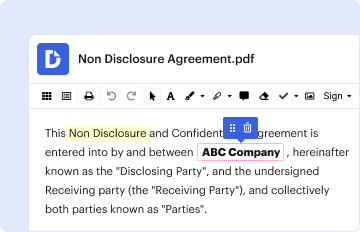
01. Edit your nh transfer tax forms online
Type text, add images, blackout confidential details, add comments, highlights and more.
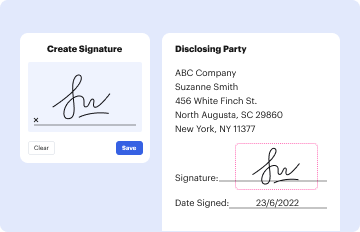
02. Sign it in a few clicks
Draw your signature, type it, upload its image, or use your mobile device as a signature pad.

03. Share your form with others
Send it via email, link, or fax. You can also download it, export it or print it out.
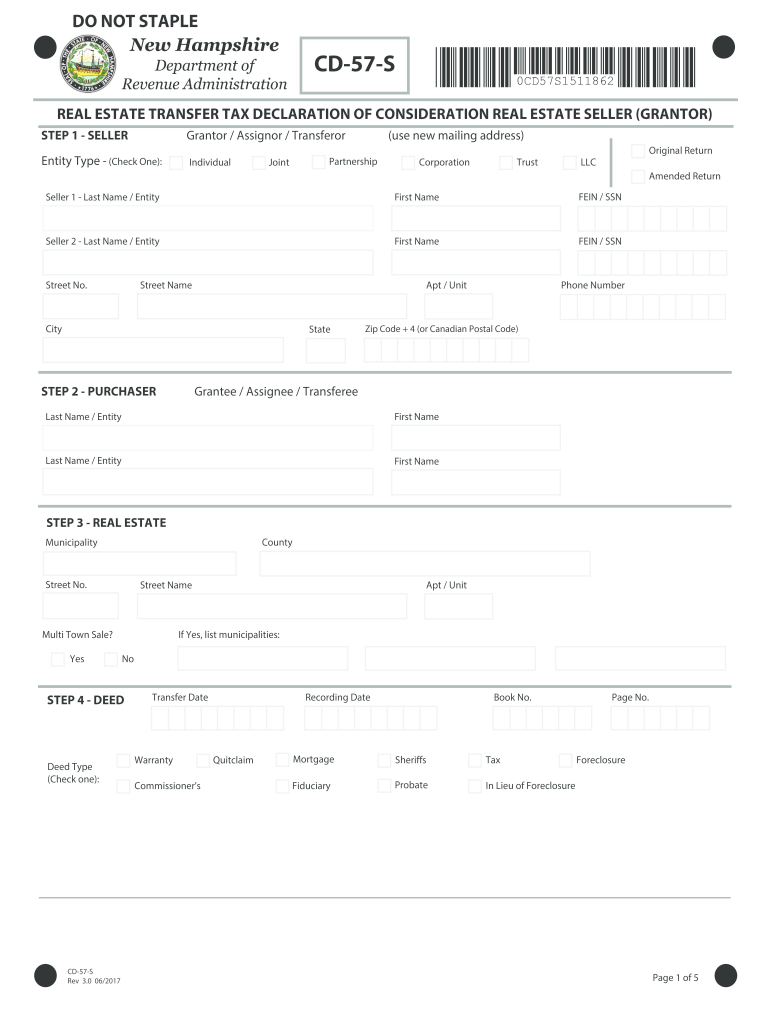
How to use or fill out new hampshire cd 57 s form with our platform

- Click ‘Get Form’ to open the New Hampshire CD 57 S form in the editor.
- In Step 1, select the applicable Entity Type for the seller and indicate if this is an original or amended return. Fill in the full name, address, phone number, and taxpayer identification number(s) for each seller.
- Proceed to Step 2 and enter the full names of the purchaser(s). Ensure all necessary details are accurately filled out.
- In Step 3, provide property location details including municipality, county, street number, and street name. If applicable, include apartment/unit numbers and tax map information.
- For Step 4, enter transfer date and recording date along with Book and Page numbers assigned by the County Register of Deeds. Select the appropriate deed type.
- In Step 5, calculate the tax amount based on the full price paid for real estate. Follow instructions to divide by $100 and apply the current tax rate.
- Finally, in Steps 6 and 7, ensure signatures are provided where required. If someone else prepared this form, include their information as well.
Start using our platform today to fill out your New Hampshire CD 57 S form easily and for free!
Fill out new hampshire cd 57 s form online
It's free
It's free
See more new hampshire cd 57 s form versions
We've got more versions of the new hampshire cd 57 s form form. Select the right new hampshire cd 57 s form version from the list and start editing it straight away!
Got questions?
We have answers to the most popular questions from our customers. If you can't find an answer to your question, please contact us.
Contact us
At what age do you stop paying property taxes in NH?
Applicant must be 65 years old before April 1 of the tax year for which the application is being made. You must have resided in New Hampshire for at least three (3) years and owned your home individually or jointly prior to April 1st of the tax year for which you are applying.
How much are closing costs for a seller in NH?
Closing costs in New Hampshire Closing costAverage rateAverage cost Seller concessions 2.00% $10,189 Title insurance 0.20% $1,025 Recording fees 0.02% $90 Real estate transfer tax 0.75% $3,8213 more rows
Do you have to pay capital gains in NH?
*While New Hampshire does not tax income or capital gains, it does tax investment income such as interest and dividends. As you may have noticed, none of these states have an income tax. Rather than raising revenues through income or capital gains taxes, these states may have higher property, corporate, or sales taxes.
How to avoid property tax in New Hampshire?
Requirements: Must be a New Hampshire resident for 3 consecutive years. Must be 65 on or before April 1st (or spouse) The property for which the exemption is applied must be the legal residence of applicant(s) Property Transfers: the property cannot be transferred within the last 5 years from a blood relative or marriage.
How much can you inherit in New Hampshire without paying taxes?
Does New Hampshire Have an Inheritance Tax or Estate Tax? New Hampshire does not have an inheritance tax. However, if you inherit from someone who lived in or owned property in a state that does have an estate tax, such as Maryland or Kentucky, then you may have to deal with that tax.
Security and compliance
At DocHub, your data security is our priority. We follow HIPAA, SOC2, GDPR, and other standards, so you can work on your documents with confidence.
Learn more


Related forms
Nv trust account
The document is a communication from the Nevada Secretary of State regarding the Trust Account Application and its Terms ...
Dnr storage and space request - State of Michigan
The document outlines the requirements for the certification of a Forest Management Plan and Timber Rights for landowner ...

Construction Safety Compliance Demolition Cover Sheet
The document is a Construction Safety Compliance Demolition Cover Sheet that outlines the necessary information and requ ...
Floridas Prescription Drug Monitoring Program
The document outlines the process for appointing an Agency Administrator for Florida's Prescription Drug Monitoring Prog ...

90-ADM-20 Care At Home (Model Waiver) Case Management; Guidelines and Procedures This directive tran
90-ADM-20 Care At Home (Model Waiver) Case Management; Guidelines and Procedures This directive tran
The document is an Administrative Directive (90 ADM-20) outlining guidelines and procedures for case management services ...
Mv93
The document is an order form for Secure Power of Attorney forms (MV-93) from the New York DMV. It provides instructions ...

VALI Intake Form-Fillable
The document is a Reported Case Intake Form for Vaping-Associated Lung Injury, last updated on 10/29/2019. It collects d ...
2018 IL Request for Name Change - Additional Children
The document is an official form approved by the Illinois Supreme Court for requesting a name change for multiple minor ...
People also ask
Does New Hampshire have a resale certificate?
The State of New Hampshire does not have a general sales and use tax. The Department does not issue Certificates for Resale or Tax Exemptions, nor does the Department issue tax exempt numbers.
What taxes do I pay when I sell my house in NH?
The tax is imposed on both the buyer and the seller at the rate of $. 75 per $100 of the price or consideration for the sale, granting, or transfer. What types of transactions are taxable? All contractual transfers are subject to tax unless specifically exempt under RSA 78-B:2.