




01. Edit your form online
Type text, add images, blackout confidential details, add comments, highlights and more.

Type text, add images, blackout confidential details, add comments, highlights and more.

Draw your signature, type it, upload its image, or use your mobile device as a signature pad.

Send it via email, link, or fax. You can also download it, export it or print it out.
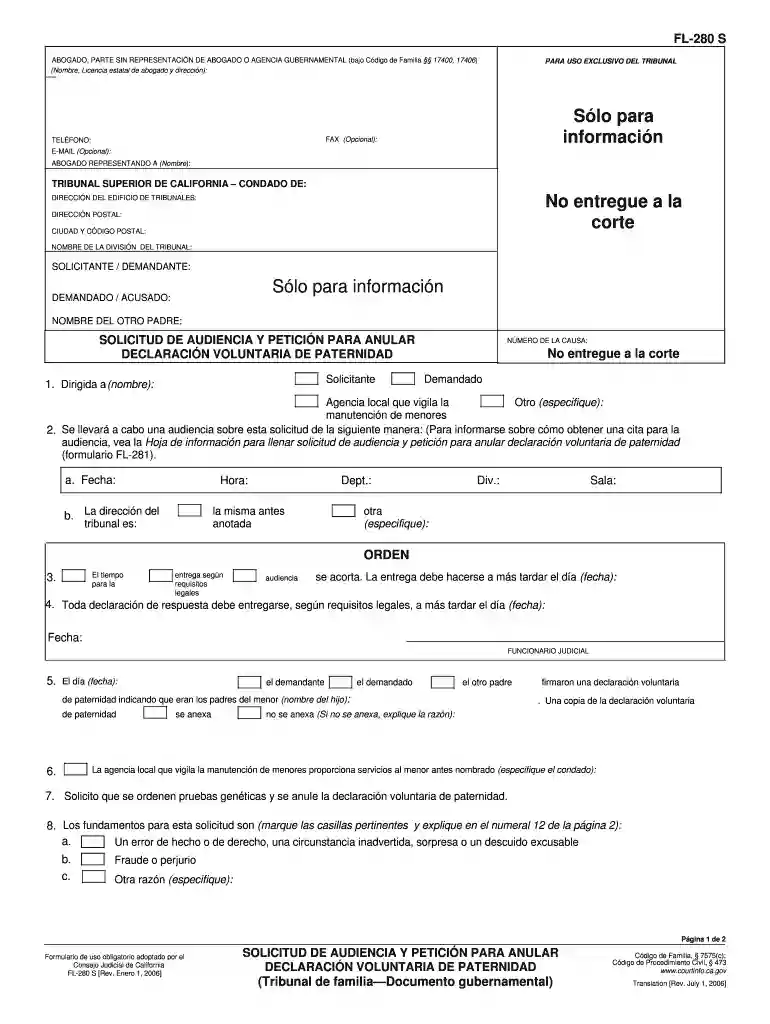
The FL-280 S is a legal form utilized in California family courts specifically designed for individuals seeking to request a hearing or annul a voluntary declaration of paternity. The form plays a critical role in family law proceedings, providing a structured approach to contesting a paternity claim when it is believed that the original declaration was made based on fraud, mistake, or error. It requires detailed information regarding the case, the parties involved, and the basis for annulment, making it essential for those seeking legal rectification in paternity matters.
To effectively use the FL-280 S, individuals need to follow a structured approach to ensure all necessary information is accurately provided:
Completing the FL-280 S involves several detailed steps:
The FL-280 S is crucial for those seeking to address inaccuracies or coercion in a voluntary paternity acknowledgment. It provides:
The form contains several key components:
California family law dictates specific guidelines for this form:
Filing the FL-280 S typically requires the following documents:
The FL-280 S can be submitted through several avenues:
Ensure you choose the method that best suits your convenience and the court's specific submission requirements.
We've got more versions of the fl280s form. Select the right fl280s version from the list and start editing it straight away!
At DocHub, your data security is our priority. We follow HIPAA, SOC2, GDPR, and other standards, so you can work on your documents with confidence.
Form Adopted for Mandatory Use Judicial Council of California FL-280 S. DE AUDIENCIA Y PETICIN PARA ANULAR (CANCELAR) ) la declaracin voluntaria de filiacin
The essay argues that legal and theological debates on usury influenced creditor behavior in 15th-century Florence. Corbinellis instructions to heirsRead more


