Oil Rendition - Kansas Department of Revenue 2026

Get Form
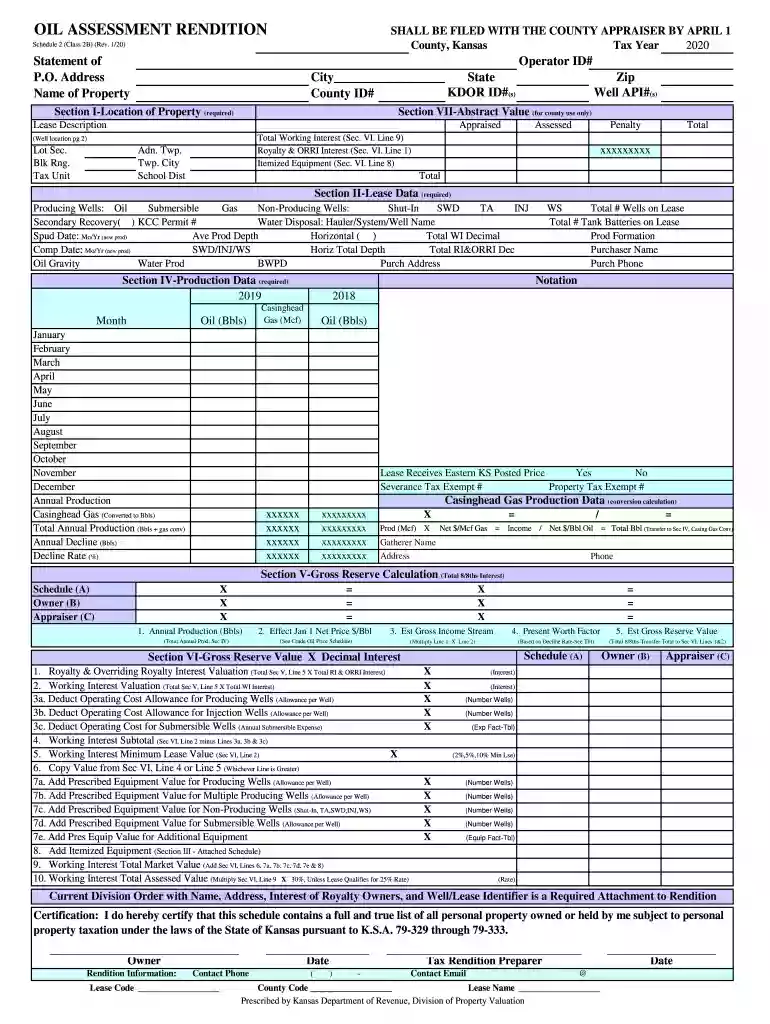
Oil Rendition - Kansas Department of Revenue Preview on Page 1

Here's how it works

01. Edit your form online
Type text, add images, blackout confidential details, add comments, highlights and more.

02. Sign it in a few clicks
Draw your signature, type it, upload its image, or use your mobile device as a signature pad.

03. Share your form with others
Send it via email, link, or fax. You can also download it, export it or print it out.

How to use or fill out Oil Rendition - Kansas Department of Revenue with our platform

Form edit decoration
9.5
Ease of Setup
DocHub User Ratings on G2
9.0
Ease of Use
DocHub User Ratings on G2
  1. Click ‘Get Form’ to open the Oil Rendition in the editor.
  2. Begin by filling out your personal information in the Statement section, including your name, address, and Operator ID#. Ensure all details are accurate for proper processing.
  3. In Section I, provide the location of your property. This includes entering the well API#s and other relevant identifiers. Make sure to double-check these entries as they are crucial for tax assessment.
  4. Proceed to Section II where you will input lease data. Specify whether the wells are producing or non-producing and include details such as spud date and average production depth.
  5. In Section IV, document your production data for each month of the previous year. Accurately report oil and gas production figures to ensure compliance with state regulations.
  6. Complete Sections V and VI by calculating gross reserve values based on your production data. Follow the provided formulas carefully to derive accurate valuations.
  7. Finally, review all sections for completeness before signing and dating the form. Attach any required additional pages as specified in the instructions.

Start using our platform today to streamline your Oil Rendition process for free!

See more Oil Rendition - Kansas Department of Revenue versions

We've got more versions of the Oil Rendition - Kansas Department of Revenue form. Select the right Oil Rendition - Kansas Department of Revenue version from the list and start editing it straight away!
Versions Form popularity Fillable & printable
2022 4.8 Satisfied (33 Votes)
2021 4.9 Satisfied (26 Votes)
2020 4.3 Satisfied (63 Votes)
2018 4.3 Satisfied (56 Votes)
2012 4.3 Satisfied (42 Votes)
be ready to get more

Complete this form in 5 minutes or less

Get form

Got questions?

We have answers to the most popular questions from our customers. If you can't find an answer to your question, please contact us.
Contact us
Nationally, Kansas ranks as the 11th largest oil producing state and 15th largest natural gas producing state. Over 2,100 licensed oil and gas operators produced nearly 27 million barrels of oil and over 127 billion cubic feet of natural gas this past year.
The rate of such tax shall be 8% of the gross value of all oil or gas severed from the earth or water in this state and subject to the tax imposed under this act.
Severance pay is a form of compensation and is considered earnings subject to the earnings tax.
Severance Pay FAQs Severance pay is taxed similarly to regular income. In the U.S., employers typically withhold federal income tax at a flat rate of 22% for severance payments. However, if the severance is combined with regular wages, it may be taxed at the individuals normal rate, which could be higher.
One common type of tax that states impose on oil and gas companies is severance tax. Severance taxes are imposed on the extraction, production, and sale of non-renewable resources to compensate for the severance (loss) of the resource from the earths surface.

Security and compliance

At DocHub, your data security is our priority. We follow HIPAA, SOC2, GDPR, and other standards, so you can work on your documents with confidence.

Learn more
ccpa2
pci-dss
gdpr-compliance
hipaa
soc-compliance

People also ask

Kansas Department of Revenue Department overview Jurisdiction Kansas Headquarters 915 S.W. Harrison Street Topeka, Kansas Department executive Mark Burghart, Secretary of Revenue Website .ksrevenue.gov1 more row

Related links