New jersey appeal 2026

Get Form
new jersey appeal Preview on Page 1

Here's how it works

01. Edit your form online
Type text, add images, blackout confidential details, add comments, highlights and more.

02. Sign it in a few clicks
Draw your signature, type it, upload its image, or use your mobile device as a signature pad.

03. Share your form with others
Send it via email, link, or fax. You can also download it, export it or print it out.

How to use or fill out New Jersey Appeal with our platform

Form edit decoration
9.5
Ease of Setup
DocHub User Ratings on G2
9.0
Ease of Use
DocHub User Ratings on G2
  1. Click ‘Get Form’ to open the New Jersey Appeal form in the editor.
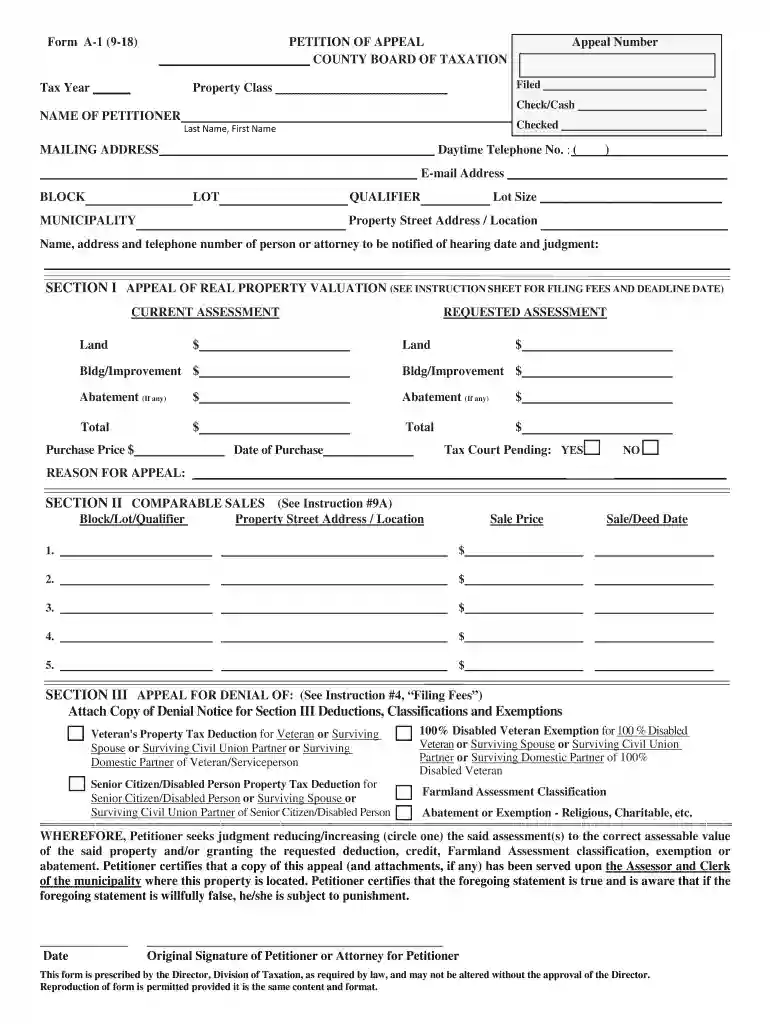
  2. Begin by filling in your personal information, including your name, mailing address, and contact details. Ensure accuracy as this information is crucial for communication regarding your appeal.
  3. In Section I, provide the current assessment and requested assessment values for both land and buildings. Be sure to include any abatements if applicable.
  4. For Section II, list up to five comparable sales that support your appeal. Include the block/lot number, property address, sale price, and sale date for each property.
  5. If appealing a denial of deductions or exemptions in Section III, attach a copy of the denial notice and check the appropriate boxes related to your appeal.
  6. Finally, review all entries for accuracy before signing and dating the form at the bottom. Ensure you have copies for yourself and that copies are sent to relevant parties as required.

Start using our platform today to streamline your New Jersey Appeal process for free!

See more new jersey appeal versions

We've got more versions of the new jersey appeal form. Select the right new jersey appeal version from the list and start editing it straight away!
Versions Form popularity Fillable & printable
2021 4.8 Satisfied (175 Votes)
2020 4.2 Satisfied (125 Votes)
2018 4.4 Satisfied (98 Votes)
2015 4.4 Satisfied (523 Votes)
2014 4.3 Satisfied (30 Votes)
2010 4 Satisfied (40 Votes)
be ready to get more

Complete this form in 5 minutes or less

Get form

Got questions?

We have answers to the most popular questions from our customers. If you can't find an answer to your question, please contact us.
Contact us
After a Decision is Issued Step 1: File the Notice of Appeal. Step 2: Pay the filing fee. Step 3: Determine if/when additional information must be provided to the appeals court as part of opening your case. Step 4: Order the trial transcripts. Step 5: Confirm that the record has been transferred to the appellate court.
An error of law is the strongest type of ground for appeal because the appellate court reviewing the case does not have to give any weight to what the trial court judge did. The appellate court will look at the law that was supposed to be applied and decide whether or not the trial court judge made a mistake.
Only about 10% of appeals are successful. You will have to balance the costs of the appeal versus the likelihood that you will win.
Appeals are successful only when theres a valid legal basis to challenge the trial courts decision. Simply being unhappy with the outcome isnt enough. Your attorney must demonstrate that a docHub error occurred during the trial and that it affected the outcome.
The process can take more than a year. The Appellate Division can only review your case if it has jurisdiction.

Security and compliance

At DocHub, your data security is our priority. We follow HIPAA, SOC2, GDPR, and other standards, so you can work on your documents with confidence.

Learn more
ccpa2
pci-dss
gdpr-compliance
hipaa
soc-compliance

People also ask

Do Appeals Usually Win? The appeals process is often not successful. You can still win an appeal with skilled representation. The appeals process is often a drawn-out, sometimes arduous journey in seeking an overturned conviction or a reduced sentence.
Having strong arguments is the best way to win. So how do you make sure your appeal is as strong as it can get? Well, the data shows you should call in an appellate attorney. Most litigators understand that a trial is predominantly about facts, whereas an appeal is predominantly about law.
Either side can appeal in a civil case, while only the defendant may appeal in a criminal case. The government can only appeal the sentence, not the guilty verdict. The odds of decision reversals are particularly lowabout one in four in civil cases.

Related links