




01. Edit your form online
Type text, add images, blackout confidential details, add comments, highlights and more.

Type text, add images, blackout confidential details, add comments, highlights and more.

Draw your signature, type it, upload its image, or use your mobile device as a signature pad.

Send it via email, link, or fax. You can also download it, export it or print it out.
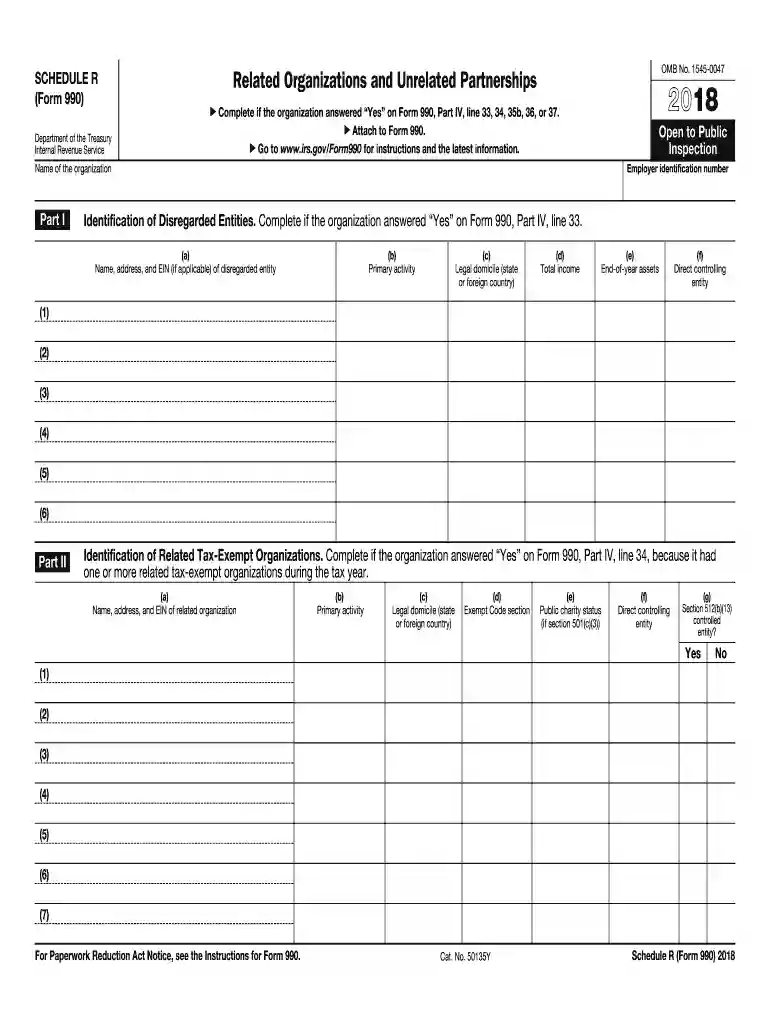
The 2018 Schedule R of Form 990 is a document that the IRS requires from organizations with related organizations or disregarded entities. This form is essential for tax-exempt entities to report their financial and organizational relationships annually. By providing details about dealings with related entities, the form ensures transparency and compliance with IRS regulations.
To effectively use the Schedule R form for 2018, organizations need to follow a structured process that aligns with IRS expectations. The form is an instrumental tool for delineating complex organizational relationships.
Gather Organizational Information: Collect detailed information about all entities connected to the primary organization. This includes tax ID numbers, names, and the nature of the relationship.
Complete Relevant Parts: Accurately fill out sections that pertain to the organization’s structure. Different parts address specific entity types.
Review and Validate Entries: Ensure all reported data is accurate and reflective of the most recent fiscal year. Cross-reference with internal and external transactional documents to prevent discrepancies.
A structured approach is crucial for correctly completing Schedule R:
Identify Related Entities: Begin by listing all entities related to the organization. This includes disregarded entities and other tax-exempt organizations.
Complete Parts I to IV: Each part focuses on different entity relationships, such as unrelated partnerships and income-producing entities.
Detail Transactions: Include a comprehensive record of transactions, specifying amounts, dates, and reasons for financial exchanges.
Review for Accuracy: Ensure there are no mistakes or omissions in the reported information. Make use of error-checking software if available.
Submit with Form 990: Attach the completed Schedule R to the Form 990 and submit it according to IRS guidelines.
The deadlines for filing Schedule R hinge on the overall deadlines for Form 990:
Non-profit organizations and other tax-exempt entities primarily use Schedule R to fulfill their IRS obligations. These may include:
Charities: Organizations with multiple operational branches or collaborations often report using this schedule.
Educational Institutions: Universities and colleges that have various related bodies.
Religious Organizations: Groups with complex structures where certain branches or operations might be legally separate yet operationally unified.


The IRS mandates transparency for organizations with complex relationships through Schedule R compliance. Following IRS guidelines ensures:
Understanding specific terms is crucial:
Disregarded Entity: An entity that is separate for legal purposes but not for tax purposes in relation to the parent body.
Related Organizations: Entities such as partnerships or corporations with substantial control or common management.
Transactions: Financial or operational interactions between the entities, requiring detailed reporting to showcase accountability.
Failure to comply with Schedule R requirements can lead to significant penalties:
Monetary Fines: Penalties may be levied for incomplete or inaccurate filing.
Revocation of Tax-Exempt Status: Consistent non-compliance can lead to losing tax-exempt privileges.
Audits: Increased scrutiny and potential audits by the IRS may occur, disrupting normal operations.
We've got more versions of the 2018 990 schedule r form pdf form. Select the right 2018 990 schedule r form pdf version from the list and start editing it straight away!
At DocHub, your data security is our priority. We follow HIPAA, SOC2, GDPR, and other standards, so you can work on your documents with confidence.
Schedule R (Form 990) 2019. Page. Complete if the organization answered Yes on Form 990, Part IV, line 34, 35b, or 36. Complete line 1 if any entity is listedRead more
1. During the tax year, did the organization engage in any of the following transactions with one or more related organizations listed in Parts IIIV?Read more


