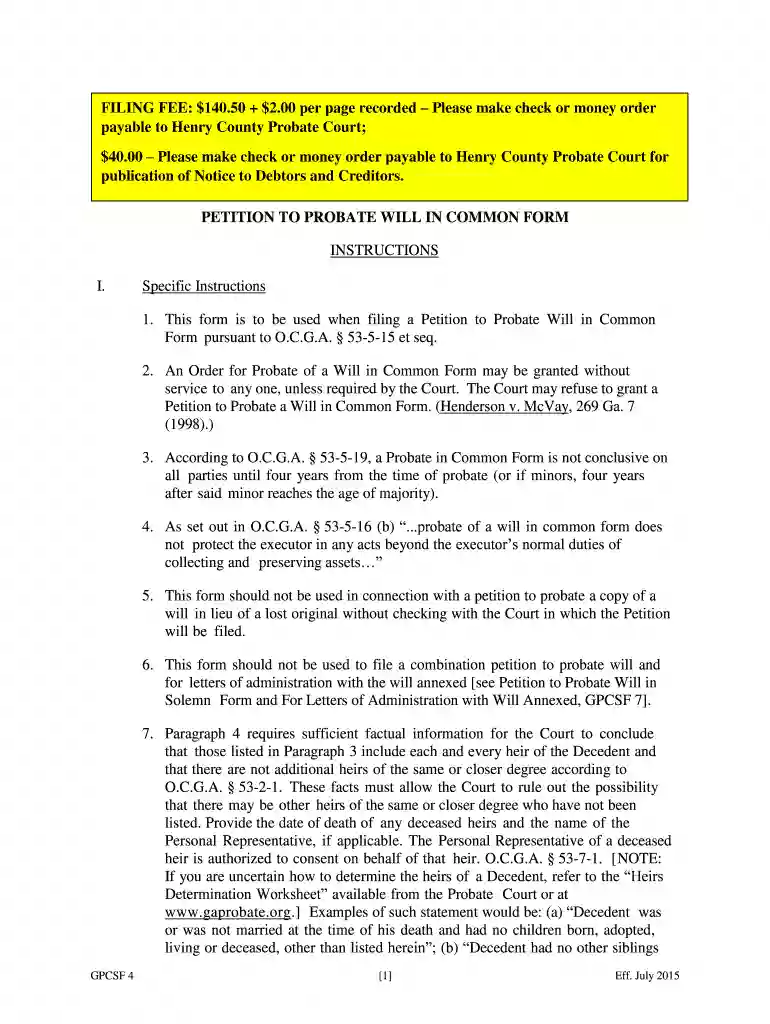
Probate will form 2015-2026

Get Form
probate will form 2015 Preview on Page 1

Here's how it works

01. Edit your form online
Type text, add images, blackout confidential details, add comments, highlights and more.

02. Sign it in a few clicks
Draw your signature, type it, upload its image, or use your mobile device as a signature pad.

03. Share your form with others
Send it via email, link, or fax. You can also download it, export it or print it out.

How to use or fill out probate will form 2015 with our platform

Form edit decoration
9.5
Ease of Setup
DocHub User Ratings on G2
9.0
Ease of Use
DocHub User Ratings on G2
  1. Click ‘Get Form’ to open the probate will form 2015 in the editor.
  2. Begin by entering the decedent's full name and address in the designated fields. Ensure accuracy as this information is crucial for legal purposes.
  3. In Paragraph 2, provide details about the Last Will and Testament, including its date and any codicils. This section is essential for establishing the validity of the will.
  4. List all heirs in Paragraph 3, including their ages and relationships to the decedent. This ensures that all potential beneficiaries are accounted for.
  5. In Paragraph 4, supply sufficient factual information regarding heirs, including any deceased heirs and their personal representatives. This helps clarify inheritance rights.
  6. Complete any additional sections as required, such as indicating if there are pending proceedings related to other wills or estates.
  7. Finally, review all entries for accuracy before signing. Use our platform’s features to save your progress and ensure everything is correctly filled out.

Start using our platform today to fill out your probate will form easily and for free!

See more probate will form 2015 versions

We've got more versions of the probate will form 2015 form. Select the right probate will form 2015 version from the list and start editing it straight away!
Versions Form popularity Fillable & printable
2016 4.8 Satisfied (60 Votes)
2015 4.4 Satisfied (1673 Votes)
2013 4.4 Satisfied (38 Votes)
be ready to get more

Complete this form in 5 minutes or less

Get form

Got questions?

We have answers to the most popular questions from our customers. If you can't find an answer to your question, please contact us.
Contact us
Probate Checklist - What to Gather What to Bring Death Certificates. Last Will and Testament. Revocable Living Trust Documents. Beneficiary Designations. Contact Information for Heirs and Beneficiaries. Pre Nuptial or Post Nuptial Agreements. Federal and State Income and Gift Tax Returns for the last three years.
A variety of things will happen if you dont file probate in Florida. Some of the most notable things that will occur are as follows: Your will cannot take effect, preventing its wishes from being enacted. Your assets will not go to the people you would like them to go to, as your will cannot take effect.
ALTHOUGH YOU ARE NOT REQUIRED TO HAVE AN ATTORNEY FOR CERTAIN PROBATE PROCEEDINGS, ONLY AN ATTORNEY CAN GIVE LEGAL ADVICE. IF YOU CHOOSE TO PROCEED WITHOUT AN ATTORNEY, AT ANY TIME IN YOUR CASE YOU MAY OPT TO HIRE ONE.
As long as the deceased person has designated a beneficiary, the money in the account may be transferred to the named person without probate.
If you are named in someones will as an executor, you may have to apply for probate. This is a legal document which gives you the authority to share out the estate of the person who has died according to the instructions in the will. You do not always need probate to be able to deal with the estate.

Security and compliance

At DocHub, your data security is our priority. We follow HIPAA, SOC2, GDPR, and other standards, so you can work on your documents with confidence.

Learn more
ccpa2
pci-dss
gdpr-compliance
hipaa
soc-compliance
be ready to get more

Complete this form in 5 minutes or less

Get form

People also ask

Formal Probate Administration: This is the full probate process of appointing the personal representative, dealing with creditors, publishing in the newspaper, etc. This is done when assets exceed $75,000, the estate has debts, heirs do not agree, there are unknown assets, and more.

Related links