






Definition and Meaning of the Free Trader Agreement in North Carolina
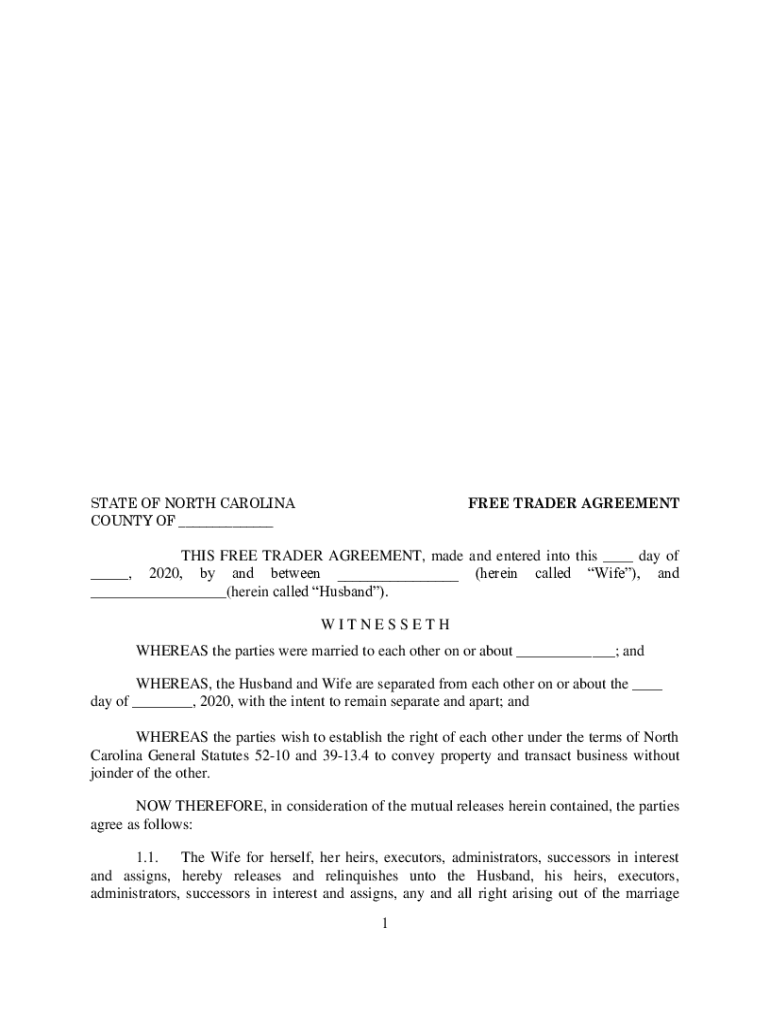
The "Free Trader Agreement" serves as a legal instrument in North Carolina, primarily designed for married couples who seek to separate their property management rights. Under this agreement, each spouse is empowered to manage, acquire, and convey property independently. This autonomy is crucial in situations such as separation or divorce, allowing both parties to make individual financial decisions without requiring permission from the other. The agreement must align with the North Carolina General Statutes to ensure its validity and enforceability.
Key features of the Free Trader Agreement include:
- Mutual property rights release: Both spouses release claims over each other's property, enhancing financial independence.
- Statutory compliance: The agreement must adhere to local laws to avoid potential disputes in court.
- Flexibility in transactions: Each spouse can buy, sell, or transfer property without needing the other's consent.
Handling the main components of this agreement carefully is essential, as misunderstandings regarding property rights can lead to legal conflicts in the future.
How to Use the Free Trader Agreement in North Carolina
Effectively utilizing the Free Trader Agreement involves several steps, ensuring all parties understand its implications:
- Consult legal counsel: Before drafting or signing the agreement, both spouses should seek advice from a qualified attorney to fully comprehend their rights and obligations.
- Draft the agreement: The document should clearly state that both parties consent to the terms and include pertinent details such as property descriptions and individual responsibilities.
- Sign and notarize: Both parties must sign the agreement in the presence of a notary public, which adds an extra layer of legal validity.
- File the agreement: While not mandatory, filing the agreement with the county register of deeds can help protect it from future disputes.
This structured approach ensures that both spouses have a clear understanding of their rights after executing the Free Trader Agreement.
Important Terms Related to the Free Trader Agreement
Understanding specific terminology associated with the Free Trader Agreement is vital for effective communication and compliance:
- Spousal consent: Refers to the mutual agreement between spouses concerning the management of property and financial decision-making.
- Independent management: The ability of each spouse to make decisions regarding property without the requirement for the other spouse's approval.
- Property division: The process of legally separating marital assets in the event of a divorce or separation, which the Free Trader Agreement can streamline.
Familiarity with these terms aids parties in comprehending their rights and responsibilities under the agreement.
Steps to Complete the Free Trader Agreement
Completing the Free Trader Agreement involves a systematic approach to ensure legality and clarity:
- Gather necessary documents: Collect information related to the property owned jointly and individually, along with any existing financial records.
- Draft the agreement clearly: Outline each spouse's rights and responsibilities in managing their separate properties. Specify properties that are considered separate versus joint.
- Include signatures and dates: Ensure both parties sign and date the agreement in the presence of a notary to validate it legally.
- Record the agreement if desired: Though not legally required, recording the agreement can serve as a protective measure against future claims of ownership or rights.
By following these steps, couples can create a comprehensive and enforceable Free Trader Agreement.
Who Typically Uses the Free Trader Agreement in North Carolina
The Free Trader Agreement is commonly utilized by:
- Couples undergoing separation: Those planning to separate may use the agreement to delineate property rights clearly.
- Divorcing spouses: This agreement assists in the division of assets in a divorce situation, clarifying individual property ownership.
- Financially independent spouses: Couples wishing to maintain independence in property management use this tool to avoid complications arising from joint ownership.
This agreement serves as a critical tool for individuals in diverse marital situations, reinforcing their financial autonomy.


Legal Uses of the Free Trader Agreement in North Carolina
The Free Trader Agreement holds specific legal significance in North Carolina:
- Asset protection: It protects individual property rights, especially during divorce proceedings, minimizing disputes related to asset division.
- Legal framework: It lays down a clear legal framework that both parties can refer to in case of future conflicts, ensuring accountability.
- Court recognition: Courts in North Carolina uphold Free Trader Agreements provided they comply with state laws, enhancing their enforceability.
Understanding the legal uses of this agreement can significantly influence financial and property-related decisions for couples in North Carolina.
State-Specific Rules for the Free Trader Agreement
North Carolina has distinct rules governing the Free Trader Agreement, which include:
- Written form requirement: The agreement must be documented in writing to be enforceable.
- Notary requirement: To ensure authenticity, both parties must sign the agreement in the presence of a notary public.
- Adherence to state laws: The agreement must conform to the provisions outlined within the North Carolina General Statutes to withstand legal scrutiny.
Awareness of these state-specific regulations is critical for couples seeking to utilize the Free Trader Agreement effectively.
Examples of Using the Free Trader Agreement in North Carolina
Practical examples of Free Trader Agreement usage include scenarios such as:
- Separation transactions: A couple decides to separate, executing a Free Trader Agreement that grants them the right to sell personal properties independently. This streamlines their individual financial responsibilities.
- Pre-marital planning: Engaged couples may establish a Free Trader Agreement before marriage to clarify that any property acquired independently during the marriage remains the sole property of the individual spouse.
- Financial independence post-divorce: A divorced individual uses the agreement to retain control over properties acquired during marriage without disputes over joint ownership.
Such examples illustrate the practical applications of the Free Trader Agreement in North Carolina, highlighting its versatility and importance in various circumstances.