Jury instruction evidence 2026

Get Form
jury instruction evidence Preview on Page 1

Here's how it works

01. Edit your form online
Type text, add images, blackout confidential details, add comments, highlights and more.
02. Sign it in a few clicks
Draw your signature, type it, upload its image, or use your mobile device as a signature pad.
03. Share your form with others
Send it via email, link, or fax. You can also download it, export it or print it out.

How to use or fill out jury instruction evidence with our platform

Form edit decoration
9.5
Ease of Setup
DocHub User Ratings on G2
9.0
Ease of Use
DocHub User Ratings on G2
  1. Click ‘Get Form’ to open the jury instruction evidence document in the editor.
  2. Begin by entering the case details at the top of the form, including the names of the plaintiff and defendant, as well as the case number. This information is crucial for identifying your specific case.
  3. Next, review the jury instruction section carefully. Here, you will find key legal principles that guide jurors in their decision-making process. Ensure that all relevant instructions are included and clearly stated.
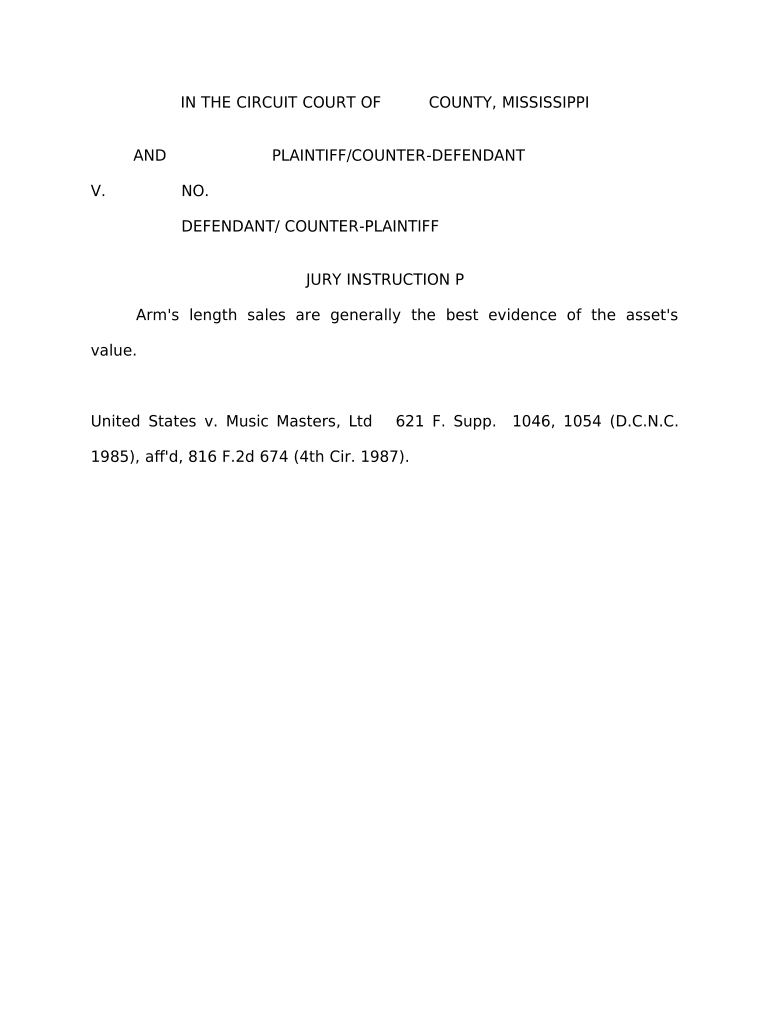
  4. Incorporate any citations or references to case law, such as 'United States v. Music Masters, Ltd', ensuring they are accurately formatted and positioned within the document.
  5. Finally, save your changes and utilize our platform’s sharing features to distribute the completed form to relevant parties for review or signature.

Start using our platform today for free to streamline your jury instruction evidence editing!

be ready to get more

Complete this form in 5 minutes or less

Get form

Got questions?

We have answers to the most popular questions from our customers. If you can't find an answer to your question, please contact us.
Contact us

Microsoft Word doesn’t have signing tools to create legitimate electronic signatures and enforceable forms. Luckily, DocHub is an online eSignature-compliant editor that supports various document formats, including .doc files. Sign in to your account and add the Word edition of your jury instruction evidence from your device and cloud, or URL - our editor will automatically turn it into an editable PDF. Make all required alterations in your form and click Sign to create your own legally-binding eSignature. You will find four signing methods from which to choose.

In case your go-to email service is Gmail, you can easily incorporate your DocHub editor into your work. Edit your jury instruction evidence with DocHub instruments and attach it to your drafts in Gmail. See how effortless it can be to exchange papers and collaborate with a swift PDF editing solution at hand.

Jury instructions are instructions for jury deliberation that are written by the judge and given to the jury. At trial, jury deliberation occurs after evidence is presented and closing arguments are made.
The judge reads the instructions to the jury. This is commonly referred to as the judges charge to the jury. In giving the instructions, the judge will state the issues in the case and define any terms or words that may not be familiar to the jurors.
All jurors should deliberate and vote on each issue to be decided in the case. When it is time to count votes, it is the presiding jurors duty to see that this is done properly. In a civil case, the judge will tell you how many jurors must agree in order to docHub a verdict.

Security and compliance

At DocHub, your data security is our priority. We follow HIPAA, SOC2, GDPR, and other standards, so you can work on your documents with confidence.

Learn more
ccpa2
pci-dss
gdpr-compliance
hipaa
soc-compliance

People also ask

Jury instructions are an important component of a trial because they focus the jury on the specific issues and laws applicable to the case being tried. Jury instructions should identify the issues the jury will need to decide and help them understand the legal principles of the case.
The judge will advise the jury that it is the sole judge of the facts and of the credibility (believability) of witnesses. He or she will note that the jurors are to base their conclusions on the evidence as presented in the trial, and that the opening and closing arguments of the lawyers are not evidence.
The circumstantial evidence jury instruction tells the jury that in order to convict a defendant based on circumstantial evidence, the jury must not only find that the circumstantial evidence is consistent with defendants guilt, but also that the evidence is not reasonably consistent with innocence.
Questions, statements, objections, and arguments by the lawyers are not evidence. The lawyers are not witnesses. Although you must consider a lawyers questions to understand the answers of a witness, the lawyers questions are not evidence.
The law is clear in California and in every other jurisdiction: Both direct evidence and circumstantial evidence are acceptable as a means of proof, according to the standards California lays out for instructions to juries. Neither is entitled to any greater weight than the other.

Related links