Landlord rent during 2026

Get Form
landlord rent during Preview on Page 1

Here's how it works

01. Edit your form online
Type text, add images, blackout confidential details, add comments, highlights and more.
02. Sign it in a few clicks
Draw your signature, type it, upload its image, or use your mobile device as a signature pad.
03. Share your form with others
Send it via email, link, or fax. You can also download it, export it or print it out.

How to use or fill out landlord rent during with our platform

Form edit decoration
9.5
Ease of Setup
DocHub User Ratings on G2
9.0
Ease of Use
DocHub User Ratings on G2
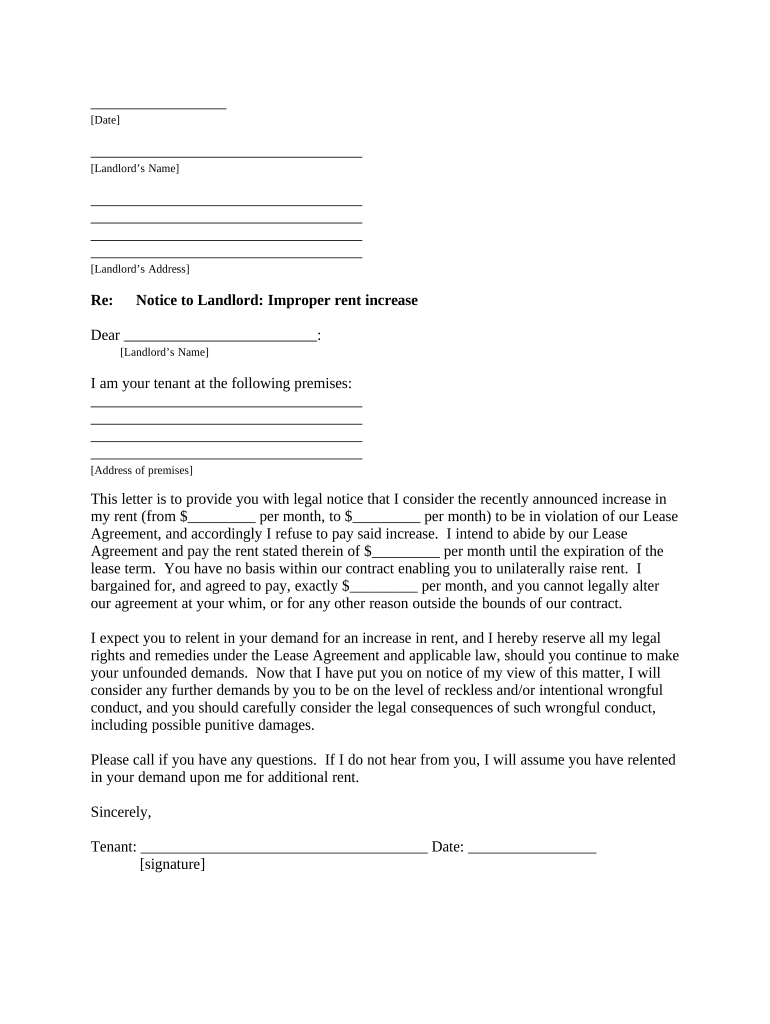
  1. Click ‘Get Form’ to open the landlord rent during document in the editor.
  2. Begin by entering the date at the top of the form. This is essential for record-keeping and establishing a timeline.
  3. Fill in your name and address as the tenant. This personalizes the notice and ensures clarity regarding who is sending it.
  4. In the body of the letter, specify your landlord's name and address. Clearly state your position on the rent increase, including both the previous and new amounts.
  5. Reiterate your commitment to pay the original agreed-upon rent amount until the lease expires. This reinforces your stance against any unauthorized increases.
  6. Sign and date at the bottom of the form to validate your notice. Ensure that you also complete the proof of delivery section, indicating how you delivered this notice to your landlord.

Start using our platform today for free to streamline your document editing and signing process!

be ready to get more

Complete this form in 5 minutes or less

Get form

Got questions?

We have answers to the most popular questions from our customers. If you can't find an answer to your question, please contact us.
Contact us
This notice must be in writing and must arrive to the tenant at least 30 days before their move-out date. The written notice must also include a specific move-out date for when the tenant must be out of the property and their tenancy has ended.
Effective January 1, 2025, the law specifies that landlords cannot terminate a tenancy, refuse to renew a lease, increase rent, or take other adverse actions if a tenant has exercised certain rights.
Illinois Rent Control Laws: An Overview The most important thing to know is that while landlords can raise rent without caps in Illinois, some cities such as Chicago require you to provide ample notice. Currently, there is no rent increase limit for the City of Chicago and Cook County.
Here are the highlight of the changes: Landlords cant require tenants to pay rent only through electronic means, so tenants have more payment options. Landlords must give written receipts for rent and security deposits, so theres more transparency and less disputes.
If the tenant fails to pay rent when due, the landlord must provide written notice to the tenant and the tenant has 5 days to pay the rent. If after 5 days, the tenant fails to pay rent, the landlord may terminate the lease by filing an action in the Circuit Court.

Security and compliance

At DocHub, your data security is our priority. We follow HIPAA, SOC2, GDPR, and other standards, so you can work on your documents with confidence.

Learn more
ccpa2
pci-dss
gdpr-compliance
hipaa
soc-compliance

People also ask

If the reason is for nonpayment, your landlord must give you five days to pay the rent. If the eviction is for violating a provision in the lease, your landlord must give you a 10-day notice. If you remain in the rental unit after the eviction notice, your landlord can file a lawsuit to evict you.
With this new legislation, landlords can no longer require tenants to pay through electronic methods and must allow tenants to make their rental payments by delivering either a paper check or cash to the landlord. Section 3.5 of the LAT Act will apply to leases or agreements executed after January 1, 2025.
The eviction stops any need to pay rent, and wipes out unpaid back rent. Instead, unpaid back rent up through the date of the trial will be converted to a Judgment Amount, along with any legal costs incurred by your former landlord for the eviction.

Related links