




01. Edit your 2017 940 online
Type text, add images, blackout confidential details, add comments, highlights and more.

Type text, add images, blackout confidential details, add comments, highlights and more.

Draw your signature, type it, upload its image, or use your mobile device as a signature pad.

Send 2017 form 940 via email, link, or fax. You can also download it, export it or print it out.
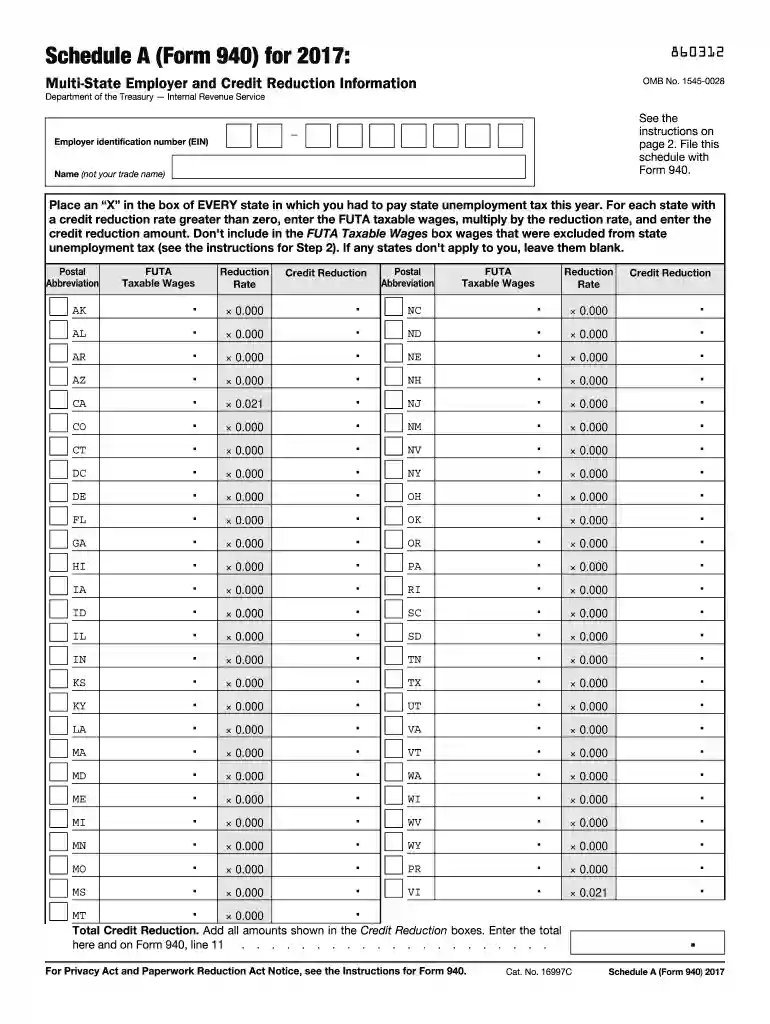
IRS Form 940 Schedule A for 2017 is designed to provide multi-state employer and credit reduction information needed when filing Form 940. Employers who operate in more than one state or in states with a credit reduction face specific guidelines. This document aids in reporting state unemployment taxes paid, offering a structured method to calculate credit reductions based on the Federal Unemployment Tax Act (FUTA) taxable wages for states with a credit reduction rate.
Adhering to precise deadlines is crucial:
Non-compliance results in significant repercussions, including:
This form is primarily employed by:
Filing IRS Form 940 Schedule A ensures employers remain compliant with federal and state unemployment tax obligations. Key legal requirements ensure:
Employers can streamline the filing process through:
Certain states, classified with credit reductions, impose unique adjustments in the calculation. In 2017, employers should evaluate:
Preparation demands gathering the following documentation:
Accurate and thorough completion of IRS Form 940 Schedule A is essential for compliance and efficient business operation within the guidelines set forth by the IRS for the year 2017.
We've got more versions of the 2017 940 form. Select the right 2017 940 version from the list and start editing it straight away!
| Versions | Form popularity | Fillable & printable |
|---|---|---|
| 2025 | 4.4 Satisfied (56 Votes) | |
| 2024 | 4.4 Satisfied (49 Votes) | |
| 2023 | 2.9 Satisfied (88 Votes) | |
| 2022 | 4.4 Satisfied (43 Votes) | |
| 2021 | 4.8 Satisfied (160 Votes) | |
| 2020 | 3.9 Satisfied (49 Votes) | |
| 2019 | 4.3 Satisfied (134 Votes) | |
| 2018 | 4 Satisfied (65 Votes) | |
| 2017 | 4.4 Satisfied (137 Votes) | |
| 2016 | 4.4 Satisfied (90 Votes) | |
| 2015 | 4 Satisfied (22 Votes) | |
| 2014 | 4 Satisfied (35 Votes) | |
| 2014 | 4.9 Satisfied (44 Votes) | |
| 2013 | 4 Satisfied (28 Votes) | |
| 2011 | 4.4 Satisfied (45 Votes) |
At DocHub, your data security is our priority. We follow HIPAA, SOC2, GDPR, and other standards, so you can work on your documents with confidence.
Because you paid wages in a state that is subject to credit reduction, you must complete Schedule A and file it with. Form 940. Total payments to all employeesRead more
May 2, 2017 Do not use these forms to report wages subject to U.S. income tax withholding. Instead, use Form W-2 to show U.S. income tax withheld. TreatmentRead more
Web form 940 is the official document that employers submit to the irs to report their annual futa tax obligations. Its based on the federal. Web generalRead more


