Special Durable Power of Attorney for Bank Account Matters - New Hampshire 2026

Get Form
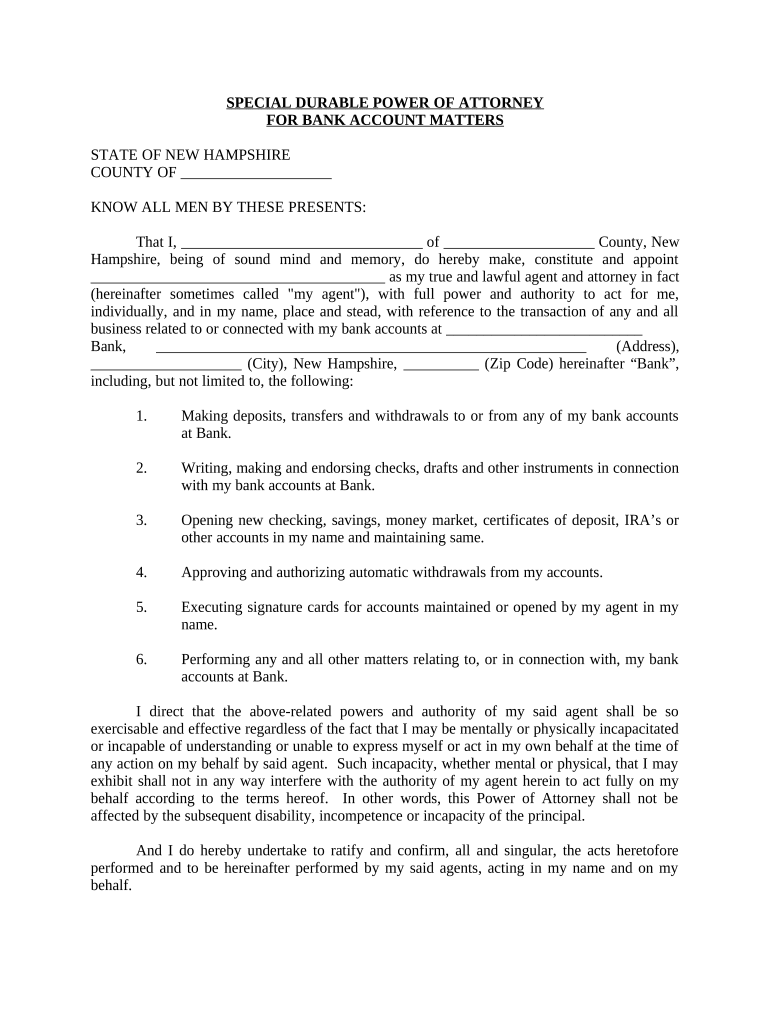
Special Durable Power of Attorney for Bank Account Matters - New Hampshire Preview on Page 1

Here's how it works

01. Edit your form online
Type text, add images, blackout confidential details, add comments, highlights and more.
02. Sign it in a few clicks
Draw your signature, type it, upload its image, or use your mobile device as a signature pad.
03. Share your form with others
Send it via email, link, or fax. You can also download it, export it or print it out.

How to use or fill out Special Durable Power of Attorney for Bank Account Matters - New Hampshire with our platform

Form edit decoration
9.5
Ease of Setup
DocHub User Ratings on G2
9.0
Ease of Use
DocHub User Ratings on G2
  1. Click ‘Get Form’ to open it in the editor.
  2. Begin by filling in your name and county at the top of the form. This identifies you as the principal granting authority.
  3. Next, designate your agent by entering their name. This person will have the authority to manage your bank accounts.
  4. Provide the name and address of your bank, ensuring accuracy for seamless transactions.
  5. Review the powers granted to your agent, which include making deposits, withdrawals, and managing accounts. Ensure these align with your intentions.
  6. Sign and date the document at the bottom. Remember to have two witnesses sign as well, confirming they are not related to you or entitled to your estate.
  7. If required, complete the notary section to validate the document further.

Start using our platform today for free to complete your Special Durable Power of Attorney efficiently!

be ready to get more

Complete this form in 5 minutes or less

Get form

Got questions?

We have answers to the most popular questions from our customers. If you can't find an answer to your question, please contact us.
Contact us
What a power of attorney cant do Change a principals will. Break their fiduciary duty to act in the principals best interests. Make decisions on behalf of the principal after their death. (POA ends with the death of the principal. Change or transfer POA to someone else.
The biggest drawback to a power of attorney is that an agent may act in a way that the principal would disapprove of. This may be unintentional if they are ignorant of the principals wishes, or it may be intentional because theyre acting in bad faith.
A person with Power of Attorney for their parents cant actually add the POA to their bank accounts. However, they may change bank accounts to be jointly owned. There are some pros and cons of doing this, as discussed in the article POAs vs. joint ownership from NWI.com.
Generally, banks are obligated to honor a valid durable power of attorney. However, financial institutions can still refuse the document for policy or protective reasons. A banks right to refuse a power of attorney is grounded in its unique position to prevent fraud and elder abuse.
Ineffective upon death: A durable power of attorney will only outline who has the authority to make decisions on your behalf during your lifetime. If you pass away, they are no longer effective. As such, they do not replace a will or trust.

Security and compliance

At DocHub, your data security is our priority. We follow HIPAA, SOC2, GDPR, and other standards, so you can work on your documents with confidence.

Learn more
ccpa2
pci-dss
gdpr-compliance
hipaa
soc-compliance

People also ask

The POA cannot transfer the responsibility to another Agent at any time. The POA cannot make any legal or financial decisions after the death of the Principal, at which point the Executor of the Estate would take over. The POA cannot distribute inheritances or transfer assets after the death of the Principal.
Durable Powers of Attorney are important documents in a California estate plan. They are used when someone is no longer willing or able to handle their finances and want the agent named in the durable power of attorney (who is usually a close family member or friend) to take over their banking and finances.
Because a power of attorney automatically terminates upon the death of the principal, there are no circumstances under which an agent could legally withdraw money from the principals financial accounts after their death.

Related links