Complex Will with Credit Shelter Marital Trust for Large Estates - North Dakota 2026

Get Form
Complex Will with Credit Shelter Marital Trust for Large Estates - North Dakota Preview on Page 1

Here's how it works

01. Edit your form online
Type text, add images, blackout confidential details, add comments, highlights and more.
02. Sign it in a few clicks
Draw your signature, type it, upload its image, or use your mobile device as a signature pad.
03. Share your form with others
Send it via email, link, or fax. You can also download it, export it or print it out.

How to use or fill out Complex Will with Credit Shelter Marital Trust for Large Estates - North Dakota

Form edit decoration
9.5
Ease of Setup
DocHub User Ratings on G2
9.0
Ease of Use
DocHub User Ratings on G2
  1. Click ‘Get Form’ to open it in the editor.
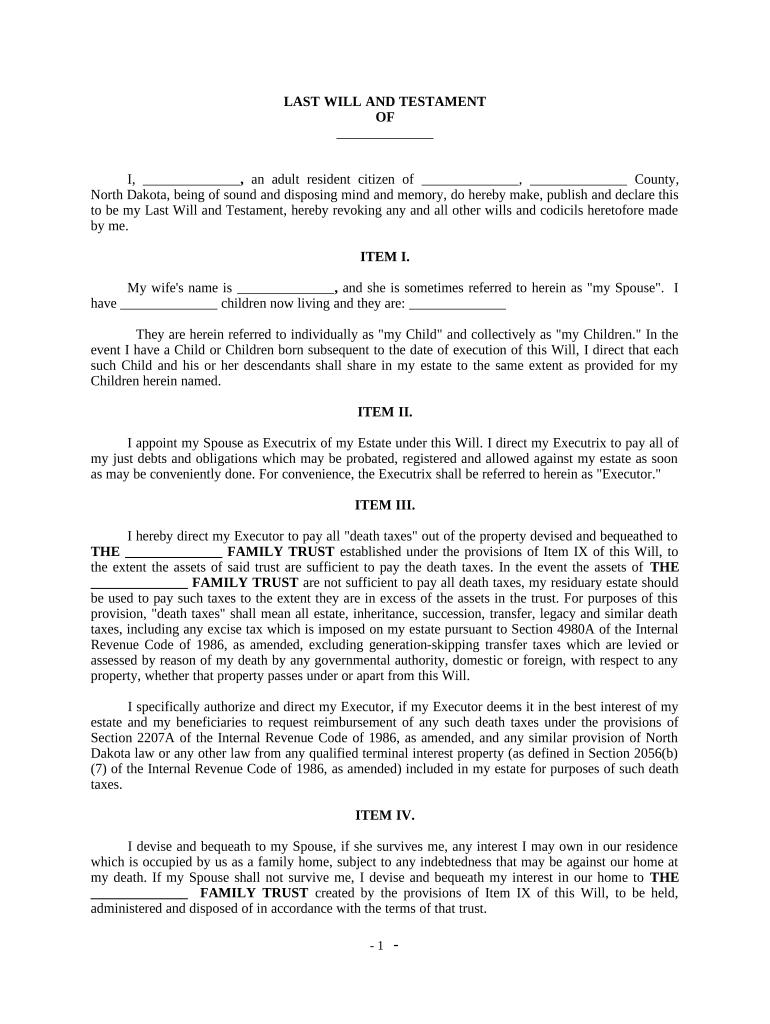
  2. Begin by entering your full name and address in the designated fields at the top of the document. This identifies you as the testator.
  3. In Item I, provide your spouse's name and list your children. Ensure all names are spelled correctly for legal accuracy.
  4. For Item II, appoint your spouse as the Executor. If you have a successor Executor, include their name here as well.
  5. Proceed to Item III where you will specify how death taxes should be handled. Clearly indicate if they should be paid from the family trust or your residuary estate.
  6. Continue filling out Items IV through IX, detailing specific bequests and establishing the family trust provisions. Be precise about asset distribution to avoid future disputes.
  7. Finally, review all entries for accuracy before signing. Ensure witnesses sign in accordance with state requirements in the designated areas at the end of the document.

Start using our platform today to easily complete your Complex Will with Credit Shelter Marital Trust for Large Estates - North Dakota!

be ready to get more

Complete this form in 5 minutes or less

Get form

Got questions?

We have answers to the most popular questions from our customers. If you can't find an answer to your question, please contact us.
Contact us
When the surviving spouse dies, any remaining principal can be distributed to children or remain in trust for their benefit, as you direct. Even though the surviving spouse has access to income (and principal, if needed), the assets in the credit shelter trust are not considered part of the survivors taxable estate.
One of the disadvantages of a credit shelter trust is that it does not give the surviving spouse immediate access or full control over the trust assets. Instead, the spouse can generally receive income from the trust and may be allowed to use the trust principal to pay for health, education, and maintenance as needed.
Types of Trusts To Minimize Taxes Irrevocable trust: An irrevocable trust is a trust that you cant terminate or change. Grantor retained annuity trust (GRAT): A GRAT is a type of irrevocable trust. Intentionally defective grantor trust (IDGT): An IDGT is another type of irrevocable trust.
Additionally, assets that are placed in a credit shelter trust receive a one-time step-up in basis at the time the trust is funded.
No additional tax return: Once a credit shelter trust is funded, the trustee of that trust will have to file a fiduciary income tax return (Form 1041) every year.

Security and compliance

At DocHub, your data security is our priority. We follow HIPAA, SOC2, GDPR, and other standards, so you can work on your documents with confidence.

Learn more
ccpa2
pci-dss
gdpr-compliance
hipaa
soc-compliance

People also ask

One such drawback is their irrevocable nature; once established, the terms are generally set and cannot be easily altered. The surviving spouses estate may also be subject to increased estate taxes upon their death, depending on the trusts structure and the value of the assets.
When you pass away, the Trustee you have named in the Credit Shelter Trust funds the Trust. This can include any amount up to the lifetime federal estate tax limits (as of 2021, that threshold was raised to $11.7m per person or $23.4m per couple - up from the 2020 limit of $11.58m and $23.16m, respectively).

Related links