Minnesota affidavit form 2026

Get Form
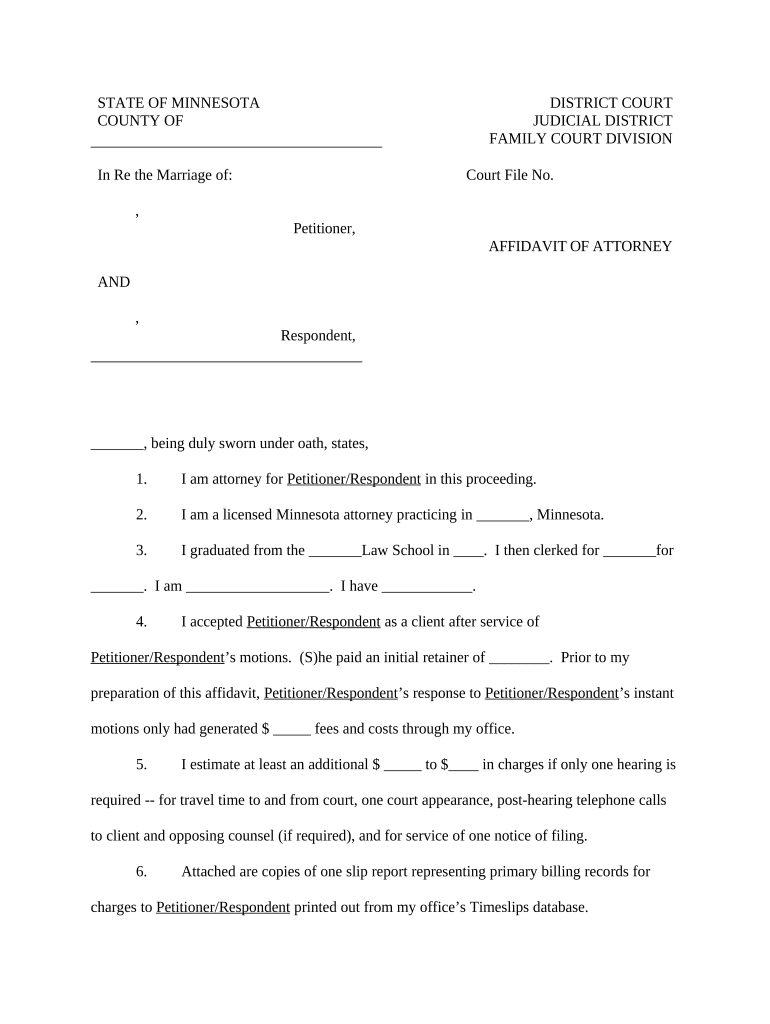
minnesota affidavit form Preview on Page 1

Here's how it works

01. Edit your form online
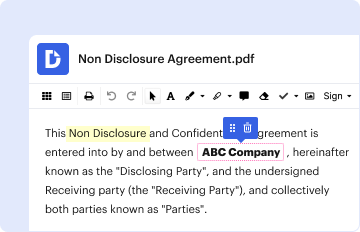
Type text, add images, blackout confidential details, add comments, highlights and more.
02. Sign it in a few clicks
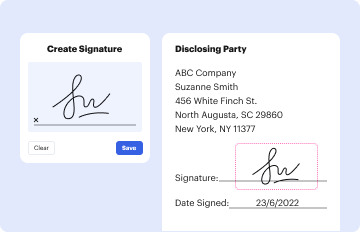
Draw your signature, type it, upload its image, or use your mobile device as a signature pad.
03. Share your form with others
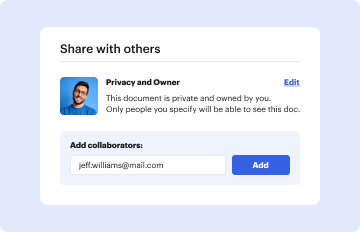
Send it via email, link, or fax. You can also download it, export it or print it out.

How to use or fill out Minnesota Affidavit Form with DocHub

Form edit decoration
9.5
Ease of Setup
DocHub User Ratings on G2
9.0
Ease of Use
DocHub User Ratings on G2
  1. Click ‘Get Form’ to open the Minnesota Affidavit form in our editor.
  2. Begin by filling in the 'Court File No.' at the top of the form. This number is essential for identifying your case.
  3. In the section labeled 'Petitioner' and 'Respondent', enter the names of both parties involved in the case.
  4. Complete the attorney information fields, including your name, license status, and practice location. This establishes your credentials.
  5. Detail your educational background and previous experience as required in sections 3 and 4. Be thorough to ensure clarity.
  6. Estimate any additional charges you anticipate for future services in section 5, providing a clear breakdown of costs.
  7. Attach any necessary documents, such as billing records, using our platform’s upload feature for easy integration.
  8. Finally, sign and date the affidavit at the bottom before submitting it for notarization.

Start using our platform today to fill out your Minnesota Affidavit form online for free!

be ready to get more

Complete this form in 5 minutes or less

Get form

Got questions?

We have answers to the most popular questions from our customers. If you can't find an answer to your question, please contact us.
Contact us
Affidavits are often used in support of certain actions filed in both state and federal courts. An Affidavit, typically signed by the client representative, must be docHubd in their presence by a notary.
Affidavits often require notarization to enhance their legal validity and credibility. While not always mandatory, notarization adds docHub weight to an affidavit in legal proceedings. It verifies the identity of the signer and confirms that they willingly signed the document under oath.
The following are six critical sections that must be included: Title. This is either your name (Affidavit of Jane Doe) or the specific case information. Statement of identity. The next paragraph tells the court about yourself. Statement of truth. Statement of facts. Closing statement of truth. Sign and docHub.
An affidavit is a sworn written statement used in legal matters. Notarization adds credibility and authenticity to an affidavit. Some legal situations require notarization, while others do not. A non-docHubd affidavit may be valid but could face challenges in court.
A notary and an affidavit are not the same things, but an affidavit must be docHubd by an actively commissioned notary public to be legally permissible. An affidavit is a sworn statement provided that must is then docHubd to ensure it meets the requirements of the state in which the proceedings take place.

Security and compliance

At DocHub, your data security is our priority. We follow HIPAA, SOC2, GDPR, and other standards, so you can work on your documents with confidence.

Learn more
ccpa2
pci-dss
gdpr-compliance
hipaa
soc-compliance

People also ask

An affidavit (/ˌfɪˈdeɪvɪt/ AF-ih-DAY-vit; Medieval Latin for he has declared under oath) is a written statement voluntarily made by an affiant or deponent under an oath or affirmation which is administered by a person who is authorized to do so by law.
In Minnesota, an affidavit is a written statement of facts that the person making it (the affiant) declares to be true to the best of their knowledge, under oath or affirmation. The affidavit must be signed in the presence of a notary public after the affiant has made a spoken oath or affirmation.

Related links