Notice to Beneficiaries of being Named in Will - Michigan 2026

Get Form
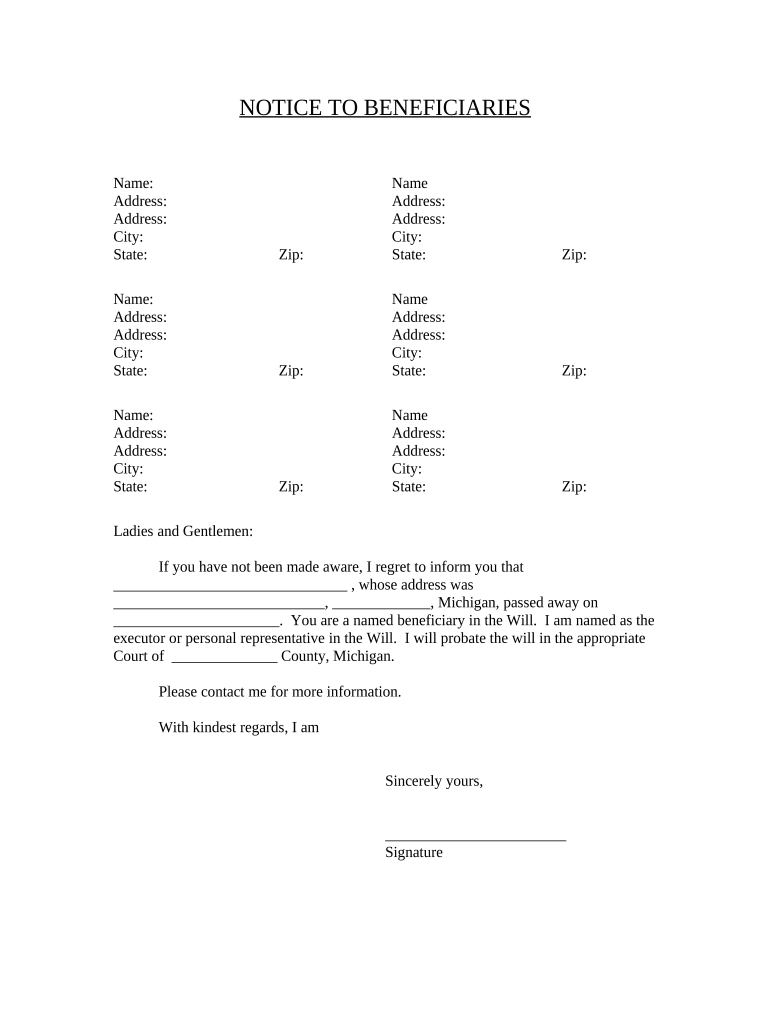
Notice to Beneficiaries of being Named in Will - Michigan Preview on Page 1

Here's how it works

01. Edit your form online
Type text, add images, blackout confidential details, add comments, highlights and more.
02. Sign it in a few clicks
Draw your signature, type it, upload its image, or use your mobile device as a signature pad.
03. Share your form with others
Send it via email, link, or fax. You can also download it, export it or print it out.

How to use or fill out Notice to Beneficiaries of being Named in Will - Michigan with DocHub

Form edit decoration
9.5
Ease of Setup
DocHub User Ratings on G2
9.0
Ease of Use
DocHub User Ratings on G2
  1. Click ‘Get Form’ to open the Notice to Beneficiaries document in our editor.
  2. Begin by filling in your name and address at the top of the form. Ensure that all details are accurate for proper identification.
  3. In the section labeled 'Ladies and Gentlemen', provide the name of the deceased, their last known address, and date of death. This information is crucial for notifying beneficiaries.
  4. List each beneficiary's name and address in the designated fields. If you have multiple beneficiaries, ensure that each entry is clear and complete.
  5. Complete the signature section at the bottom, including your printed name as executor or personal representative, along with the date.
  6. Review all entries for accuracy before saving or exporting your completed document. Our platform allows you to easily modify any sections if needed.

Start using our platform today to fill out your Notice to Beneficiaries form online for free!

be ready to get more

Complete this form in 5 minutes or less

Get form

Got questions?

We have answers to the most popular questions from our customers. If you can't find an answer to your question, please contact us.
Contact us
(b) Subject to subsection (6), within 63 days after accepting a trusteeship, notify the qualified trust beneficiaries of the acceptance, of the court in which the trust is registered, if it is registered, and of the trustees name, address, and telephone number.
Neither the executor of a will nor a trustee of a trust has the authority to unilaterally exclude a beneficiary. If a person is named as a beneficiary in a will or trust, they are legally entitled to what was left to them.
Whether or not to disclose the will to the beneficiary is at your discretion as the executor. Once probate has been granted and you begin to manage the estate, the will becomes a public document. As such, a beneficiary can request their own copy of the will from the Probate Registry by performing a standing search.
Notice to beneficiaries and heirs: If the trust becomes irrevocable when the settlor dies, the trustee has 60 days after becoming trustee or 60 days after the settlors death, whichever happens later, to give written notice to all beneficiaries of the trust and to each heir of the decedent.
How Long Does a Trustee have to Distribute the Assets to Beneficiaries? A trustee is responsible for distributing assets within a reasonable amount of time. However, there are many factors that can play into how long it will take. Generally, the full distribution for a revocable living trust is about 12-18 months.

Security and compliance

At DocHub, your data security is our priority. We follow HIPAA, SOC2, GDPR, and other standards, so you can work on your documents with confidence.

Learn more
ccpa2
pci-dss
gdpr-compliance
hipaa
soc-compliance

People also ask

As a beneficiary, you have the right to know whats in the trust and how its being managed. Michigan law requires trustees to notify beneficiaries of the trusts existence within 63 days after accepting their role. You should also receive a copy of the trust document and any amendments.
Beneficiary notification methods Some states require the use of specific language; others allow trustees or executors to use a simple, informal letter or their own words. When beneficiaries cant be docHubed, a notice in a local newspaper may suffice. The required information in notifications might also vary by state.
Beneficiaries are typically notified through formal communication from the executor of the estate. This usually involves a letter or email detailing their inheritance and any required actions, such as if they need to provide identification or sign documents.

Related links