Type text, add images, blackout confidential details, add comments, highlights and more.
02. Sign it in a few clicks
Draw your signature, type it, upload its image, or use your mobile device as a signature pad.
03. Share your form with others
Send it via email, link, or fax. You can also download it, export it or print it out.
How to use or fill out Letter from Tenant to Landlord about Inadequacy of heating resources insufficient heat - Texas with our platform
Ease of Setup
DocHub User Ratings on G2
Ease of Use
DocHub User Ratings on G2
Click ‘Get Form’ to open it in the editor.
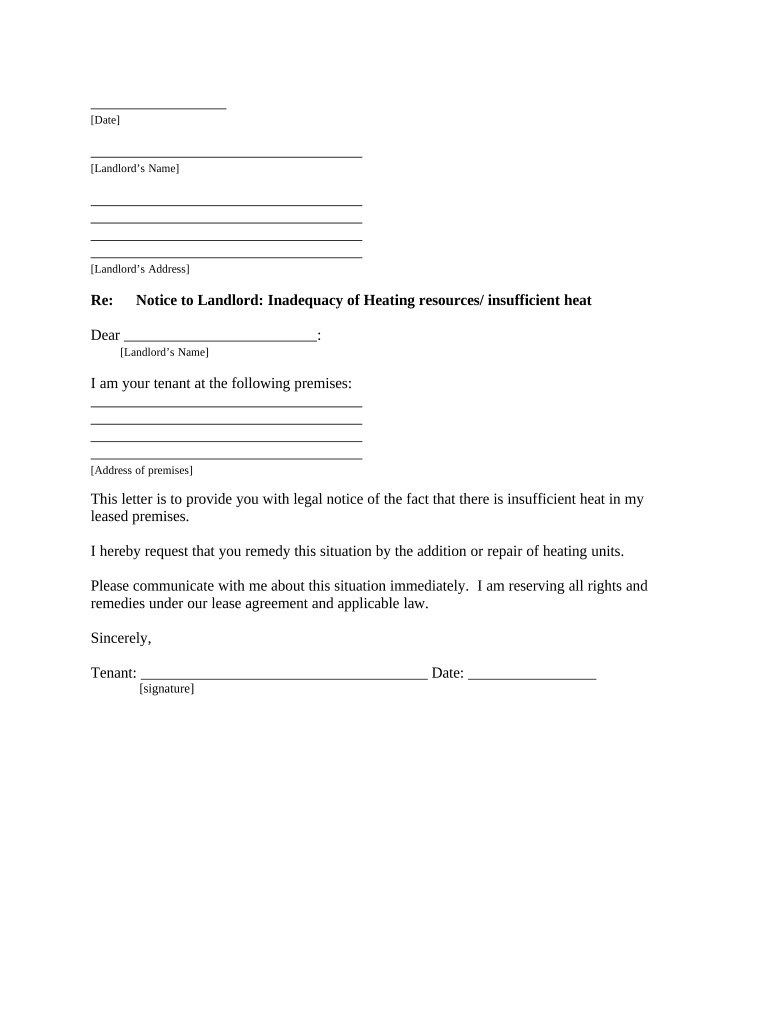
Begin by entering the date at the top of the letter. This is important for record-keeping and establishes when the notice was sent.
Fill in the landlord’s name and address in the designated fields. Ensure accuracy to avoid any delivery issues.
In the greeting, address your landlord directly using their name. This personal touch can help facilitate communication.
Provide your address as the tenant in the specified section. This clarifies which property is affected by the heating issue.
Clearly state that there is insufficient heat in your leased premises. Be concise but assertive about your request for repairs or additional heating units.
Request immediate communication regarding this situation, emphasizing your rights under the lease agreement and applicable law.
Sign and date at the bottom of the letter where indicated, ensuring you have a record of your correspondence.
Complete the Proof of Delivery section by selecting how you will deliver this notice to your landlord, signing, and dating it accordingly.
Start using our platform today to easily fill out and send your tenant notice for free!
Fill out Letter from Tenant to Landlord about Inadequacy of heating resources insufficient heat - Texas online It's free
What constitutes unsafe living conditions in Texas?
The Texas Health and Safety Code stipulates that habitable homes must provide basic structural integrity, adequate sanitation, and essential utilities. The code mandates that residences be maintained in a condition that is weatherproofed, structurally sound, and sanitary.
What makes a rental uninhabitable in Texas?
So, a property that violates health codes likely has serious cleanliness issues that can make the rental uninhabitable. Common health hazards include pest or vermin infestations, mold, mildew, or sanitation problems. Less commonly, it could also be a lead, radon, or asbestos issue.
How to prove a house is uninhabitable?
Lack of Essential Utilities: The absence of running water, heating during cold seasons, or consistent electricity can render a property unlivable. Presence of Toxic Materials: Asbestos, lead paint, radon, or high carbon monoxide levels will almost certainly lead to an uninhabitable house.
What is the legal temperature for a tenant in Texas?
Examples of items that materially affect the health and safety of an ordinary tenant are sewage backups, roaches, rats, no hot water, faulty wiring, roof leaks, and, sometimes, a lack of heat or air conditioning.
Can I sue my landlord for unhealthy living conditions?
You can sue for anything. Proving that the living conditions are unsafe and that the landlord is to blame and that the landlord has done nothing to mitigate the unsafe condition will require proof.
Related Searches
Materially affects the physical health or safety of an ordinary tenantLandlord rules and regulations form TexasTexas landlord-tenant law utilitiesTexas implied warranty of habitabilityTenant privacy rights TexasTexas renters rights moldReasonable time for landlord to make repairsSection 92.051 et seq of the Texas Property Code
Security and compliance
At DocHub, your data security is our priority. We follow HIPAA, SOC2, GDPR, and other standards, so you can work on your documents with confidence.
What is considered uninhabitable living situations for a tenant Texas?
There is no state law that specifically gives tenants the right to be provided with climate control measures like air conditioning or heating.
How long can a landlord leave you without heat in Texas?
Your landlord should make a diligent effort to repair the problem within a reasonable time after receipt of the notice. The law presumes seven days to be a reasonable time, but the landlord can rebut this presumption.
Related links
Landlord and Tenant Rights in General - The Peoples Lawyer
The landlords failure to comply with this law may entitle a tenant to In most cases a simple letter to your landlord will get your deposit returned.
Does my landlord have to provide air conditioning or
Sep 6, 2024 There is no state law that specifically gives tenants the right to be provided with climate control measures like air conditioning or heating.
OSWER Technical Guide for Assessing and Mitigating the Vapor
This document presents current technical recommendations of the U.S. Environmental. Protection Agency (EPA) based on our current understanding of vapor
Cookie consent notice
This site uses cookies to enhance site navigation and personalize your experience.
By using this site you agree to our use of cookies as described in our Privacy Notice.
You can modify your selections by visiting our Cookie and Advertising Notice.