Letter from Tenant to Landlord about Landlord using Unlawful Self-Help to Gain Possession - Connecticut 2026

Get Form
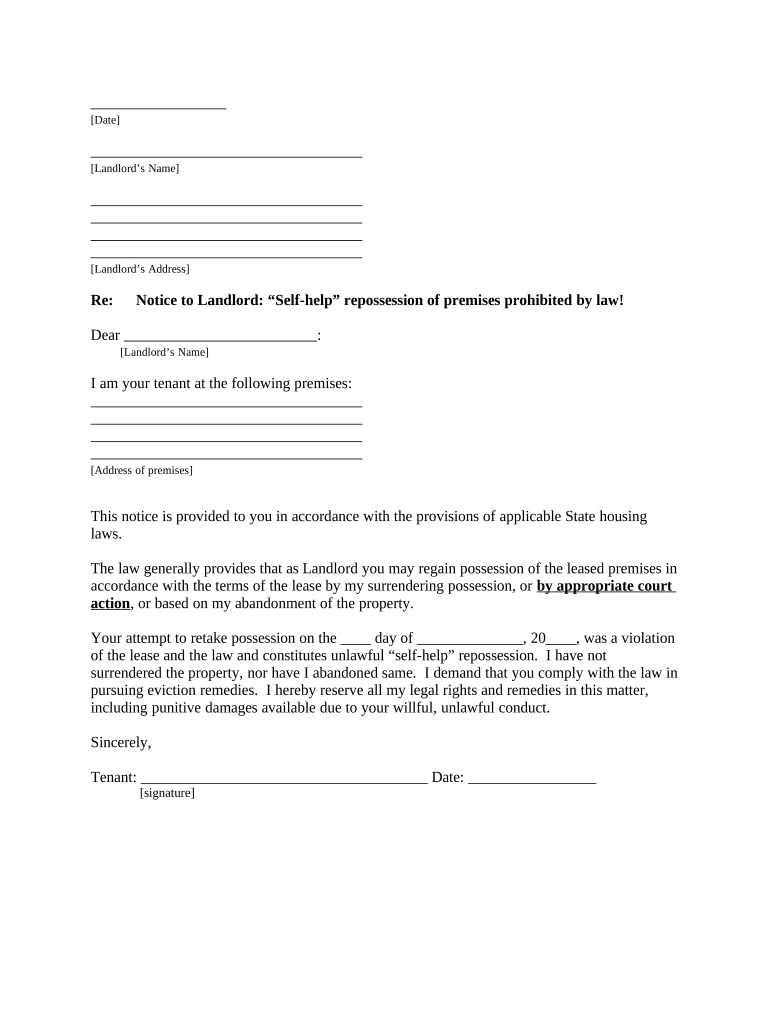
Letter from Tenant to Landlord about Landlord using Unlawful Self-Help to Gain Possession - Connecticut Preview on Page 1

Here's how it works

01. Edit your form online
Type text, add images, blackout confidential details, add comments, highlights and more.
02. Sign it in a few clicks
Draw your signature, type it, upload its image, or use your mobile device as a signature pad.
03. Share your form with others
Send it via email, link, or fax. You can also download it, export it or print it out.

How to use or fill out Letter from Tenant to Landlord about Landlord using Unlawful Self-Help to Gain Possession - Connecticut

Form edit decoration
9.5
Ease of Setup
DocHub User Ratings on G2
9.0
Ease of Use
DocHub User Ratings on G2
  1. Click ‘Get Form’ to open it in the editor.
  2. Begin by entering the date at the top of the letter. This is important for record-keeping and establishing timelines.
  3. Fill in the landlord’s name and address in the designated fields. Ensure accuracy to avoid any miscommunication.
  4. In the greeting, address your landlord directly by name, maintaining a professional tone.
  5. Provide your address as the tenant in the specified section. This clarifies your identity and location.
  6. Clearly state the date of the unlawful self-help attempt by filling in the blanks. This is crucial for legal context.
  7. Sign and date at the bottom of the letter, ensuring that your signature matches any previous documents for consistency.
  8. Complete the Proof of Delivery section by selecting how you delivered this notice to your landlord, signing, and dating it accordingly.

Start using our platform today to easily fill out and manage your important documents for free!

be ready to get more

Complete this form in 5 minutes or less

Get form

Got questions?

We have answers to the most popular questions from our customers. If you can't find an answer to your question, please contact us.
Contact us
Some of the most common lease violations by tenants include unauthorized subletting, keeping pets without permission, failure to pay rent, and violating noise or occupancy restrictions. When tenants violate the lease agreement, landlords have the right to take legal action to enforce the terms of the lease.
Landlords in Connecticut cant discriminate against tenants based on protected characteristics, enforce illegal rent control or excessive late fees, enter a rental unit without proper notice or just cause, forcibly evict tenants without following legal procedures, or fail to maintain the property to required safety and
Eviction: If the court finds that there is a bdocHub of lease they will issue an Order of Restitution, which orders the Sherriff to remove the Tenant from the property. Attorneys fees may be available.
When responding to a landlord, keep your letter clear and concise. Focus on relevant facts like lease terms, payment history, and specific concerns. Avoid overly long explanations or emotional language. Highlight your willingness to resolve issues and stay in the home. Proofread for clarity and professionalism.
When a tenant overstays their lease, he or she is considered a holdover tenant. This isnt evidence of a new lease, instead the rental converts to a month-to-month tenancy. Security deposits in Connecticut are usually limited to two months rent. However, for tenants over 62, the limit is one months rent.

Security and compliance

At DocHub, your data security is our priority. We follow HIPAA, SOC2, GDPR, and other standards, so you can work on your documents with confidence.

Learn more
ccpa2
pci-dss
gdpr-compliance
hipaa
soc-compliance

People also ask

One of the most common problems landlords face is unpaid rent. Lease agreements should state the due date for payments, so even a single late payment can constitute a violation of the agreement.

Related links