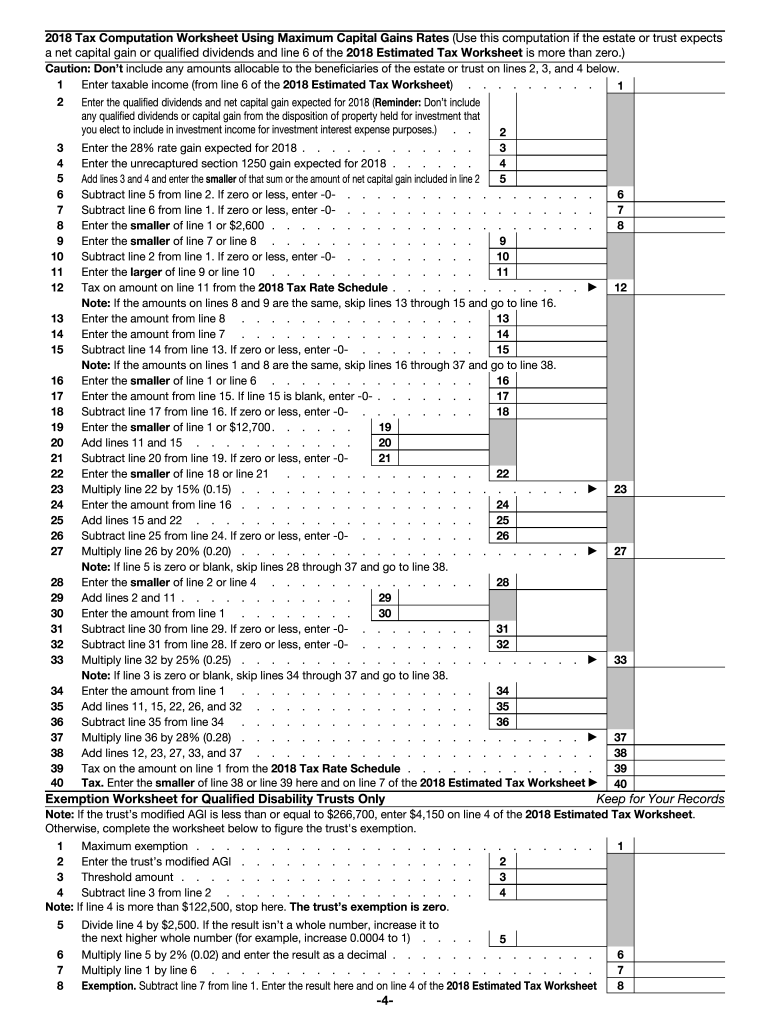
2016 form estimated-2026

Get Form
2016 form estimated Preview on Page 1

Here's how it works

01. Edit your form online
Type text, add images, blackout confidential details, add comments, highlights and more.
02. Sign it in a few clicks
Draw your signature, type it, upload its image, or use your mobile device as a signature pad.
03. Share your form with others
Send it via email, link, or fax. You can also download it, export it or print it out.

How to use or fill out 2016 form estimated with our platform

Form edit decoration
9.5
Ease of Setup
DocHub User Ratings on G2
9.0
Ease of Use
DocHub User Ratings on G2
  1. Click ‘Get Form’ to open the 2016 Form 1041-ES in the editor.
  2. Begin by entering the estate's or trust's name and Employer Identification Number (EIN) in the designated fields at the top of the form.
  3. Proceed to Line 1, where you will input the adjusted total income expected for 2016. This is crucial for calculating your estimated tax.
  4. For Line 2, enter any expected income distribution deduction. If applicable, continue with Line 3 for any estate tax deductions.
  5. Add Lines 2 through 4 to determine your taxable income on Line 6. Use our platform’s calculation tools for accuracy.
  6. Next, figure your tax based on Line 6 using the provided Tax Rate Schedule. Input this amount on Line 7.
  7. Complete Lines for credits and other taxes as necessary, ensuring all calculations are accurate before moving to payment vouchers.
  8. Finally, review all entries and click ‘Save’ before printing or sending your completed form directly from our platform.

Start filling out your 2016 Form 1041-ES online for free today!

See more 2016 form estimated versions

We've got more versions of the 2016 form estimated form. Select the right 2016 form estimated version from the list and start editing it straight away!
Versions Form popularity Fillable & printable
2024 4.5 Satisfied (60 Votes)
2022 4.2 Satisfied (49 Votes)
2021 4.8 Satisfied (81 Votes)
2020 4.4 Satisfied (141 Votes)
2019 4.4 Satisfied (278 Votes)
2018 4.4 Satisfied (305 Votes)
2017 4.3 Satisfied (186 Votes)
2016 4.3 Satisfied (184 Votes)
2013 4.2 Satisfied (37 Votes)
be ready to get more

Complete this form in 5 minutes or less

Get form

Got questions?

We have answers to the most popular questions from our customers. If you can't find an answer to your question, please contact us.
Contact us
Estimated tax is a quarterly payment of taxes for the year based on the filers reported income for the period. Most of those who are required to pay taxes quarterly are small business owners, freelancers, and independent contractors.
Who must pay estimated tax. Individuals, including sole proprietors, partners, and S corporation shareholders, generally have to make estimated tax payments if they expect to owe tax of $1,000 or more when their return is filed.
In most cases, to avoid a penalty, you need to make estimated tax payments if you expect to owe $1000 or more in taxes for the year--over and above the amount withheld from your wages or other income. (TRUE FOR US) In some cases, though, the $1000 trigger point doesnt matter.
Once a due date has passed, the IRS will typically dock 0.5% of the entire amount you owe. For each partial or full month you dont pay the tax in full, the penalty increases. Its capped at 25%.
Estimated tax is the method used to pay tax on income that is not subject to withholding (for example, earnings from self-employment, interest, dividends, rents, alimony, etc.).

Security and compliance

At DocHub, your data security is our priority. We follow HIPAA, SOC2, GDPR, and other standards, so you can work on your documents with confidence.

Learn more
ccpa2
pci-dss
gdpr-compliance
hipaa
soc-compliance

People also ask

Generally, you must make estimated tax payments for the current tax year if both of the following apply: You expect to owe at least $1,000 in tax for the current tax year after subtracting your withholding and refundable credits.
Generally, most taxpayers will avoid this penalty if they either owe less than $1,000 in tax after subtracting their withholding and refundable credits, or if they paid withholding and estimated tax of at least 90% of the tax for the current year or 100% of the tax shown on the return for the prior year, whichever is
Use Form 1040-ES to figure and pay your estimated tax. Estimated tax is the method used to pay tax on income that is not subject to withholding (for example, earnings from self-employment, interest, dividends, rents, alimony, etc.).

Related links