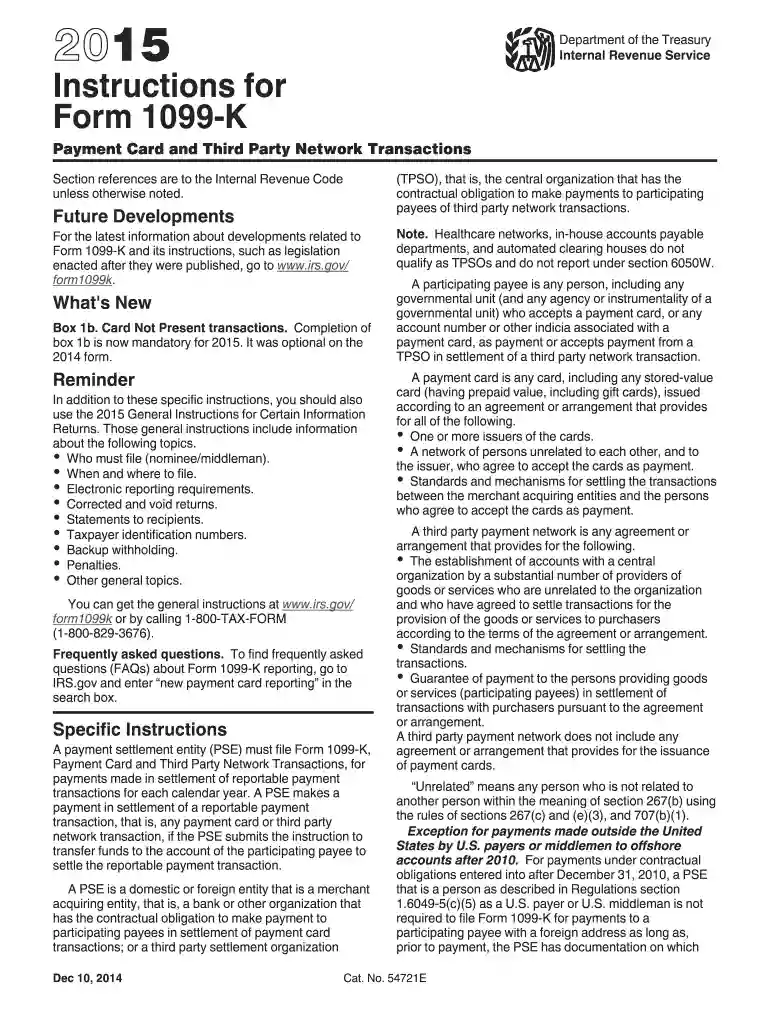
2015 instructions k form-2025

Get Form
2015 instructions k form Preview on Page 1

Here's how it works

01. Edit your form online
Type text, add images, blackout confidential details, add comments, highlights and more.

02. Sign it in a few clicks
Draw your signature, type it, upload its image, or use your mobile device as a signature pad.

03. Share your form with others
Send it via email, link, or fax. You can also download it, export it or print it out.

How to use or fill out 2015 instructions k form with our platform

Form edit decoration
9.5
Ease of Setup
DocHub User Ratings on G2
9.0
Ease of Use
DocHub User Ratings on G2
  1. Click ‘Get Form’ to open the 2015 Instructions K form in the editor.
  2. Begin by entering your name, address, and federal identification number in the designated boxes at the top left corner of the form.
  3. In Box 1a, input the gross amount of total reportable payment card transactions for the calendar year. Ensure this amount reflects all transactions without adjustments.
  4. For Box 1b, enter amounts for card-not-present transactions, typically related to online or phone sales.
  5. Complete Box 2 by entering the appropriate merchant category code (MCC) that classifies your business type.
  6. Fill in Box 3 with the total number of payment transactions processed during the year, excluding refunds.
  7. If applicable, indicate any federal income tax withheld in Box 4 and provide state information if required in Boxes 6 through 8.

Start using our platform today to easily fill out your forms for free!

See more 2015 instructions k form versions

We've got more versions of the 2015 instructions k form form. Select the right 2015 instructions k form version from the list and start editing it straight away!
Versions Form popularity Fillable & printable
2022 4.7 Satisfied (46 Votes)
2021 4.8 Satisfied (65 Votes)
2020 4.2 Satisfied (52 Votes)
2019 4.4 Satisfied (120 Votes)
2018 4.2 Satisfied (73 Votes)
2017 4.4 Satisfied (197 Votes)
2016 4.3 Satisfied (48 Votes)
2015 4.3 Satisfied (73 Votes)
2012 4 Satisfied (33 Votes)
2011 4.4 Satisfied (144 Votes)
be ready to get more

Complete this form in 5 minutes or less

Get form

Got questions?

We have answers to the most popular questions from our customers. If you can't find an answer to your question, please contact us.
Contact us
The Schedule K-1 is the form that reports the amounts passed to each party with an interest in an entity, like a business partnership or an S corporation. The parties use the information on the K-1 to prepare their separate tax returns.
Schedule K-1 rules are complex, and many taxpayers make these common mistakes, including: Misclassifying income as passive or active. Ignoring at-risk or passive activity loss limitations. Using capital account instead of basis for deductions.
A K-1 form is usually prepared by the accountant who manages the entitys taxes, before being issued to each partner, shareholder, or beneficiary. The entity must file a copy of the relevant K-1 (Form 1065, Form 1120-S, or Form 1041) with the IRS.
General Instructions Keep it for your records. Dont file it with your tax return unless youre specifically required to do so. (See Code O under Box 15, later.) The partnership files a copy of Schedule K-1 (Form 1065) with the IRS.
If you have an amount on Schedule K-1 (565), line 6, column (c), report this amount on Schedule CA (540), Part I, Section A, line 3, or on Schedule CA (540NR), Part II, Section A, line 3, column B or column C, whichever is applicable.

People also ask

Is Schedule K-1 considered income? A Schedule K-1 lists taxable income, similar to a W2 or a Form 1099, but only for the particular types of business entities outlined above. As far as K-1 distributions are concerned, they are generally not considered taxable income.
A Schedule K-1 can impact your personal taxes in key ways. It reports income from partnerships, S-corporations, and trusts. This income is often considered pass-through, meaning it goes directly to you without being taxed at the entity level.
Each form has three sections. Part I asks for information about your company. Part II asks for information about the partner or shareholder. Part III is where you detail the partner or shareholders share of income, gains, losses, deductions, and credits.

Related links