Letter from Tenant to Landlord responding to Notice to Terminate for Noncompliance - Noncompliant condition caused by Landlord's own deliberate or negligent act - Colorado 2026

Get Form
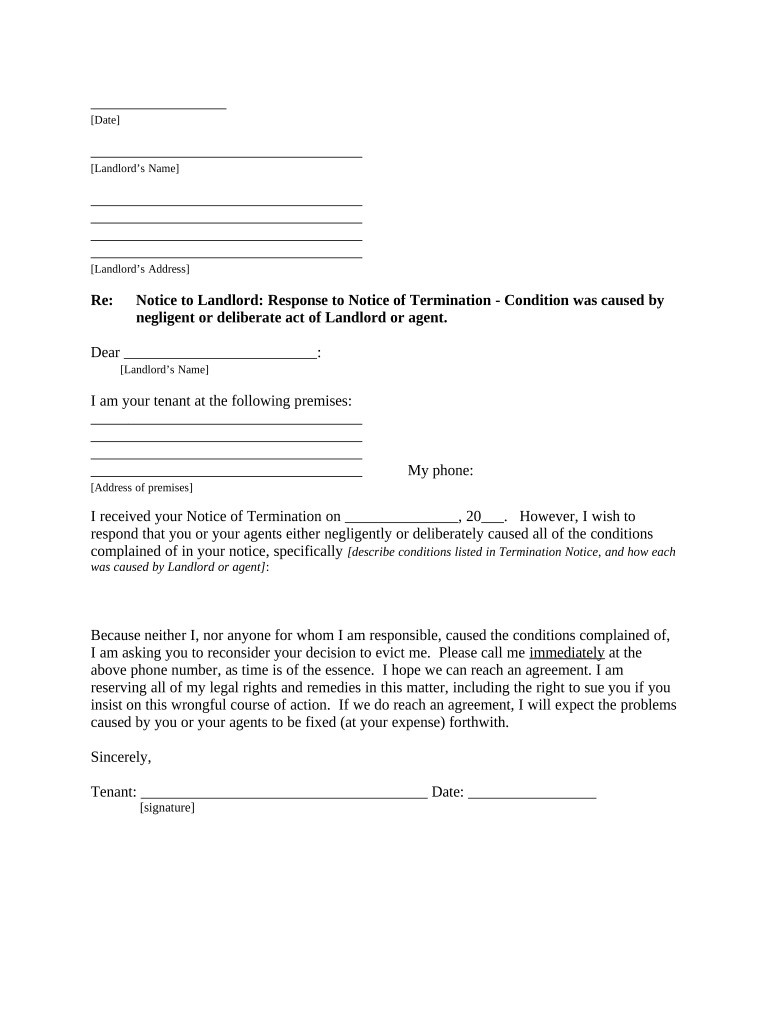
Letter from Tenant to Landlord responding to Notice to Terminate for Noncompliance - Noncompliant condition caused by Landlord's own deliberate or negligent act - Colorado Preview on Page 1

Here's how it works

01. Edit your form online
Type text, add images, blackout confidential details, add comments, highlights and more.
02. Sign it in a few clicks
Draw your signature, type it, upload its image, or use your mobile device as a signature pad.
03. Share your form with others
Send it via email, link, or fax. You can also download it, export it or print it out.

How to use or fill out Letter from Tenant to Landlord responding to Notice to Terminate for Noncompliance - Noncompliant condition caused by Landlord's own deliberate or negligent act - Colorado with our platform

Form edit decoration
9.5
Ease of Setup
DocHub User Ratings on G2
9.0
Ease of Use
DocHub User Ratings on G2
  1. Click ‘Get Form’ to open it in the editor.
  2. Begin by entering the date at the top of the letter. This sets the context for your response.
  3. Fill in the landlord’s name and address in the designated fields. Ensure accuracy for effective communication.
  4. In the salutation, address your landlord directly using their name, which personalizes your response.
  5. Provide your address as a tenant, ensuring that it matches the premises mentioned in your lease agreement.
  6. State the date you received the Notice of Termination clearly, as this is crucial for legal timelines.
  7. Describe each condition listed in the termination notice and explain how they were caused by the landlord or their agents. Be specific and factual.
  8. Conclude with a request for reconsideration of eviction, emphasizing urgency and willingness to resolve issues amicably.
  9. Sign and date the letter at the bottom. This formalizes your response and indicates your commitment to addressing these concerns.
  10. Complete the Proof of Delivery section by selecting how you delivered this notice to ensure proper documentation.

Start editing your document today for free on our platform!

be ready to get more

Complete this form in 5 minutes or less

Get form

Got questions?

We have answers to the most popular questions from our customers. If you can't find an answer to your question, please contact us.
Contact us

Managing your documents with DocHub this way is extremely simple after you have downloaded its extension for Google Chrome. Navigate to the Chrome Web Store and install DocHub - Sign PDF from Gmail to get it. Give our tool access to your Google account, and then open an email containing Letter from Tenant to Landlord responding to Notice to Terminate for Noncompliance - Noncompliant condition caused by Landlord's own deliberate or negligent act - Colorado as an attachment and point to the file with your cursor - the DocHub extension button will automatically appear there. Click on it to open your file in our editor. Make any essential adjustments, complete the blanks, and click Sign to create your legally-binding eSignature.

Document editing with DocHub is equally convenient on desktop and mobile devices. You only need an internet browser to revise your Letter from Tenant to Landlord responding to Notice to Terminate for Noncompliance - Noncompliant condition caused by Landlord's own deliberate or negligent act - Colorado on Android. Open our site and sign in to access the instruments you need. Add your file and introduce your intended changes. After that, you can keep your form in your file storage or send it out immediately.

Landlords cannot retaliate against tenants for exercising their legal rights, such as reporting unsafe living conditions or requesting necessary repairs. Retaliatory actions, including raising rent, refusing to renew a lease, or attempting to evict a tenant in response to a complaint, are prohibited under Colorado law.
A notice to vacate is a formally written document that notifies either a tenant or a landlord of the intent to terminate a rental agreement. This document is typically required to end a lease, whether it is initiated by the tenant (tenant notice to vacate) or by the landlord (landlord notice to vacate).
The lease controls when the landlord may end the tenancy and take steps to evict the tenant. If there is no written lease, the Colorado statutes control. The most commons reasons for eviction are: Non-payment of rent, violation of the lease provisions and No Cause if there is no agreement as to the term of occupancy.

Security and compliance

At DocHub, your data security is our priority. We follow HIPAA, SOC2, GDPR, and other standards, so you can work on your documents with confidence.

Learn more
ccpa2
pci-dss
gdpr-compliance
hipaa
soc-compliance
be ready to get more

Complete this form in 5 minutes or less

Get form

People also ask

A tenancy for one year or longer: 90 days notice 2. A tenancy between 6-12 months: 28 days notice 3. A tenancy between one and six months: 21 days notice 4. A tenancy between one week and one month, or a tenancy at will: 3 days notice.
The length of your lease is often determined by how often you pay your rent (i.e. if you pay your rent in bulk at the beginning of the year, you have likely established a one year tenancy): 1. A tenancy for one year or longer: 90 days notice 2. A tenancy between 6-12 months: 28 days notice 3.
A Notice to Vacate should clearly state the tenants name, property address, and the date by which they must leave. Include the reason for the notice if required by law. Specify the exact move-out date, respecting any minimum notice period mandated by local or state law.
The Colorado Notice to Vacate Form must contain the date on which the Notice to Vacate is given, and the time frame in which the rental property should become vacant. Specific details must be clearly stated on the notice, so the other party has reasonable awareness about their responsibilities.
A: Conditions that affect whether a unit is habitable and situations that interfere with a renters life, health or safety and were not caused by the renter, including: roof and exterior walls that leak broken windows and exterior doors that have broken locks gas and plumbing problems mold broken appliances*

Related links