Final Order for Appointment of Guardian of the Person and/or Property - Accountings Waived - Delaware 2026

Get Form
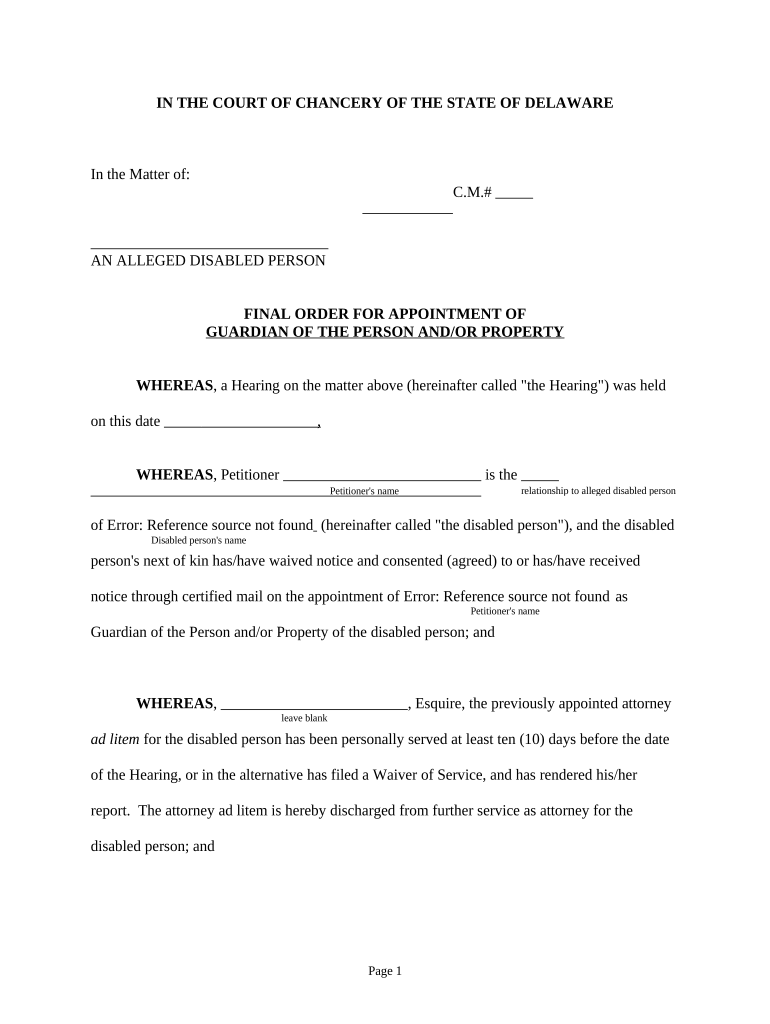
Final Order for Appointment of Guardian of the Person and/or Property - Accountings Waived - Delaware Preview on Page 1

Here's how it works

01. Edit your form online
Type text, add images, blackout confidential details, add comments, highlights and more.
02. Sign it in a few clicks
Draw your signature, type it, upload its image, or use your mobile device as a signature pad.
03. Share your form with others
Send it via email, link, or fax. You can also download it, export it or print it out.

How to use or fill out Final Order for Appointment of Guardian of the Person and/or Property - Accountings Waived - Delaware with our platform

Form edit decoration
9.5
Ease of Setup
DocHub User Ratings on G2
9.0
Ease of Use
DocHub User Ratings on G2
  1. Click ‘Get Form’ to open it in the editor.
  2. Begin by entering the name of the alleged disabled person in the designated field. Ensure accuracy as this is crucial for legal documentation.
  3. Fill in your relationship to the disabled person and your name as the petitioner. This establishes your role in the guardianship process.
  4. Indicate whether notice has been waived by next of kin or if they have received notice through certified mail. This section is vital for compliance with legal requirements.
  5. Check all applicable boxes regarding the disabled person's condition, confirming their inability to manage personal care or property.
  6. Complete the appointment section by selecting whether you are appointed as Guardian of the Person, Property, or both. Fill in your name accordingly.
  7. Specify any bond amount required and ensure it is filed within 7 days post-order issuance.
  8. Review all entries for accuracy before saving and submitting your completed form through our platform.

Start using our platform today to streamline your document editing and signing process for free!

be ready to get more

Complete this form in 5 minutes or less

Get form

Got questions?

We have answers to the most popular questions from our customers. If you can't find an answer to your question, please contact us.
Contact us
Any person at least 18 years old may be the Guardian of a child. However, if you are not a relative (immediate family member, grandparent, aunt, uncle, first cousin, great-grandparent, grand aunt or grand uncle, half-brother of half-sister), the Division of Family Services must assess the placement.
While there is some variation from state to state, when a court appoints a guardian, that court may remove the individuals right to: Determine residence. Consent to medical treatment. Make end-of-life decisions. Possess a drivers license. Manage, buy, or sell property. Own or possess a firearm or weapon.
Only a natural person (not a bank or a company) can be appointed as a guardian of the person. A guardian of the estate is appointed to manage the property and financial assets of the ward for the wards best interests. Specifically, the guardian of the estate must: Pay all debts owed by the ward.
Guardianship: Often necessary when someone is severely incapacitated and cannot make even basic decisions for themselves. Power of Attorney: Suitable when someone wants to plan ahead and designate someone to manage their affairs if they become incapacitated, but still retain control while they have capacity.
A Guardian has the legal authority to take care of the child as if he/she were the childs parent until the child turns 18 years of age. Included in a Guardianship Order is a Custody Order. Therefore, a Guardian has the same legal authority to care for the child as a parent would.

Security and compliance

At DocHub, your data security is our priority. We follow HIPAA, SOC2, GDPR, and other standards, so you can work on your documents with confidence.

Learn more
ccpa2
pci-dss
gdpr-compliance
hipaa
soc-compliance
be ready to get more

Complete this form in 5 minutes or less

Get form