Limited Power of Attorney where you Specify Powers with Sample Powers Included - Kansas 2026

Get Form
Limited Power of Attorney where you Specify Powers with Sample Powers Included - Kansas Preview on Page 1

Here's how it works

01. Edit your form online
Type text, add images, blackout confidential details, add comments, highlights and more.
02. Sign it in a few clicks
Draw your signature, type it, upload its image, or use your mobile device as a signature pad.
03. Share your form with others
Send it via email, link, or fax. You can also download it, export it or print it out.

How to use or fill out Limited Power of Attorney where you Specify Powers with Sample Powers Included - Kansas

Form edit decoration
9.5
Ease of Setup
DocHub User Ratings on G2
9.0
Ease of Use
DocHub User Ratings on G2
  1. Click ‘Get Form’ to open it in the editor.
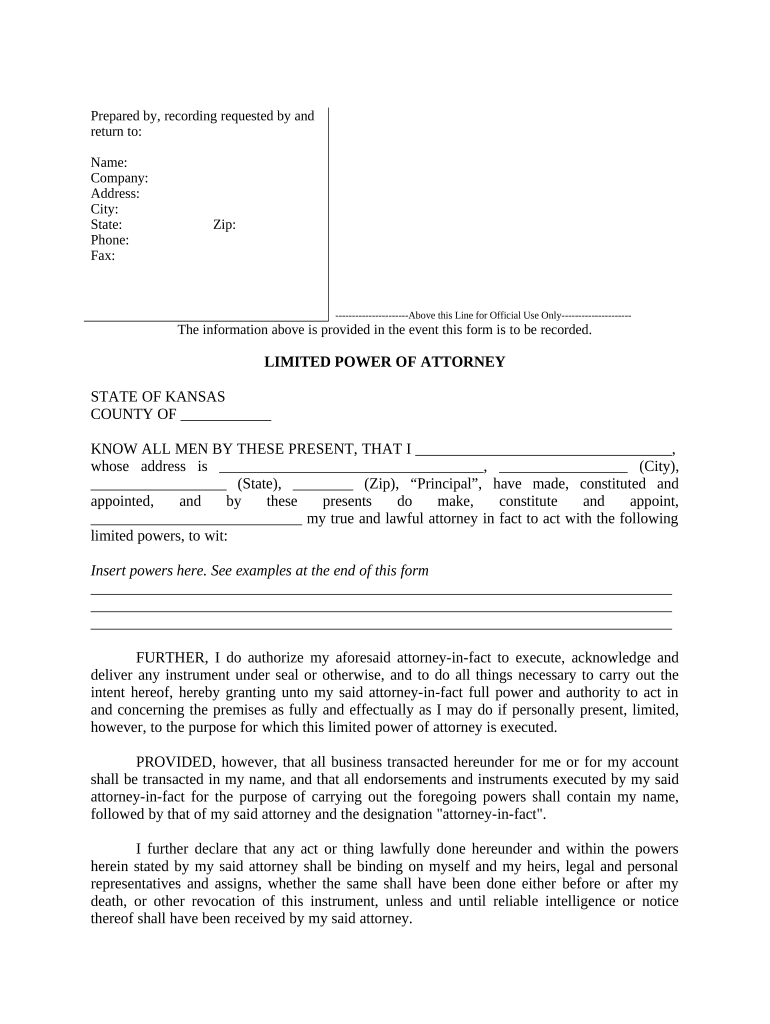
  2. Begin by filling in your personal information at the top, including your name, address, and contact details. This identifies you as the 'Principal'.
  3. Next, designate your attorney-in-fact by entering their name and address in the specified fields. This person will act on your behalf.
  4. In the section labeled 'Insert powers here', specify the limited powers you wish to grant. You can refer to the sample powers provided at the end of the form for guidance.
  5. Indicate whether this power of attorney is non-durable or durable by checking the appropriate box.
  6. Sign and date the document at the bottom as the Principal. Ensure that witnesses sign as well, confirming they observed your signature.
  7. Finally, have a notary public acknowledge your signature to complete the process.

Start using our platform today to easily fill out and manage your Limited Power of Attorney form for free!

be ready to get more

Complete this form in 5 minutes or less

Get form

Got questions?

We have answers to the most popular questions from our customers. If you can't find an answer to your question, please contact us.
Contact us
For your POA to be valid in Kansas, it must meet certain requirements. Mental Capacity for Creating a POA. Notarization or Witnessing Requirement. Create the POA Using a Form, Software, or an Attorney. Sign the POA in the Presence of a Notary Public. Store the Original POA in a Safe Place.
A power of attorney agreement authorizes one partycalled the agent or attorney in factto act on behalf of the other party, called the principal. Under a limited power of attorney agreement, the agent can only act and make decisions on specified activities, and only to the extent that the principal authorizes.
Kansas Power of Attorney Requirements The power of attorney document must be in writing. You must sign the document in the presence of a notary public or two witnesses who are not related to you and do not stand to benefit from the power of attorney.
(d) A power of attorney executed by a resident of another state, may authorize the carrying out in this state of all acts permitted to be delegated to an attorney in fact by the laws of the state of the residence of the principal, the laws of the state where the power of attorney is executed or the laws of this state,
This type of financial power of attorney in Kansas allows the principal to grant specific powers to the agent for particular tasks, such as selling a property or managing a specific financial account. Once the task is completed or the specified time period expires, the limited POA becomes void.

Security and compliance

At DocHub, your data security is our priority. We follow HIPAA, SOC2, GDPR, and other standards, so you can work on your documents with confidence.

Learn more
ccpa2
pci-dss
gdpr-compliance
hipaa
soc-compliance

People also ask

The durable POA remains in effect even if the principal becomes incapacitated or unable to make decisions for themselves. On the other hand, a limited POA or springing POA only takes effect under certain specified circumstances, such as when the principal becomes incapacitated.
Conclusion. A Special Power of Attorney (SPA) is required for specific, often major transactions (e.g., sale of real estate, making donations, compromising claims), while a General Power of Attorney (GPA) covers a broader range of administrative or routine acts.

Related links