Legal Last Will and Testament Form for Single Person with No Children - Iowa 2026

Get Form
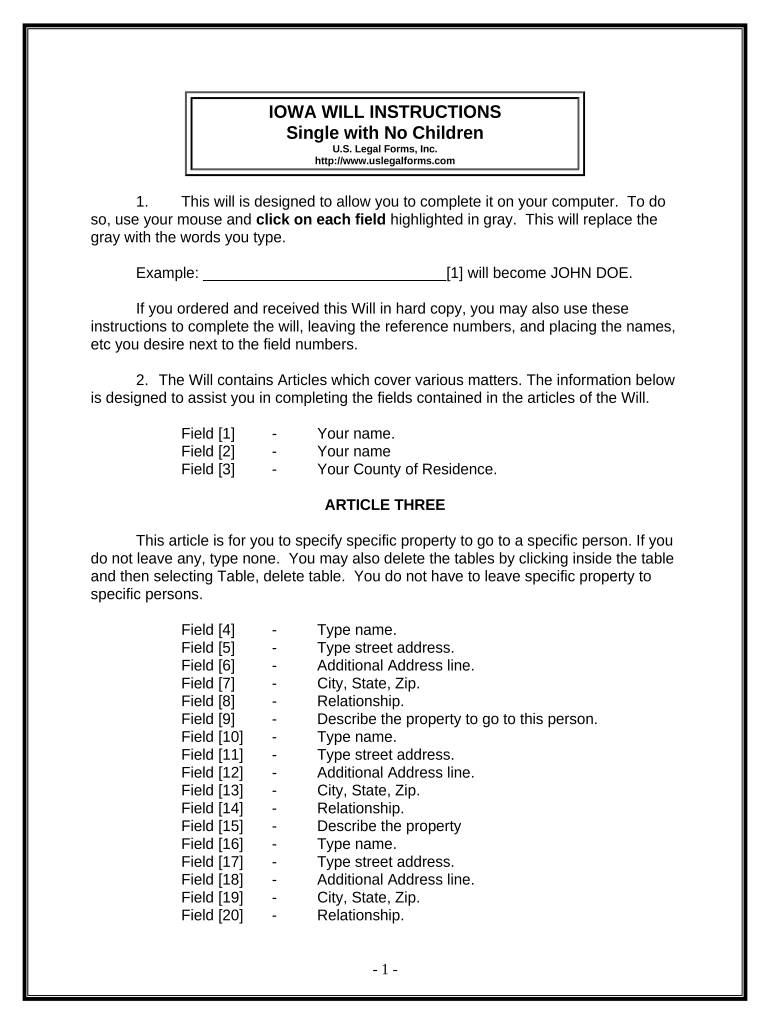
Legal Last Will and Testament Form for Single Person with No Children - Iowa Preview on Page 1

Here's how it works

01. Edit your form online
Type text, add images, blackout confidential details, add comments, highlights and more.
02. Sign it in a few clicks
Draw your signature, type it, upload its image, or use your mobile device as a signature pad.
03. Share your form with others
Send it via email, link, or fax. You can also download it, export it or print it out.

How to use or fill out Legal Last Will and Testament Form for Single Person with No Children - Iowa

Form edit decoration
9.5
Ease of Setup
DocHub User Ratings on G2
9.0
Ease of Use
DocHub User Ratings on G2
  1. Click ‘Get Form’ to open it in the editor.
  2. Begin by entering your name in Field [1] and your county of residence in Field [3]. This establishes your identity and jurisdiction.
  3. In Article Three, specify any specific property you wish to bequeath. If none, simply type 'none' in the designated field.
  4. For your homestead, complete Field [22] with the name of the person receiving it. You can designate multiple recipients if desired.
  5. In Article Six, appoint a Personal Representative by filling out Fields [27] and [28]. This person will manage your estate.
  6. Review all entries for accuracy before printing. Ensure you sign in front of two witnesses who are not related to you.

Start using our platform today to easily complete your Legal Last Will and Testament form online for free!

be ready to get more

Complete this form in 5 minutes or less

Get form

Got questions?

We have answers to the most popular questions from our customers. If you can't find an answer to your question, please contact us.
Contact us
Top five mistakes when writing a Will Failing to have the Will witnessed correctly. All Wills need to be signed in the presence of two independent witnesses, who in turn must sign the document. Creating a DIY Will. Forgetting key assets. Not updating the Will after your circumstances change. Not writing one at all.
Simple wills are best for uncomplicated estates. For example, a single person or a married couple with few assets and no special conditions.
If you have no children, consider naming a charity, club, organization, or even the city you love as your beneficiary. In your will, you will also appoint an executor for your estatethis is the person you wish to carry out the details of distributing your assets.
FreeWill is a secure, online tool that will take you through the will preparation process step by step. If you have a simple estate, you can print your legal will to be signed and witnessed.
In order to write a valid will, the person must be at least 18 years old or married and of sound mind. The will must be signed by the maker of the will in front of at least two competent witnesses who are at least 16 years old. The two witness must also sign the will in front of the maker of the will and each other.

Security and compliance

At DocHub, your data security is our priority. We follow HIPAA, SOC2, GDPR, and other standards, so you can work on your documents with confidence.

Learn more
ccpa2
pci-dss
gdpr-compliance
hipaa
soc-compliance

People also ask

If youre unmarried with no children, your estate will be allocated in the following order: your parents, full siblings, half-siblings, grandparents, uncles and aunts (then their children), half-uncles and half-aunts (then their children).
Yes, you can write your own will in Iowa and have it docHubd if you wish. You must make sure that the will meets the states legal requirements and have it witnessed and signed by at least two competent adults before going to the notary for acknowledgment. With these steps taken, your will should be legally valid.
To write a will, Mississippi law states you must be at least 18 years old, of sound and disposing mind, must intend the document to be your will and must have the written will validly executed. Upon your death, your will must go through probate, a court proceeding that declares the will valid or invalid.

Related links