Provision of List of ADSL Qualified Loops Agreement 2026

Get Form
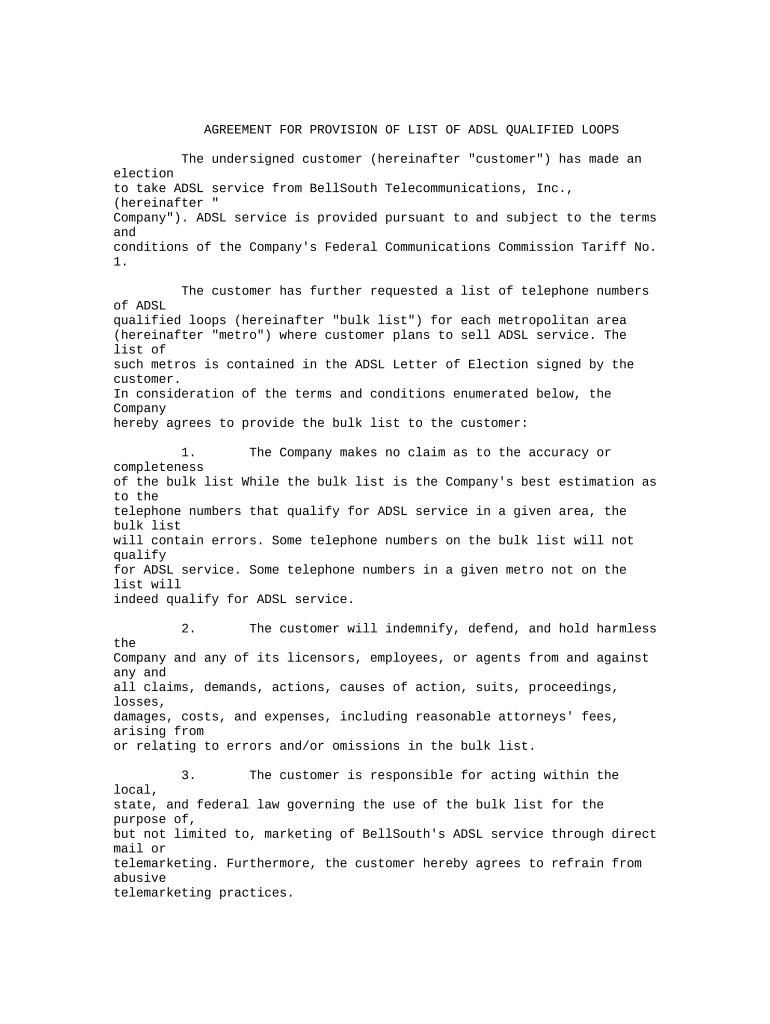
Provision of List of ADSL Qualified Loops Agreement Preview on Page 1

Here's how it works

01. Edit your form online
Type text, add images, blackout confidential details, add comments, highlights and more.
02. Sign it in a few clicks
Draw your signature, type it, upload its image, or use your mobile device as a signature pad.
03. Share your form with others
Send it via email, link, or fax. You can also download it, export it or print it out.

How to use or fill out Provision of List of ADSL Qualified Loops Agreement

Form edit decoration
9.5
Ease of Setup
DocHub User Ratings on G2
9.0
Ease of Use
DocHub User Ratings on G2
  1. Click ‘Get Form’ to open it in the editor.
  2. Begin by entering your company name and address in the designated fields. Ensure that all information is accurate to avoid any issues.
  3. Review the terms outlined in the agreement carefully. Pay special attention to the indemnification clauses, as they outline your responsibilities regarding the use of the bulk list.
  4. Sign the document electronically in the signature field provided. This confirms your acceptance of the terms and conditions stated within.
  5. Finally, save your completed form and share it with relevant parties using our platform’s sharing features for seamless distribution.

Start using our platform today to easily fill out and manage your Provision of List of ADSL Qualified Loops Agreement for free!

be ready to get more

Complete this form in 5 minutes or less

Get form

Got questions?

We have answers to the most popular questions from our customers. If you can't find an answer to your question, please contact us.
Contact us
Originally conceived in 1994, ADSL delivers the huge amounts of bandwidth needed for interactive gaming, multimedia services and video-on-demand. These applications, along with videoconferencing, remote schooling and home shopping are still attractive applications.
ADSL is a popular, older type of broadband, with the term standing for Asymmetric Digital Subscriber Line. It is a broadband connection that works through the copper wires of existing phone lines and is mainly used for home broadband and within small businesses.
Asymmetric Digital Subscriber Line (ADSL) is a technology that allows high-speed digital data transmission over existing copper telephone lines. It is called asymmetric because it provides higher download speeds than upload speeds, which is suitable for applications such as web browsing, email, and streaming video.
ADSL (Asymmetric Digital Subscriber Line) is a technology that facilitates fast data transmission at a high bandwidth on existing copper wire telephone lines to homes and businesses. Unlike regular dial-up copper telephone line service, ADSL provides continuously available, always-on broadband connections.
Greater Data Speed Over the Existing Infrastructure DSL (Digital Subscriber Line) is a modem technology that uses existing telephone lines to transport high-bandwidth data, such as multimedia and video, to service subscribers. DSL provides dedicated, point-to-point, public network access.

Security and compliance

At DocHub, your data security is our priority. We follow HIPAA, SOC2, GDPR, and other standards, so you can work on your documents with confidence.

Learn more
ccpa2
pci-dss
gdpr-compliance
hipaa
soc-compliance