






Definition & Meaning
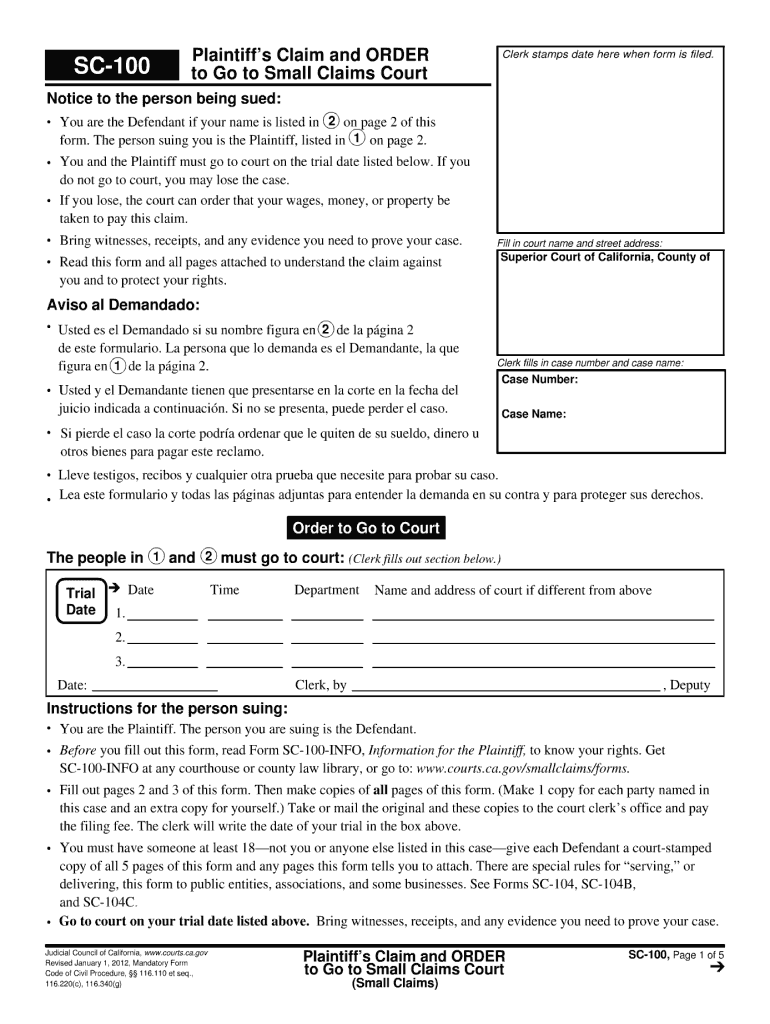
The SC-100 Plaintiff's Claim and ORDER to Go to Small Claims Court form is a legal document used in the United States by individuals or entities to initiate a small claims case. This form allows the plaintiff to present their claim against a defendant in a small claims court, where cases are typically resolved more quickly and with less formality compared to other court systems. The SC-100 form is specifically tailored for claims that fall under a determined financial threshold, varying by state, and often revolves around disputes such as payment collection, property damage, or breach of contract.
How to Obtain the SC Form
Securing the SC form is a straightforward process, with multiple avenues available to prospective plaintiffs. The form can generally be accessed:
- Online: Most state court websites offer downloadable versions of the form, accompanied by detailed instructions or FAQs for assistance.
- In-person: Court clerks’ offices can provide paper copies or direct individuals to other resources if necessary.
- Legal Aid: Some nonprofit legal organizations provide not only forms but also assistance in completing them to ensure accuracy.
Each method ensures that the plaintiff has access to the necessary documentation to initiate the small claims process.
Steps to Complete the SC Form
Completing the SC form involves a structured approach to capture all required details accurately:
- Identify the Defendant: Input the full legal name and address of the individual or entity you are suing.
- State the Claim: Clearly describe the nature of the claim, including the amount sought and the reason for the lawsuit.
- Provide Plaintiff Details: Include your full name, address, contact information, and any relevant identifiers like case numbers if available.
- Sign and Date: Ensure the form is signed and dated to affirm the truthfulness of your claims.
Thorough completion minimizes errors and ensures the court processes your claim efficiently.
Who Typically Uses the SC Form
The SC form is primarily utilized by individuals and small to mid-sized businesses who need to resolve disputes without engaging in protracted and costly litigation. Typical users include:
- Landlords seeking unpaid rent or property damage compensation.
- Small business owners recovering unpaid invoices for services or products.
- Consumers pursuing refunds or compensation from businesses not meeting their obligations.
This form provides a platform to resolve these issues in a cost-effective manner.


Steps to File the SC Form
Filing the SC-100 requires careful attention to detail and adherence to court procedures:
- Complete the Form: Accurately fill out all required sections as detailed above.
- Calculate Court Fees: Determine the filing fee, which is often based on the amount claimed.
- Submit the Form: Present the completed form and fees at the appropriate court; submission methods may include in-person, by mail, or increasingly, through electronic systems.
- Serve the Defendant: Ensure the defendant is formally notified of the claim through an approved method such as certified mail or professional process server.
A well-executed filing process sets the stage for a smooth progression through the legal system.
Key Elements of the SC Form
The SC-100 form comprises various essential components, each requiring detailed input:
- Parties Information: Detailed contact information for both plaintiff and defendant.
- Nature of Claim: An explicit description of the case, summarizing the events leading to the claim.
- Amount Sought: The specific monetary value of the claim including all damages and fees.
- Court Selection: Details on the jurisdiction and choice of small claims court.
The clarity in each section aids in the effective adjudication of the claim.
Legal Use of the SC Form
The SC-100 form must be used in accordance with small claims court rules and regulations:
- Amount Limits: Ensure the claim does not exceed the state-specific maximum monetary thresholds.
- Type of Claims: Restricted to certain claim types such as contract disputes or personal injury claims.
- Statute of Limitations: Claims must be filed within legal timeframes from the date of the incident or dispute.
Compliance with these parameters is critical to the form's acceptance and subsequent hearing.
Important Terms Related to SC Form
Familiarity with common terms can aid in understanding and using the SC-100 form effectively:
- Plaintiff: The individual or entity initiating the lawsuit.
- Defendant: The individual or entity being sued.
- Judgment: The court's final decision regarding the claim.
- Service of Process: The formal procedure of notifying the defendant of the lawsuit.
These terms form the foundation of navigating the small claims process successfully.