Agreement for Sale - Residential 2026

Get Form
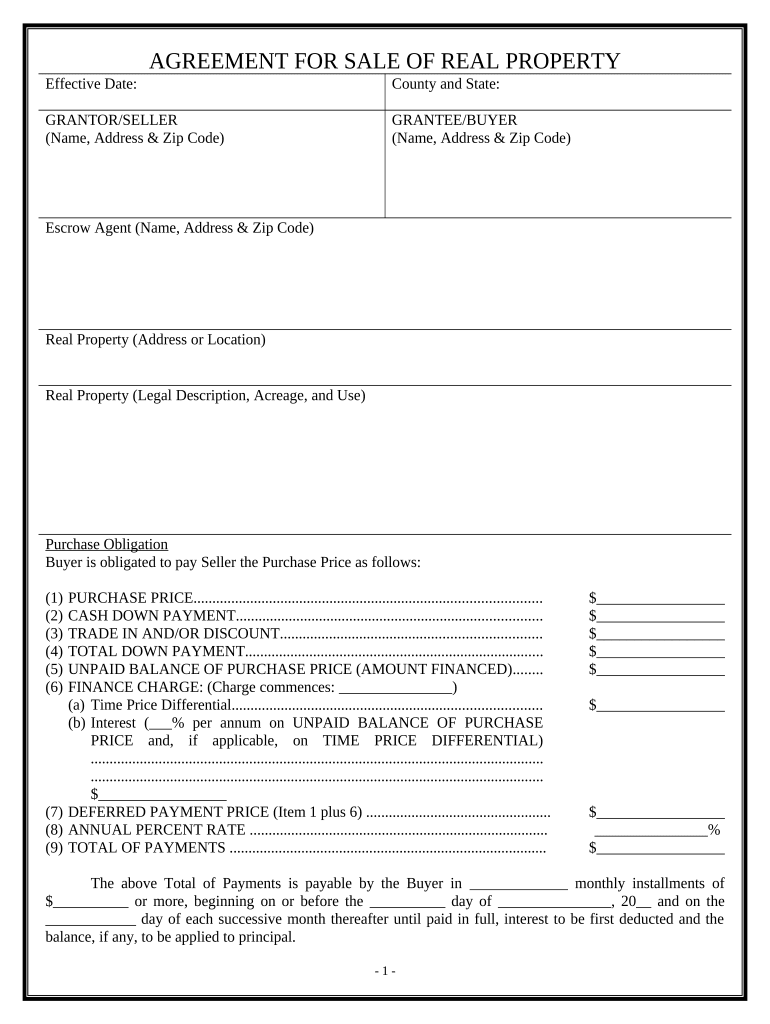
Agreement for Sale - Residential Preview on Page 1

Here's how it works

01. Edit your form online
Type text, add images, blackout confidential details, add comments, highlights and more.
02. Sign it in a few clicks
Draw your signature, type it, upload its image, or use your mobile device as a signature pad.
03. Share your form with others
Send it via email, link, or fax. You can also download it, export it or print it out.

How to use or fill out Agreement for Sale - Residential with our platform

Form edit decoration
9.5
Ease of Setup
DocHub User Ratings on G2
9.0
Ease of Use
DocHub User Ratings on G2
  1. Click ‘Get Form’ to open the Agreement for Sale - Residential in the editor.
  2. Begin by entering the Effective Date, County, and State at the top of the form. This information is crucial for legal clarity.
  3. Fill in the Grantor/Seller and Grantee/Buyer sections with their respective names, addresses, and zip codes. Ensure accuracy to avoid future disputes.
  4. Specify the Escrow Agent's details, including name and address. This agent will facilitate the transaction.
  5. Detail the Real Property's address and legal description. Include acreage and intended use to provide a complete picture of the property being sold.
  6. Outline the Purchase Obligation by filling in payment details such as cash down payment, total down payment, unpaid balance, finance charge, and total payments. Be precise with numbers to ensure transparency.
  7. Review all sections thoroughly before signing. Utilize our platform’s features to save your progress or share it with others for review.

Start using our platform today to streamline your Agreement for Sale - Residential process for free!

be ready to get more

Complete this form in 5 minutes or less

Get form

Got questions?

We have answers to the most popular questions from our customers. If you can't find an answer to your question, please contact us.
Contact us
Writing your own contracts is perfectly possible, and legal. But its also an incredibly bad idea. Theres two reasons for this: Property law is complicated. Because its such a fundamental part of legislation, its often lots and lots of different laws layered on top of each other.
(a) An agreement of sale, other than for a cemetery lot, mausoleum or cremation space or opening, shall contain: (1) The date of the agreement. (2) The names of the buyer and seller. (3) A description of the property and the interest to be conveyed.
Identify the names and addresses of both the buyer and the seller. Detail the price of the property and the terms of the purchase. Set the closing date and closing costs. Detail any taxes and other related costs, and establish which party is paying those costs.
Exclusive Right to Sell Listing Agreement This is the most commonly used listing agreement. You grant one broker full control over marketing and selling the property for a set period. Even if you find a buyer yourself, you must still pay the broker their commission.
Purchase Agreements Lets start with the most common contract, the purchase agreement. This contract is binding between the buyer and seller of the property and outlines all the details of a home sale transaction. These details can include: Buyer and seller info.

Security and compliance

At DocHub, your data security is our priority. We follow HIPAA, SOC2, GDPR, and other standards, so you can work on your documents with confidence.

Learn more
ccpa2
pci-dss
gdpr-compliance
hipaa
soc-compliance

People also ask

Most Realtor contracts last between three and six months, but the length isnt set in stone. Some agreements are as short as 30 days, while others extend beyond 6 months to a year, depending on the brokerage and market conditions. If your home is in a hot market, a shorter contract may be ideal.
Bilateral contracts are agreements in which both parties exchange mutual promises to perform certain obligations, making this type of contract the most common in business transactions.

Related links