




01. Edit your plea agreement online
Type text, add images, blackout confidential details, add comments, highlights and more.

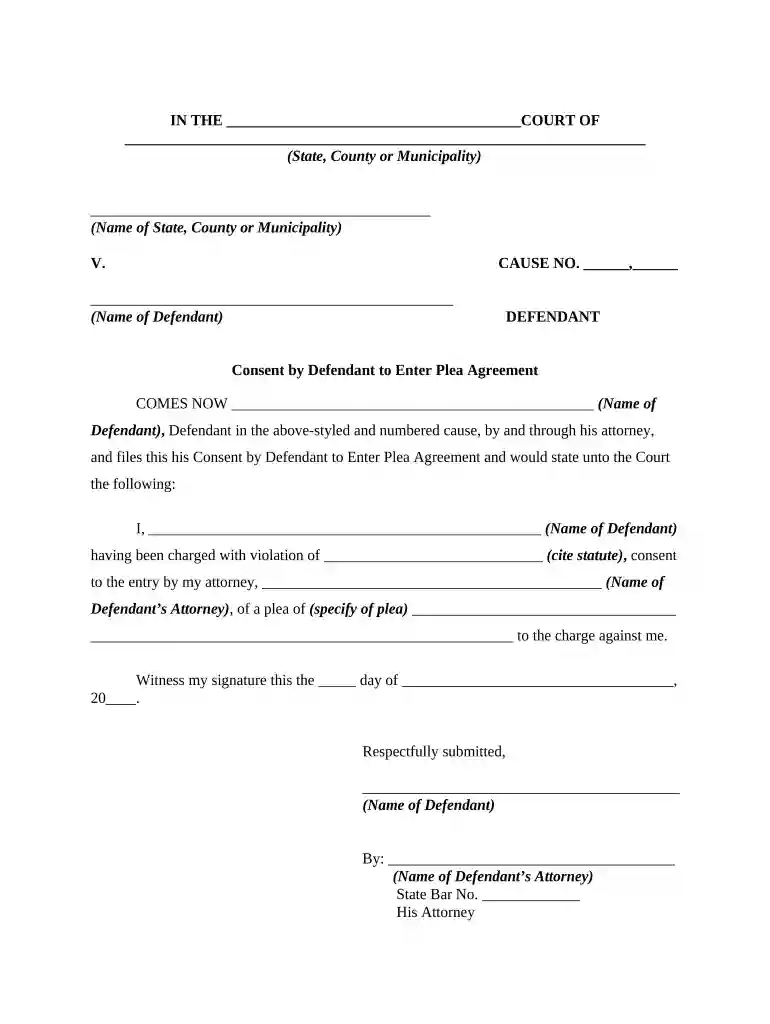
Type text, add images, blackout confidential details, add comments, highlights and more.

Draw your signature, type it, upload its image, or use your mobile device as a signature pad.

Send plea paper template via email, link, or fax. You can also download it, export it or print it out.
A plea agreement form is a legal document that outlines an agreement between the defendant and the prosecuting attorney regarding the resolution of criminal charges. This often involves the defendant agreeing to plead guilty to a lesser charge or receiving a reduced sentence in exchange for specific concessions. The form formalizes this agreement, specifying the terms that both parties must adhere to, and is submitted to the court prior to sentencing.
The plea agreement serves multiple purposes:
Understanding the implications of a plea agreement is critical for defendants, as it can significantly affect their legal standing and future.
Specific terminology is essential for understanding and accurately completing a plea agreement form:
Familiarity with these terms equips defendants and legal representatives to effectively navigate the plea bargaining process.
Utilizing the plea agreement form involves several steps to ensure compliance and clarity for all parties involved. The process can be structured as follows:
Obtain the Form: The appropriate plea agreement form can often be accessed through legal aid services, the court’s website, or an attorney. Ensure you have the correct version as per your jurisdiction’s requirements.
Fill Out the Necessary Information: Critical details include:
Review and Sign: Both the defendant and the prosecutor must review the completed form for accuracy before signing. Legal representation can assist in ensuring that all terms are understood.
Submit to Court: The final step is submitting the plea agreement form to the court clerk for filing. Depending on jurisdiction, this may require a court appearance.
Attention to detail throughout this process is crucial, as errors can lead to complications or delays in the legal proceedings.
Completing the plea agreement form effectively involves several key steps:
Step One: Gather Necessary Documentation
Compile documents that may be relevant, such as prior convictions, evidence of rehabilitation, or victim impact statements.
Step Two: Consult an Attorney
If possible, engage a defense attorney to assist in understanding the implications of the plea deal and to ensure that your rights are protected.
Step Three: Fill in Personal and Case Details
Ensure that all required fields are filled out with accurate information about the defendant, the charges, and the proposed plea.
Step Four: Discuss Terms with the Prosecutor
Prior to finalizing the form, communicate with the prosecutor to discuss any potential negotiations for a favorable outcome.
Step Five: Review Before Signing
Take time to review the entire document. It is essential to ensure understanding and agreement on all terms.
Step Six: File and Confirm Submission
After signing, verify that the form has been properly filed with the court, and keep a copy for personal records.
Completing these steps diligently aids in ensuring that the plea agreement is executed correctly.
The plea agreement form is utilized by various individuals within the criminal justice system. Its primary users include:
Defendants: Individuals facing criminal charges who seek to negotiate a resolution without going to trial. They must understand the terms and implications before agreeing to a plea.
Defense Attorneys: Legal professionals who guide defendants through the plea process, ensuring that all rights are protected and that the defendant understands the consequences of their plea.
Prosecutors: Legal representatives of the state or government who negotiate plea agreements based on the available evidence, severity of the crime, and potential outcomes.
Judges: While judges do not fill out the forms, they play a crucial role in reviewing and approving plea agreements in the court system.
Understanding who is involved in the plea agreement process is essential for accommodating the needs and expectations of each party.


Several real-world scenarios illustrate the application of a plea agreement form:
Case One: Drug Possession
A defendant charged with possession of a controlled substance might enter into a plea agreement to plead guilty to a lesser charge in exchange for community service and probation instead of jail time.
Case Two: Theft Charges
A person accused of theft may be offered a plea deal where they agree to return stolen property and pay restitution in exchange for a reduced sentence.
Case Three: DUI Charges
An individual charged with driving under the influence might agree to a plea deal that includes mandatory alcohol counseling and a fine, potentially avoiding a felony conviction.
Each of these examples emphasizes how plea agreements can lead to more favorable outcomes for defendants in various types of criminal cases.
The legal use of a plea agreement form is governed by specific rules and guidelines, ensuring that it meets the standards of the judicial system:
Compliance with State Laws: Each state has unique laws governing plea agreements, including what charges can be pled to and the required processes.
Voluntary Agreement: The defendant must enter the agreement without coercion. Courts will often conduct a hearing to confirm that the defendant understands the terms and implications of their plea.
Judicial Approval: The plea agreement must be approved by a judge. The court will assess whether the plea is in the interest of justice and aligns with the evidence presented.
Documentation: Proper documentation of the plea agreement is essential. This includes not only the signed agreement but also any related court orders post-approval.
Understanding the legal framework surrounding the plea agreement form is critical for all parties involved to ensure that their rights are upheld and the agreement is enforceable.
We've got more versions of the plea agreement form. Select the right plea agreement version from the list and start editing it straight away!
| Versions | Form popularity | Fillable & printable |
|---|---|---|
| 2020 | 4.8 Satisfied (60 Votes) |
At DocHub, your data security is our priority. We follow HIPAA, SOC2, GDPR, and other standards, so you can work on your documents with confidence.

By this Plea Agreement, defendant agrees to enter a voluntary plea of guilty to the following counts of the indictment: Counts One and Two, which charge. Page 2Read more
If you want to construct a plea bargain that includes pleading guilty to a related but unindicted offense, the prosecutor should dismiss the indictment withRead more
Oct 15, 2018 plea agreement containing a waiver of FOIA rights. The Court noted that a plea agreement that attempts to waive a right conferred by aRead more


