Living trust with 2026

Get Form
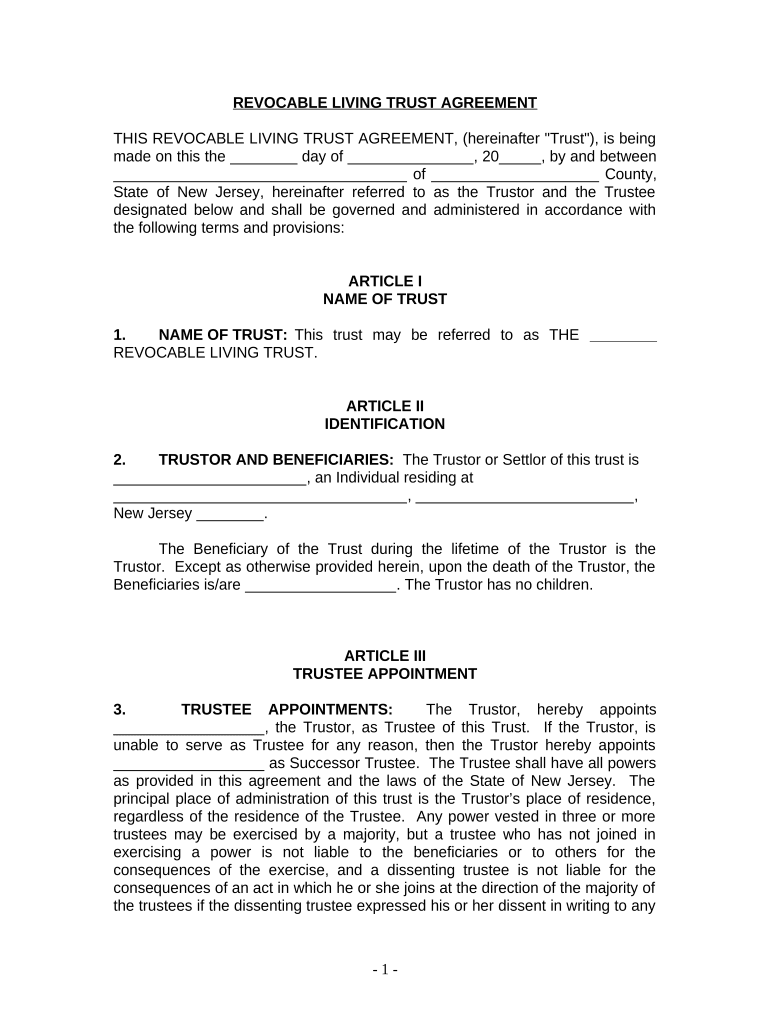
living trust with Preview on Page 1

Here's how it works

01. Edit your form online
Type text, add images, blackout confidential details, add comments, highlights and more.
02. Sign it in a few clicks
Draw your signature, type it, upload its image, or use your mobile device as a signature pad.
03. Share your form with others
Send it via email, link, or fax. You can also download it, export it or print it out.

How to Use or Fill Out Living Trust with Our Platform

Form edit decoration
9.5
Ease of Setup
DocHub User Ratings on G2
9.0
Ease of Use
DocHub User Ratings on G2
  1. Click ‘Get Form’ to open the Living Trust Agreement in the editor.
  2. Begin by filling in the 'Name of Trust' section. Enter the desired name for your trust, ensuring it reflects your intentions.
  3. In the 'Trustor and Beneficiaries' section, provide your full name and address as the Trustor. Specify the beneficiaries who will inherit upon your passing.
  4. Complete the 'Trustee Appointment' section by designating yourself as Trustee and naming a Successor Trustee in case you are unable to serve.
  5. List all assets intended for inclusion in the trust under 'Assets of Trust'. Attach any additional property documentation if necessary.
  6. Review all sections carefully, ensuring accuracy and completeness before saving or sharing your document for signatures.

Start using our platform today to effortlessly create and manage your Living Trust for free!

be ready to get more

Complete this form in 5 minutes or less

Get form

Got questions?

We have answers to the most popular questions from our customers. If you can't find an answer to your question, please contact us.
Contact us
Pros and Cons of Having a Trust Pro 1: Flexibility. A living trust is the way to go if youre seeking maximum flexibility. Pro 2: No Probate Necessary. Pro 3: Privacy. Con 1: Control. Con 2: Responsibility and Paperwork. Con 3: Taxes. Contact an Estate Planning Attorney Today. Pros and Cons of Having a Trust - Arenson Law Group, PC arensonlaw.com blog pros-and-cons-of- arensonlaw.com blog pros-and-cons-of-
Trusts can be broadly categorized into four main types: Living Trusts, Testamentary Trusts, Revocable Trusts, and Irrevocable Trusts. There are many different types of trusts you can choose from, and understanding how they are different can help you pick the right one for your needs. What Are the Different Types of Trusts? What to Know westernsouthern.com retirement what-ar westernsouthern.com retirement what-ar
You Have Control Over What You Put in the Trust You have control over what you put into this type of trust, of course, so this is an effective way to protect your family home, inherited treasures, and other important assets from Medicaid, creditors, and legal action.
A trust is a form of division of property rights and a fiduciary relationship , in which ownership of assets goes to a third party , known as a trustee , and the beneficial enjoyment goes to the beneficiary . The person who transfers the property into the trust is known as the grantor or settlor . trust | Wex | US Law | LII / Legal Information Institute cornell.edu wex trust cornell.edu wex trust

Security and compliance

At DocHub, your data security is our priority. We follow HIPAA, SOC2, GDPR, and other standards, so you can work on your documents with confidence.

Learn more
ccpa2
pci-dss
gdpr-compliance
hipaa
soc-compliance