




01. Edit your form online
Type text, add images, blackout confidential details, add comments, highlights and more.

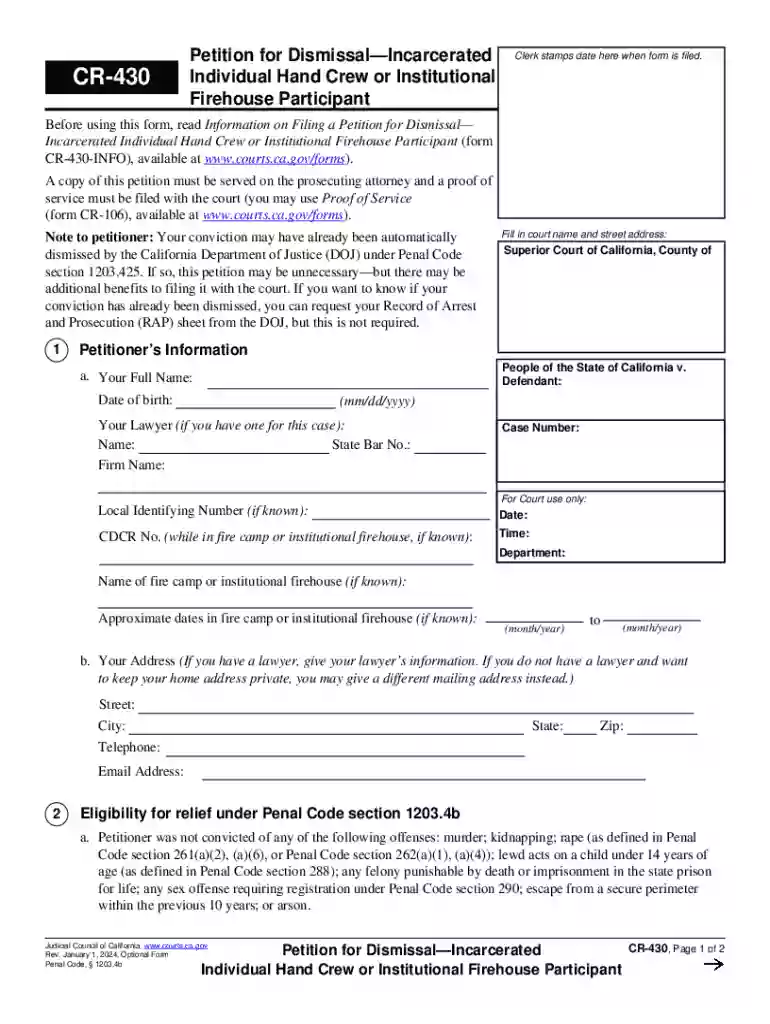
Type text, add images, blackout confidential details, add comments, highlights and more.

Draw your signature, type it, upload its image, or use your mobile device as a signature pad.

Send it via email, link, or fax. You can also download it, export it or print it out.
The CR-430 is a legal petition form that allows incarcerated individuals who have participated in hand crew or institutional firehouse programs to request the dismissal of their convictions under Penal Code Section 1203.4b. This process is a significant opportunity for eligible individuals to have their criminal records revised and potentially improve their post-incarceration opportunities. The form outlines the necessary steps for dismissal requests and serves as a critical legal instrument for those seeking relief from past convictions due to their rehabilitation efforts through specific correctional programs.
The CR-430 form comprises several essential elements that individuals must understand to complete the process successfully:
For someone to qualify for the CR-430 petition, there are specific criteria that must be met:


Understanding some key legal terms can facilitate the CR-430 petitioning process:
Individuals incarcerated in California who have engaged in correctional programs associated with firefighting are the primary users of the CR-430 form. These individuals are typically seeking legal reassessment of their convictions to assist with reintegration into civilian life post-incarceration.

The use of the CR-430 is deeply embedded in the legal framework supporting the rehabilitation of incarcerated individuals in California. By successfully petitioning through this form, individuals not only seek personal relief from their convictions but also contribute to broader societal reintegration goals. Proper legal use of this form requires understanding the implications of the dismissal, including how it affects one's criminal record and potential civic opportunities.
While the CR-430 form is primarily utilized within California, understanding any county-level additional requirements is crucial. Different jurisdictions may have nuanced practices for processing and accepting petitions, affecting timelines and procedural steps. It's important for petitioners to verify specific rules applicable to their cases in their local court systems.
Consider the case of Jack, a participant in the California Conservation Camp program, who obtains the CR-430 to seek dismissal of his non-violent offenses from a decade ago. Through successful petitioning, aided by his rehabilitation documentation, Jack gains new employment opportunities post-release. Other real-world scenarios might include individuals using the CR-430 to pursue educational opportunities without the barrier of their past convictions, demonstrating the form's impact on societal reintegration efforts.
We've got more versions of the Cr-430 form. Select the right Cr-430 version from the list and start editing it straight away!
| Versions | Form popularity | Fillable & printable |
|---|---|---|
| 2024 | 4.8 Satisfied (35 Votes) |
At DocHub, your data security is our priority. We follow HIPAA, SOC2, GDPR, and other standards, so you can work on your documents with confidence.





This course dives into narrative mediation, a powerful approach to resolving disputes by reshaping the way people see and tell their stories. Youll explore the
Jan 1, 2024 Petition for DismissalIncarcerated Individual Hand Crew or Institutional Firehouse Participant (CR-430). Get form CR-430.Read more


