California visitation 2026

Get Form
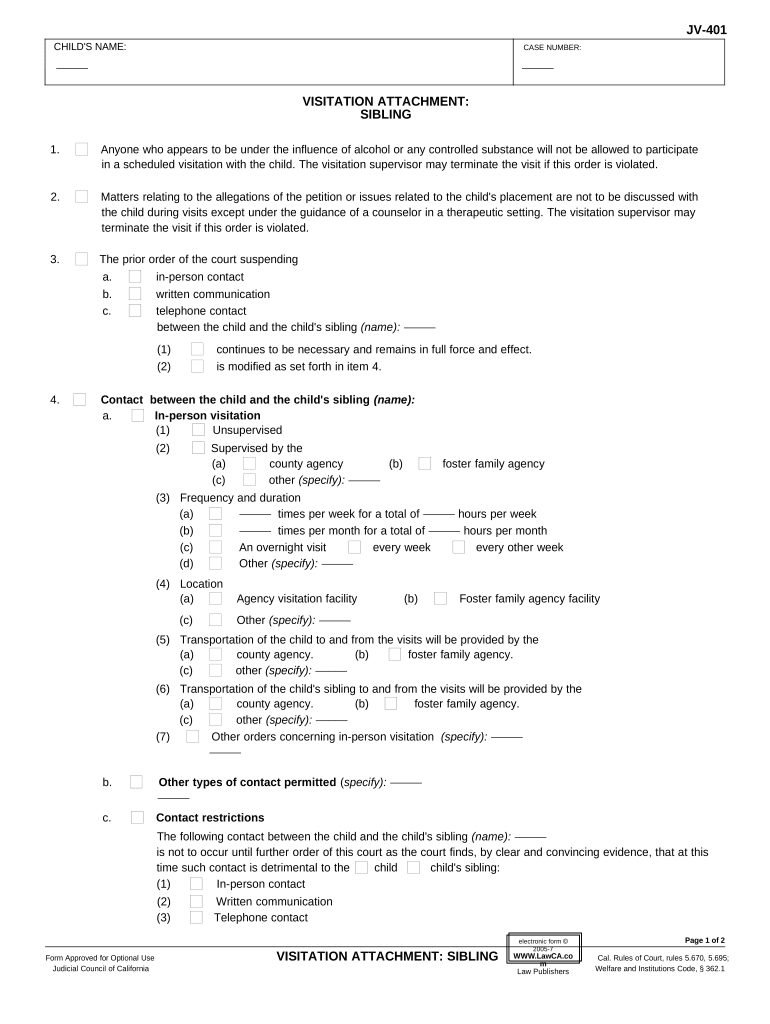
california visitation Preview on Page 1

Here's how it works

01. Edit your form online
Type text, add images, blackout confidential details, add comments, highlights and more.
02. Sign it in a few clicks
Draw your signature, type it, upload its image, or use your mobile device as a signature pad.
03. Share your form with others
Send it via email, link, or fax. You can also download it, export it or print it out.

How to use or fill out California Visitation with our platform

Form edit decoration
9.5
Ease of Setup
DocHub User Ratings on G2
9.0
Ease of Use
DocHub User Ratings on G2
  1. Click ‘Get Form’ to open the California Visitation document in the editor.
  2. Begin by entering the child's name and case number at the top of the form. This information is crucial for identifying the specific visitation case.
  3. In the visitation attachment section, specify any restrictions on contact between the child and their sibling. Clearly indicate if in-person, written, or telephone contact is suspended.
  4. Detail the terms of visitation, including whether visits will be supervised or unsupervised. Specify who will supervise if applicable, and outline the frequency and duration of visits.
  5. Indicate where visits will take place, selecting from options like agency facilities or foster family agency locations. Ensure transportation details are filled out accurately for both siblings.
  6. Review all entries for accuracy before saving your changes. Utilize our platform's features to sign and distribute the completed form as needed.

Start using our platform today to easily complete your California Visitation form online for free!

be ready to get more

Complete this form in 5 minutes or less

Get form

Got questions?

We have answers to the most popular questions from our customers. If you can't find an answer to your question, please contact us.
Contact us
Q: What If My 14-Year-Old Doesnt Want to See Her Father? A: Children ages 14 years old and older must be allowed to express their preferences to the court when considering visitation and custody arrangements in California.
In California, a minor at least 14 years old can be considered of sufficient age to express a preference for which parent they want to live with. However, they can express that preference at any age, but it may not be viewed seriously when younger than 14.
The alternating weeks schedule has your child spend seven days with one parent, then seven days with the other. You can customize this to fit your situation with Custody X Change. The 3-4-4-3 schedule has your child spend three days with one parent, then four days with the other parent.
This amendment further adds that a child who is at least 14 years old must be allowed to directly address the court regarding custody and visitation unless the judge finds that it would not be in the childs best interests, in which case the reasons must be stated on the record.
At what age can a child refuse visitation in California? In summary, in California, a child can refuse visitation once they are legally considered an adult. The court may still consider the childs wishes if they are mature enough to express their needs and preferences before they reach adulthood.

Security and compliance

At DocHub, your data security is our priority. We follow HIPAA, SOC2, GDPR, and other standards, so you can work on your documents with confidence.

Learn more
ccpa2
pci-dss
gdpr-compliance
hipaa
soc-compliance

People also ask

A mother can only refuse access to the father if a court gives her the right to do so. Court-ordered regulations determining that a parent has no access to their children are rare and unusual. In these cases, the court would possibly determine that the child-parent relationship is detrimental to the childs well-being.
Once the parties have separated, California law encourages both parents to maintain a relationship with the child under most circumstances. Absent a history of abuse, neglect, domestic violence, or substance abuse, there is usually a presumption for reasonable visitation with each parent.

Related links