Order show cause 2026

Get Form
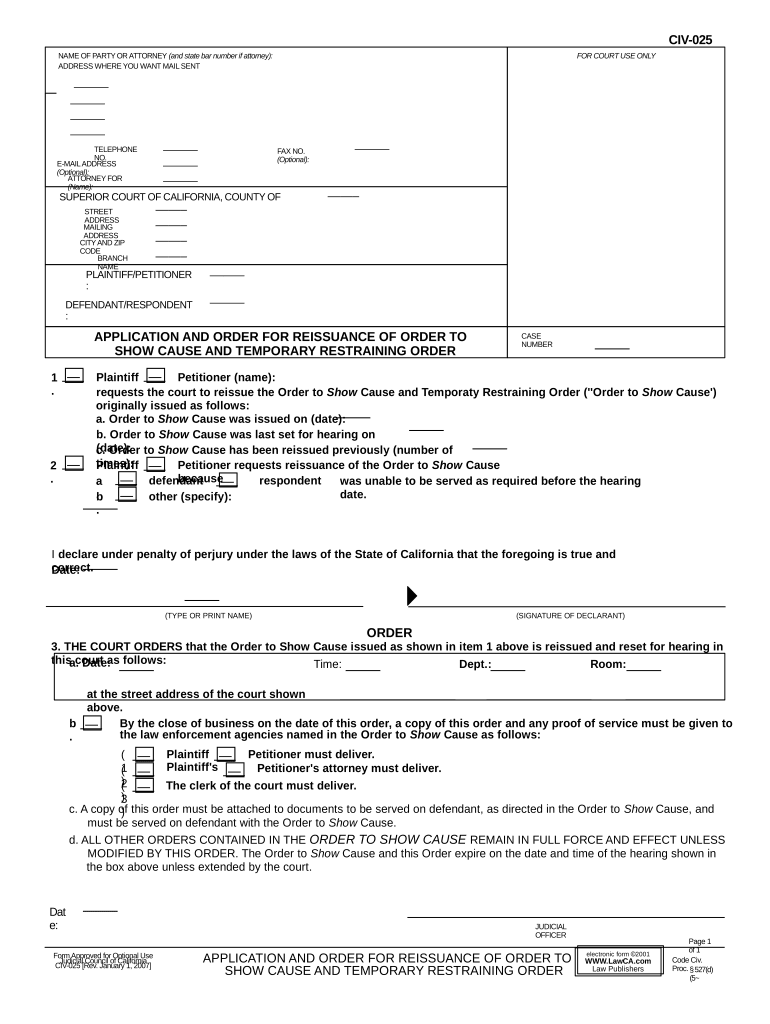
order show cause Preview on Page 1

Here's how it works

01. Edit your form online
Type text, add images, blackout confidential details, add comments, highlights and more.
02. Sign it in a few clicks
Draw your signature, type it, upload its image, or use your mobile device as a signature pad.
03. Share your form with others
Send it via email, link, or fax. You can also download it, export it or print it out.

How to use or fill out order show cause with our platform

Form edit decoration
9.5
Ease of Setup
DocHub User Ratings on G2
9.0
Ease of Use
DocHub User Ratings on G2
  1. Click ‘Get Form’ to open the Order Show Cause document in the editor.
  2. Begin by entering the name of the party or attorney at the top of the form, including the state bar number if applicable. Fill in your mailing address, telephone number, and optional email address for correspondence.
  3. In the 'FOR COURT USE ONLY' section, provide details about the court's street address and mailing address, along with city and zip code.
  4. Identify yourself as either the Plaintiff/Petitioner or Defendant/Respondent by filling in your name accordingly.
  5. Complete Section 1 by specifying when the original Order to Show Cause was issued and when it was last set for hearing. Indicate how many times reissuance has been requested and provide reasons for this request.
  6. Sign and date the declaration under penalty of perjury, ensuring that your printed name is clearly visible.
  7. In Section 3, review and confirm that all orders remain effective unless modified. Fill in details regarding the new hearing date, time, department, and room number as required.

Start using our platform today to easily complete your Order Show Cause form online for free!

be ready to get more

Complete this form in 5 minutes or less

Get form

Got questions?

We have answers to the most popular questions from our customers. If you can't find an answer to your question, please contact us.
Contact us
An order to show cause (O.S.C.), is a court order or the demand of a judge requiring a party to justify or explain why the court should or should not grant a motion or a relief. For example, if a party requests a restraining order from a judge, the judge may need more information.
An Order to Show Cause is a court directive requiring you to appear before a judge to explain why you should not be held in contempt for allegedly violating a court order. It is typically filed by the opposing party when they believe you failed to comply with a previous court ruling.
Example 1: Contempt of Court A Show Cause Order is issued to a party who has allegedly violated a court order. The individual must appear in court to explain why they should not be held in contempt for failing to comply with the original order, such as not paying court-ordered child support.
Why did I receive an Order to Show Cause? You likely received the Order because someoneoften through their attorneyhas claimed you are not following a prior court order. Common examples include: Violating a custody or visitation agreement.
Dear [Employee First Name], You have been interviewed on [Interview Date] in the presence of [Support Person] and you were provided with an opportunity to give your account. It was explained to you that your [Issue] does not meet [Company Name]s acceptable standards of [Policy].

Security and compliance

At DocHub, your data security is our priority. We follow HIPAA, SOC2, GDPR, and other standards, so you can work on your documents with confidence.

Learn more
ccpa2
pci-dss
gdpr-compliance
hipaa
soc-compliance

People also ask

Your Response to the Order to Show Cause must show a good reason (cause) for not following the Courts rules, directions, or deadlines. You must also do anything else the Court tells you to do in the Order to Show Cause.
A show cause letter is a formal notice requiring the recipient to explain or justify their actions before any definitive action is taken. Its primary objectives include ensuring procedural fairness, gathering additional information, initiating formal proceedings, and protecting the legal rights of all parties involved.

Related links