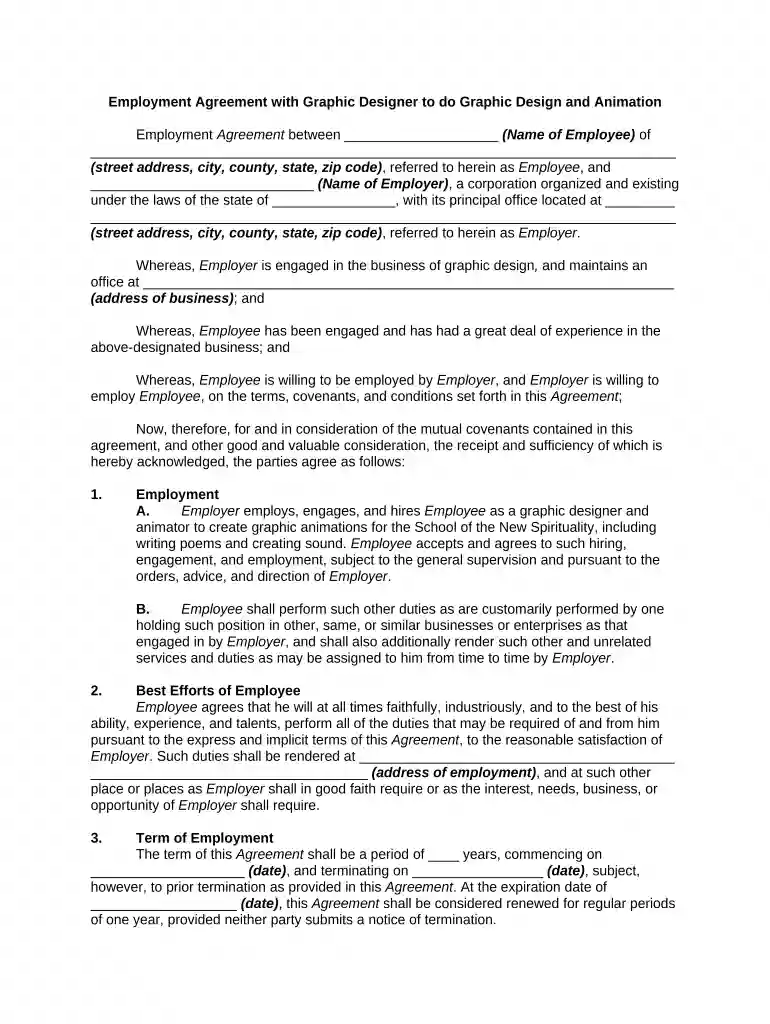
Employment Agreement with Graphic Designer to do Graphic Design and Animation 2026

Get Form
freelance animation contract template Preview on Page 1

Here's how it works

01. Edit your freelance animation contract template online
Type text, add images, blackout confidential details, add comments, highlights and more.

02. Sign it in a few clicks
Draw your signature, type it, upload its image, or use your mobile device as a signature pad.

03. Share your form with others
Send animation contract template via email, link, or fax. You can also download it, export it or print it out.

Essential Components of an Employment Agreement with a Graphic Designer

An Employment Agreement with a Graphic Designer to do Graphic Design and Animation encompasses various fundamental elements that outline the responsibilities, rights, and obligations of both parties. The following sections detail the critical components of such an agreement, reflecting its importance to ensuring clarity and compliance throughout the employment relationship.

Job Responsibilities and Expectations

Defining the specific responsibilities of the Graphic Designer is crucial to managing expectations. The agreement should delineate the following:

  • Creative Duties: Detail the type of design work expected, such as branding, marketing materials, or UI/UX design, and animation projects.
  • Collaboration: Describe how the designer will interact with teams, including project managers, writers, and other stakeholders to ensure project alignment.
  • Deadlines and Deliverables: Set clear timelines for projects and specify what deliverables are expected, with mechanisms for feedback and revisions outlined.

For example, if the designer is to work on a branding project, the agreement could specify that the designer must present initial concepts within two weeks, followed by revisions based on client feedback. This sets a clear expectation for both parties.

Compensation Structure

The compensation section of the employment agreement should be transparent and comprehensive, including:

  • Salary or Hourly Rate: Specify whether compensation is a fixed annual salary or hourly wage, along with payment frequency (biweekly, monthly).
  • Bonuses and Incentives: Outline any performance bonuses or other incentives based on project completion or business performance.
  • Reimbursement for Expenses: Detail which costs will be reimbursed, such as materials, software subscriptions, or travel expenses related to the job.

This clarity helps prevent misunderstandings regarding compensation and ensures that both parties are aligned on financial expectations.

Duration of Employment

The agreement should indicate the following aspects regarding the duration of employment:

  • Employment Type: Distinguish between a fixed-term contract and at-will employment, outlining the implications of each.
  • Renewal and Termination: Specify conditions under which the agreement may be renewed, as well as procedures for either party to terminate the agreement, including notice periods.

For instance, in an at-will contract, the employer or employee may terminate the relationship at any time without cause, while a fixed-term agreement may require specific conditions for early termination.

Confidentiality and Intellectual Property Rights

Protection of sensitive information and intellectual property is crucial in creative fields. Elements to include are:

  • Confidential Information: Define what constitutes confidential information and outline the obligations of the designer to protect this information during and after employment.
  • Ownership of Work: Specify that all designs, animations, and related works created during employment are owned by the employer, outlining the rights the employee has regarding their work post-employment.

This section ensures that proprietary information and company assets are secure.

Dispute Resolution Methods

In the event of disagreements, an effective dispute resolution clause can prevent lengthy legal battles. Important aspects to address include:

  • Arbitration Clause: Define the process for resolving disputes through arbitration rather than court, providing a potentially expedited and cost-effective resolution.
  • Governing Law: Specify which state’s laws will govern the agreement, which is particularly important in a legal context.

For example, the agreement may state that any disputes will be settled through binding arbitration in the state of California, adhering to the rules of the American Arbitration Association.

Non-compete and Non-solicitation Clauses

To protect the employer’s business interests, it may be beneficial to include non-compete and non-solicitation provisions:

  • Non-compete Clause: Outline any restrictions on the designer working for competitors for a specified period after leaving the company, ensuring they do not take crucial trade secrets to a rival.
  • Non-solicitation Clause: Prevent the designer from soliciting clients or employees of the company after termination, safeguarding the company's relationships.

These clauses should be reasonable in scope and length to ensure enforceability.

Legal Compliance and Governing Jurisdiction

Ensure the agreement adheres to applicable labor laws and employment regulations in the relevant jurisdiction. By including:

  • Compliance with Labor Laws: A statement that both parties agree to adhere to local, state, and federal employment regulations.
  • Governing Jurisdiction: Identification of the appropriate legal jurisdictions, providing clarity on where any legal issues may be resolved.

This structuring promotes legal integrity and protects both parties.

Final Considerations in Employment Agreements

While the above components are vital, there are additional considerations to keep in mind:

  • Amendments: Elucidate how the agreement can be amended, requiring written consent from both parties.
  • Severability Clause: State that if any part of the agreement is found to be unenforceable, the rest remains valid and in force.

Including these elements helps fortify the agreement, ensuring that both the employer and the Graphic Designer have clear guidelines governing their professional relationship while also accommodating future adjustments.

be ready to get more

Complete this form in 5 minutes or less

Get form

Got questions?

We have answers to the most popular questions from our customers. If you can't find an answer to your question, please contact us.
Contact us
Generally, graphic design projects can cost anywhere from 100 to over 10,000. For instance, a simple logo design might fall in the lower end of this spectrum, while comprehensive branding packages can command higher prices.
Mid sized and Smaller vfx studios that have more open portfolios (not just feature but also advertising) tend to hire motion an graphic peeps to fulfill contracts. Animation studios hire as well although the market is more competitive.
Graphic design encompasses all motion graphics and animation, but it is also a means of creating those works.
Yes, graphic designers can work in the animation industry! As a graphic designer, Ive made an animation in the past for one of my college projects, and I gained a lot of experience from that and used the knowledge in a few future projects.
Lets take an in-depth look at each of these components. Every designer Should have detailed descriptions. Timeline for client deliverables. Get paid: payment details. Copyright ownership. Termination clause - peace of mind! Contracts: signature and date. Deliverables. Be professional with clear add-on options.

Security and compliance

At DocHub, your data security is our priority. We follow HIPAA, SOC2, GDPR, and other standards, so you can work on your documents with confidence.
Learn more
ccpa2
pci-dss
gdpr-compliance
hipaa
soc-compliance