North carolina judgment 2026

Get Form
collecting on a judgment in north carolina Preview on Page 1

Here's how it works

01. Edit your collecting on a judgment in north carolina online
Type text, add images, blackout confidential details, add comments, highlights and more.

02. Sign it in a few clicks
Draw your signature, type it, upload its image, or use your mobile device as a signature pad.

03. Share your form with others
Send it via email, link, or fax. You can also download it, export it or print it out.

How to use or fill out North Carolina Judgment with our platform

Form edit decoration
9.5
Ease of Setup
DocHub User Ratings on G2
9.0
Ease of Use
DocHub User Ratings on G2
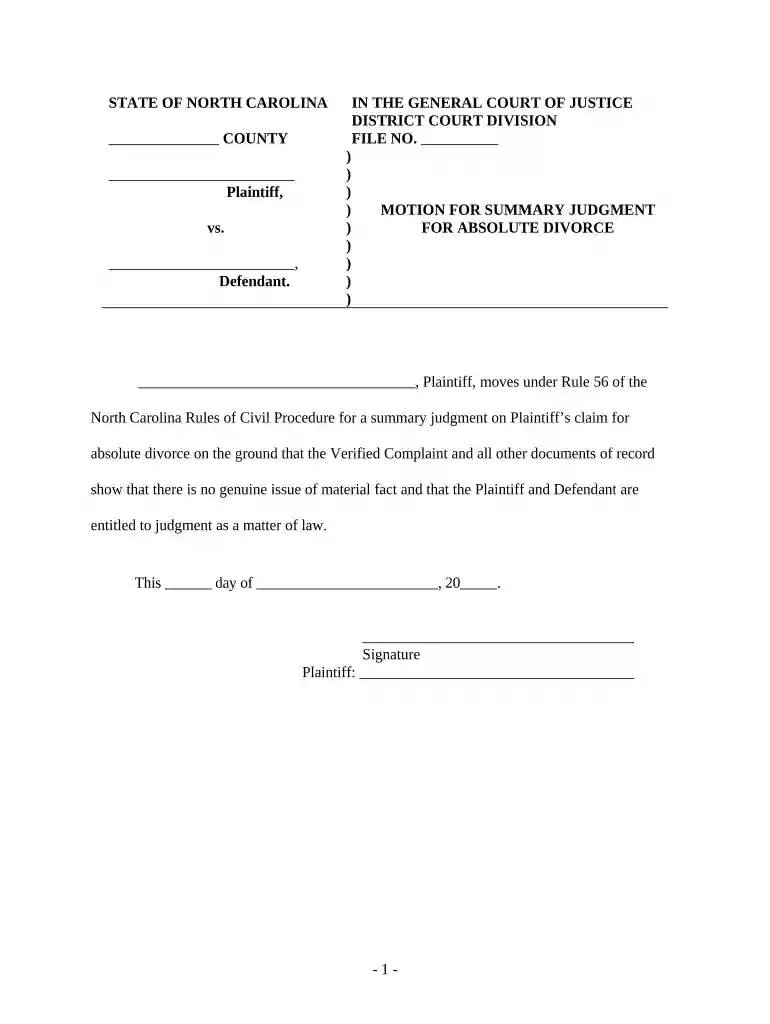
  1. Click ‘Get Form’ to open the North Carolina Judgment document in the editor.
  2. Begin by filling in the 'FILE NO.' section at the top of the form, which is essential for identifying your case.
  3. In the 'COUNTY' field, specify the county where your case is being filed. This ensures proper jurisdiction.
  4. Next, complete the Plaintiff and Defendant sections with their respective names. This identifies who is involved in the motion.
  5. In the body of the motion, ensure you clearly state your request for summary judgment and reference any supporting documents as needed.
  6. Fill in the date fields appropriately to reflect when you are submitting this motion.
  7. Finally, sign and date at the bottom of the form to validate your submission. Don’t forget to include a Certificate of Service if required.

Start using our platform today to easily fill out and manage your North Carolina Judgment forms online for free!

be ready to get more

Complete this form in 5 minutes or less

Get form

Got questions?

We have answers to the most popular questions from our customers. If you can't find an answer to your question, please contact us.
Contact us
The court will review the case and issue a rejection or order. If the motion is rejected, you still have a chance to fight back in court. If the judge orders a motion for default, then you still have a chance to fight back, but you must first file a motion to vacate or set aside the judgment.
If you do not timely respond or contact the plaintiffs counsel, the plaintiff may move for entry of default and default judgment against you. If that judgment is obtained, the defendant may receive a Notice of Right to Designate Exemptions, which begins the process of attempting to collect the judgment against you.
North Carolinas property exemptions usually cover most property owned by someone facing a judgment. North Carolina allows you to exempt: Up to $35,000 in equity in your primary residence. Up to $3,500 in equity in a vehicle.
On motion and upon such terms as are just, the court may relieve a party or his legal representative from a final judgment, order, or proceeding for the following reasons: (1) Mistake, inadvertence, surprise, or excusable neglect; (2) Newly discovered evidence which by due diligence could not have been discovered in
You may be able to negotiate a settlement with the debt collector to allow you to pay off the judgment under better terms. In Limited Civil cases (cases for $35,000 or less), if the other side will not agree to a payment plan, you can ask the judge to order a payment plan.

Security and compliance

At DocHub, your data security is our priority. We follow HIPAA, SOC2, GDPR, and other standards, so you can work on your documents with confidence.

Learn more
ccpa2
pci-dss
gdpr-compliance
hipaa
soc-compliance

People also ask

In North Carolina a judgment accrues 8% interest from the time it is entered. Judgment can be enforced by execution/through Court process. A creditor with a judgment can attempt to use some of your property to pay the judgment. However, the creditor MUST use the Court system before getting access to your property.
Judgment is a court decision that settles a dispute between two parties by determining the rights and obligations of each party. Judgments are classified as in personam, in rem, or quasi in rem. Judgments are usually monetary, but can also be non-monetary, and are legally enforceable.

Related links